The Basic Conditions of Employment Act (Act 75 of 1997) sets enforceable minimum standards for annual, sick, maternity, and family responsibility leave, forming the legal foundation of leave policy in South Africa. For companies expanding into South Africa, understanding local labor laws is critical, as employers can offer more generous benefits but cannot contract below the statutory minimums prescribed by the BCEA, making the country firmly employee-friendly.
This guide breaks down mandatory versus discretionary leave entitlements, common market practices, and the key global HR compliance considerations foreign employers must factor into employment contracts before onboarding their first South African hire.
Overview of labor laws
The BCEA (Act 75 of 1997, as amended) is the primary legislation governing South Africa’s employee leave requirements for most workers in the country. Its basic conditions automatically form part of every employment contract; employees cannot waive them, and employers cannot contract out of them. Understanding these rules is essential for complying with broader employment laws in South Africa.
Who is covered: The Act applies to the vast majority of workers. Exceptions include members of the National Defence Force, the National Intelligence Agency, the South African Secret Service, and unpaid volunteers working for charities. Independent contractors also fall outside its scope. A statutory employee covered under the BCEA is entitled to minimum leave protections regardless of company policy.
The earnings threshold: Employees earning above R261,748.45 per year (effective from 1 April 2025) are excluded from certain protections, notably overtime and related provisions, though core leave entitlements still apply.
Statutory versus contractual leave: Statutory leave is the legal minimum employers must provide under the BCEA. Contractual leave refers to any additional entitlement offered through employment contracts, workplace policies, or collective agreements. Where a contract or collective agreement offers more favorable terms, those terms prevail. Any policy offering less than the statutory minimum is unenforceable.
Annual leave (Vacation)
Annual leave entitlement in South Africa is governed by the Basic Conditions of Employment Act (BCEA), which sets a statutory minimum of 15 working days per year for employees working a standard five-day week, equivalent to 21 consecutive calendar days. Employees working a six-day week are entitled to 18 working days. These leave entitlements form a core part of broader employee benefits in South Africa.
Leave is calculated per annual leave cycle, which runs for 12 months from the employee’s start date.
Work schedule | Statutory minimum leave |
5-day work week | 15 working days / 21 consecutive days |
6-day work week | 18 working days |
How accruals work: The BCEA provides two accrual methods. An employee earns one day of leave of absence for every 17 days worked, or one hour for every 17 hours worked. For practical workforce planning and accrued payroll tracking, this translates to roughly 1.25 days per month on a five-day schedule.
Review your leave entitlements in context with the average paid vacation days by country. South Africa’s statutory minimum sits in the mid-range globally.
Carry-over and timing: Leave must be taken no later than six months after the end of the annual leave cycle. There is no statutory right to carry leave over indefinitely. Employers may schedule leave to coincide with a shutdown period. If there is no agreement between employer and employee on timing, the employer has the right to determine when leave is taken.
Encashment: Paying out accrued leave instead of actual time off is prohibited while the employment relationship continues. Accrued leave may only be paid out upon termination.
Public holidays during leave: If a public holiday falls on a day an employee would normally have worked, and that day falls within their annual leave period, they are entitled to an additional day of paid leave.
South African law does not formally recognize concepts such as unlimited PTO, though employers may offer additional discretionary leave through internal policies. Likewise, optional arrangements such as voluntary time off or compensatory time off may be provided contractually, provided statutory minimum leave entitlements remain protected.
Public holidays
Public holidays in South Africa 2026 are governed by the Public Holidays Act (No. 36 of 1994). South Africa observes 12 national paid holidays each year. When a public holiday falls on a Sunday, the following Monday becomes the observed public holiday.
An employer cannot require an employee to work on a public holiday without prior agreement. Where an employee does work on a public holiday that falls on a day they would ordinarily work, the minimum holiday pay requirement is double their normal daily wage. If working on that day results in pay exceeding double the normal rate (because of hours worked), the higher amount applies. These overtime rules should be reflected clearly in employment contracts and payroll policies.
Check your obligations against South Africa’s 2026 public holiday calendar:
Date | Public holiday |
1 January | New Year’s Day |
21 March | Human Rights Day |
3 April | Good Friday |
6 April | Family Day |
27 April | Freedom Day |
1 May | Workers’ Day |
16 June | Youth Day |
9 August | National Women’s Day |
10 August | Public Holiday (Observed — National Women’s Day falls on Sunday) |
24 September | Heritage Day |
16 December | Day of Reconciliation |
25 December | Christmas Day |
26 December | Day of Goodwill |
Some employers may also offer discretionary leave arrangements such as a floating holiday through internal policies or collective agreements, though this is not a statutory requirement under South African law.
For workforce planning, payroll processing, and leave administration, maintaining a clear South African compliance calendar is essential when managing local employees alongside global teams.
Sick leave policy
South Africa’s sick leave policy is governed by the Basic Conditions of Employment Act (BCEA), which sets minimum entitlements for paid sick leave and forms an important part of broader employee benefits in South Africa.
During the first six months of employment, a new employee earns one day of paid sick leave for every 26 days worked. After that initial period, the full entitlement under the sick leave rules in South Africa applies: 30 working days per 36-month cycle for employees working a five-day week, and 36 working days for employees on a six-day schedule.
The employer bears the full cost of sick leave. There is no government reimbursement or social insurance funding mechanism for ordinary sick leave. Employees taking extended sick time may therefore effectively be on a short-term medical leave of absence funded directly by the employer.
When a medical certificate is required
Employees absent for more than two consecutive days, or who take sick leave more than twice during eight weeks, can be required to provide a medical certificate issued by a registered medical practitioner. Medical certificates must meet BCEA evidentiary standards; employers may reject non-compliant documentation.
Employment period | Sick leave entitlement | Pay rate |
First 6 months | 1 day per 26 days worked | Full pay |
After 6 months (5-day week) | 30 days per 36-month cycle | Full pay |
After 6 months (6-day week) | 36 days per 36-month cycle | Full pay |
For employers managing larger teams, monitoring leave usage and long-term absenteeism is essential for maintaining compliance and workforce continuity under South African employment law.
Parental leave
South Africa’s parental leave framework combines statutory protections, UIF-funded benefits, and evolving family leave rights that employers should monitor closely as part of broader employee benefits in South Africa.
Maternity leave
Maternity leave benefits in South Africa entitle pregnant employees to four continuous months of maternity leave. Leave may start any time from four weeks before the expected birth date, or earlier if a medical practitioner certifies it as necessary. Written notice of the intended start and return dates must reach the employer at least four weeks before commencement.
The employer is not required to pay the full salary during maternity leave. Employees claim maternity benefits from the Unemployment Insurance Fund (UIF), which pays approximately 66% of the employee’s salary for a maximum of 121 consecutive days. To qualify, the employee must have contributed to the UIF, worked more than 24 hours per month, and been employed for at least 13 weeks before the application date.
Paternity leave
Paternity leave stands at 10 consecutive days, introduced through a 2018 amendment to the BCEA. The employee claims these days through the UIF rather than receiving full employer-paid leave.
Constitutional Court ruling, October 2025
A Constitutional Court judgment handed down on 3 October 2025 introduced interim arrangements treating parental leave as a shared entitlement, pending legislative updates from Parliament. Foreign employers should monitor this development closely, as the legislative position is in transition.
Adoption leave
An adoptive parent of a child under two years old qualifies for adoption leave from the date the adoption order is granted or the child is placed in their care. Eligible adoptive or commissioning parents may also qualify for statutory parental leave under applicable BCEA provisions.
Job protection
Dismissing an employee on grounds of pregnancy, or any reason related to pregnancy or intended pregnancy, is prohibited. An employer must keep the employee’s position open for the duration of maternity leave. Review international benefits and compensation standards to benchmark your parental leave offering against local market practice.
Other statutory leaves
Beyond annual, sick, and parental leave, South African employment law also recognizes a limited number of additional leave-related rights that employers should reflect in their internal workplace policies.
Bereavement / Compassionate leave
South Africa does not provide standalone statutory bereavement leave. Instead, employees may use family responsibility leave for the death of an immediate family member, including a spouse, parent, grandparent, child, grandchild, or sibling.
Eligible employees are entitled to three days of paid leave per annual cycle if they have worked for the same employer for at least four months and work at least four days per week. Employers may request documentary proof before approving this form of leave of absence.
Marriage leave
The BCEA does not require employers to provide statutory marriage leave. Any leave granted for weddings or civil unions is typically governed through employment contracts, collective agreements, or company-specific policies.
Study / Exam leave
Study leave has no statutory basis in South Africa. Any arrangements for education, examinations, or professional training are purely contractual and may be offered as paid leave, annual leave usage, or unpaid time off.
Voting / Jury duty
South Africa does not provide statutory voting leave. Employees are generally expected to vote outside normal working hours where possible. The country also does not operate a jury duty system, so jury leave does not apply.
Domestic violence leave
There is currently no dedicated statutory domestic violence leave entitlement under South African employment law. Employees may instead rely on annual leave, sick leave, family responsibility leave, or employer-specific support measures, depending on the circumstances.
For a broader understanding of statutory employment obligations, employers should review working hours in South Africa alongside leave and attendance requirements.
Simplify South Africa compliance with Multiplier
Tracking South Africa’s leave cycles, UIF obligations, public holiday calendars, and evolving parental leave rules creates significant administrative complexity for foreign HR teams, especially those managing employees across multiple jurisdictions at once. One compliance gap is whether through an incorrect UIF deduction or a missed statutory leave entitlement.
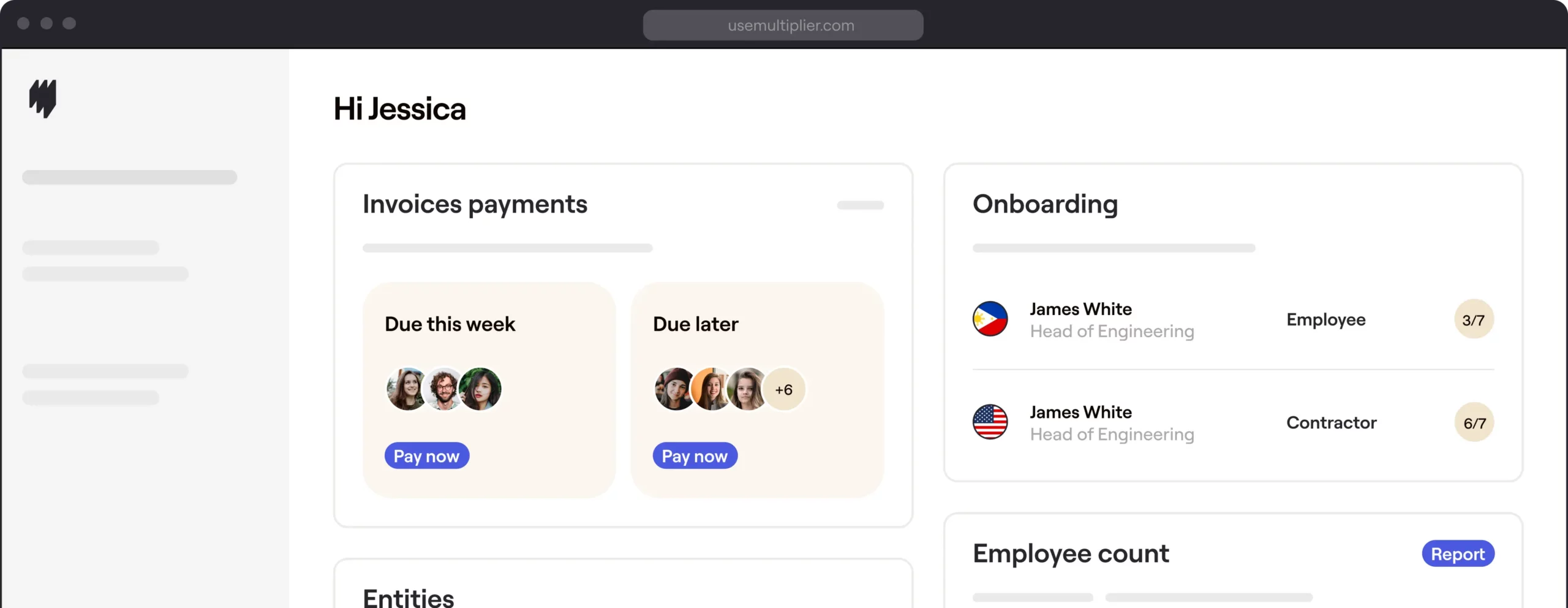
Multiplier’s Employer of Record platform helps companies manage these obligations without establishing a local entity. Recognized among the best EOR services for global teams, the platform enables you to hire employees in South Africa while ensuring employment contracts align with BCEA minimum standards from day one.
Leave accruals are automated, public holiday calendars stay updated, and global payroll compliance requirements, including UIF contributions and statutory deductions, are handled accurately in local currency. You can configure leave policies at a country or employee level while the system automatically enforces statutory minimum entitlements.
If you are evaluating how to hire in South Africa, Multiplier also streamlines onboarding, contract management, leave administration, and payroll in South Africa through a single centralized workflow.
Before onboarding your next employee, review your internal global compliance checklist to ensure your HR processes align with South African employment law requirements.
Book a demo and see how Multiplier handles South Africa leave compliance end to end.
FAQs
How do employers calculate leave for part-time employees?
Leave for part-time employees is typically calculated proportionally based on hours worked or full-time equivalent employment arrangements under the BCEA.
Can companies offer flexible leave policies in South Africa?
Yes. Employers may offer enhanced leave models such as unlimited PTO, provided statutory BCEA minimum leave entitlements remain protected.
Are employees entitled to extra pay for working on public holidays?
Yes. Employees working on public holidays are generally entitled to double pay or enhanced holiday pay under South African employment law.
How many leave days do employees get annually in South Africa?
Most full-time employees receive at least 15 working days annually under the BCEA minimum leave policy in South Africa.
Does Multiplier manage South Africa leave and payroll compliance?
Yes. Multiplier automates BCEA leave tracking, UIF deductions, payroll, and statutory compliance for foreign employers hiring in South Africa.
Is maternity leave paid by employers in South Africa?
Not fully. South African maternity leave is primarily funded through UIF, while direct employer salary payment is generally not mandatory.
Can Multiplier help companies hire in South Africa without an entity?
Yes. Multiplier’s Employer of Record solution enables compliant hiring, payroll, and leave administration without local entity setup.