Liechtenstein’s economy is thriving, with a 2025 PPP GDP per capita estimated at $201,112, ranking it among the wealthiest nations globally. The principality’s business-friendly environment, combined with its strategic location between Switzerland and Austria, creates unique opportunities and compliance requirements for companies looking to hire.
Hiring trends in Liechtenstein, 2025
- According to sector-level data, around 17% of Liechtenstein’s workforce is employed in financial services.
- Cross-border commuters comprise nearly 57% of the workforce, primarily from Switzerland, Austria, and Germany.
- The principality maintains strict labor protections with mandatory collective bargaining agreements in many industries.
- Average salaries range from $74,830.20 to $149,660.40 annually, reflecting the high cost of living.
- Digital transformation initiatives are driving demand for IT and engineering professionals.
Building a team in Liechtenstein means navigating a strong business environment alongside a complex regulatory system. This guide outlines practical hiring steps, whether you set up an entity or use an Employer of Record (EOR) for faster, compliant expansion.
Why businesses should consider hiring in Liechtenstein
Despite its small size, Liechtenstein punches above its weight as a European business hub. The workforce is highly educated, multilingual, and accustomed to international business standards.
Key advantages include:
- Highly skilled workforce: Access professionals with expertise in finance, manufacturing, and technology
- Strategic European location: Part of the European Economic Area with access to EU markets
- Business-friendly taxation: Corporate tax rates around 12.5% with favorable holding company structures
- Political and economic stability: Consistent policies and a robust legal framework
These benefits make Liechtenstein attractive, but the hiring process demands careful attention to local employment regulations and cross-border complexities.
Key hiring complexities and costs to consider in Liechtenstein
Understanding Liechtenstein’s hiring landscape requires careful attention to statutory expenses, social security rules, and mandatory benefits. Below are key cost components employers must plan for:
- Total employment costs often range from 1.25 to 1.4× base salary, depending on benefits and insurance obligations.
- Social security contributions include AHV/IV/FAK, unemployment insurance, and accident insurance, with employer rates generally 7–12%.
- Mandatory benefits include a 13th-month salary, paid leave, and comprehensive health and accident coverage.
- Administrative expenses cover payroll processing, compliance reviews, and HR documentation.
Before launching your recruitment efforts, determine your approach: building internal HR capabilities or leveraging an Employer of Record to manage compliance complexities.
What is an EOR, and how does it simplify recruitment in Liechtenstein?
An EOR legally employs your talent while you handle selection and day-to-day management. The EOR manages contracts, payroll, taxes, benefits, and compliance.
- You: Choose and manage employees’ daily work
- Multiplier (EOR): Handles payroll, taxes, contracts, compliance
- Employee: Works for you but is legally employed by the EOR
In Liechtenstein, where regulations blend EU standards with local rules, an EOR removes administrative complexity, making it ideal for market testing or hiring specialists without setting up an entity.
Hiring employees in Liechtenstein: A strategic playbook
Let’s examine the actual hiring process and compare managing it in-house versus working with an EOR partner.
Step 1: Establish your legal entity
To hire directly, you’ll need to register a company in Liechtenstein. This involves selecting your business structure (AG, GmbH, or establishment), registering with the Public Register, and obtaining necessary permits from the Office of Economic Affairs.
With an EOR: Entity registration in Liechtenstein can take 4-8 weeks and requires ongoing compliance with local reporting standards. An EOR eliminates this timeline — you can legally hire full-time employees without establishing your own entity. This proves especially valuable when hiring a small team or entering the market gradually.
Step 2: Register for social insurance and payroll
Liechtenstein’s social insurance system requires registration with multiple authorities, including the Liechtenstein Old-Age and Survivors’ Insurance (AHV-IV-FAK), health insurance providers, and accident insurance carriers.
With an EOR: Your EOR manages all social insurance registrations, contribution calculations, and remittances. They ensure compliance with Liechtenstein’s unique position within the European insurance framework, handling both domestic and cross-border requirements seamlessly.
Step 3: Understand employment regulations
Liechtenstein employment laws blend European standards with local requirements. Key regulations include:
- Labor Contract Law (Arbeitsvertragsrecht)
- The Working Time Act establishes maximum hours
- Mandatory collective agreements in specific sectors
- Protection against unfair dismissal
You must also navigate regulations for cross-border workers, work permits for non-EEA nationals, and industry-specific requirements. Missteps can result in significant penalties and reputational damage.
With an EOR: Rather than building internal expertise across Liechtenstein’s regulatory landscape, your EOR maintains current knowledge of all employment requirements. They manage employee benefits and compensation according to local standards and collective agreements.
Step 4: Source and evaluate qualified candidates
Talent acquisition in Liechtenstein requires understanding the local and cross-border labor market. Define your requirements clearly, focusing on:
- Employment type: Full-time employees (typically 40-42 hours weekly), part-time arrangements, or contractors
- Required qualifications: Language skills (German is essential, English often required), industry certifications, and experience levels
- Work authorization: EEA nationals can work freely; others need permits
Use local hiring channels like LinkedIn, regional job boards, and specialized recruiters. Run structured, skills-focused interviews and conduct thorough background checks on education, employment history, and references.
With an EOR: While you lead candidate selection, your EOR streamlines the administrative process. They handle employment contracts, onboarding documentation, and payroll integration, allowing your team to focus on identifying the right talent fit.
Step 5: Create compliant employment contracts
Employment contracts in Liechtenstein must specify:
- Compensation and payment schedule (including 13th-month salary)
- Working hours and location
- Probation period (typically 1-3 months)
- Notice periods (minimum one month after probation)
- Benefits and leave entitlements
- Termination conditions
Contracts must comply with applicable collective bargaining agreements and industry standards. Proper classification between employees and contractors is critical — misclassification can result in penalties, back taxes, and mandatory benefit payments.
With an EOR: Your EOR leverages local legal expertise to draft fully compliant contracts aligned with Liechtenstein requirements and collective agreements. This reduces your exposure to classification errors and contract disputes.
Step 6: Complete compliant onboarding
Onboarding in Liechtenstein requires careful documentation and systematic execution:
- Register employees with the social insurance authorities
- Establish payroll accounts and tax withholdings
- Provide employment policies and workplace guidelines
- Coordinate system access and equipment delivery
Proper onboarding ensures productivity, maintains compliance, and creates positive employee experiences from day one.
With an EOR: Your EOR standardizes onboarding across all compliance requirements, automating documentation and regulatory filings. They coordinate with local authorities while you focus on integrating new hires into your team culture and operations.
Hiring in Liechtenstein requires time, expertise, and constant compliance management. Balancing EU and local rules can strain internal resources. An EOR manages these complexities so you can focus on building your team.
Key considerations checklist for Liechtenstein hiring
☐ Job descriptions aligned with local classification standards
☐ Contracts reflecting collective agreements and labor laws
☐ Social insurance registrations across all required authorities
☐ Mandatory benefits including 13th-month salary and insurance
☐ Work permits for non-EEA employees
☐ Compliance with cross-border employment regulations
Beyond initial setup, ongoing compliance includes regular reporting, benefit adjustments, and regulatory updates. An EOR manages these continuous requirements without adding to your administrative burden.
In-house hiring vs. using an Employer of Record
Before choosing your hiring model, it’s important to understand how each approach compares in speed, cost, and compliance:
Criteria | In-house HR (with entity) | Employer of Record (EOR) |
Registration required | Yes | No |
Time to hire | 4-8 weeks | 3-5 days |
Setup and admin | Weeks of processing | Days |
Compliance risk | High | Low (handled by EOR) |
Cost | High upfront and ongoing | Zero upfront, pay-as-you-go |
If you’re establishing a permanent presence with extensive local operations, building internal capabilities may work. However, for faster market entry, smaller teams, or testing the Liechtenstein market, an EOR like Multiplier offers a streamlined, compliant alternative.
With Multiplier, you receive:
- Compliant Liechtenstein employment contracts
- Automated tax withholdings and payroll processing
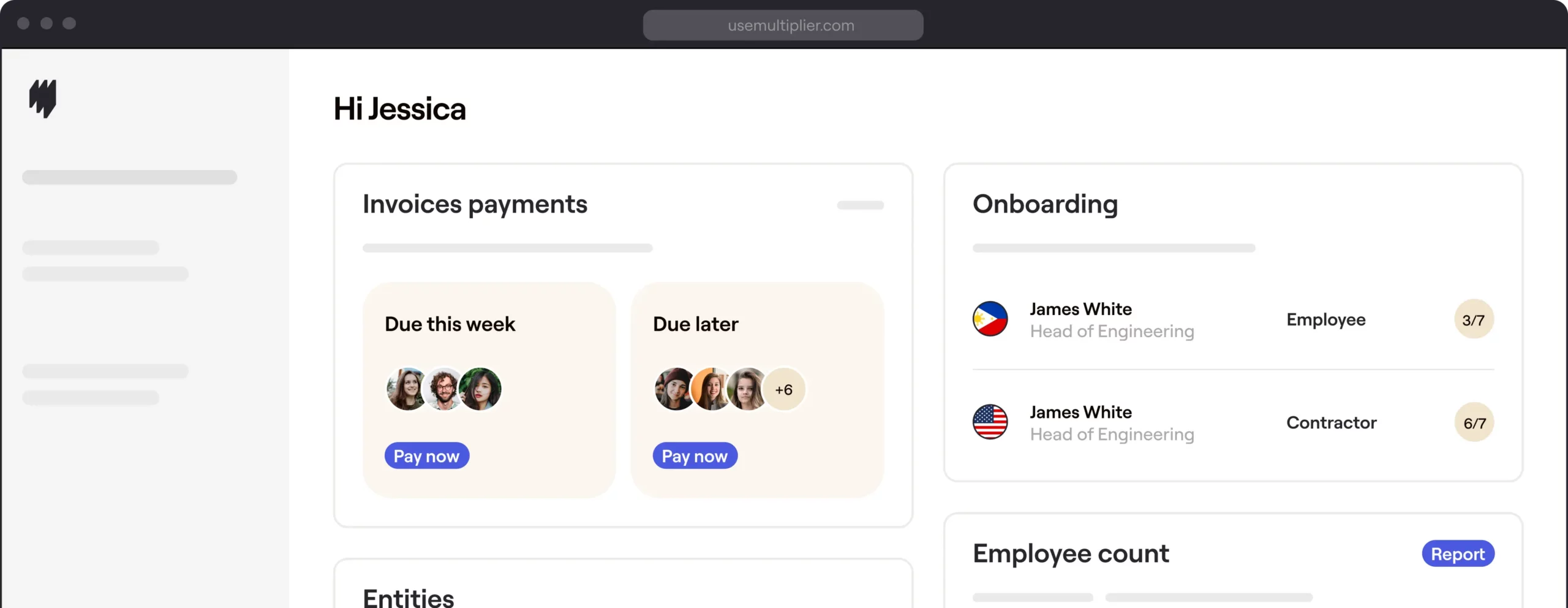
- Unified platform managing onboarding, benefits, and compliance
- Complete adherence to local and European regulations
Why HR teams love Multiplier for global hiring in Liechtenstein
Expanding into specialized markets like Liechtenstein requires an EOR in Liechtenstein that delivers precision, transparency, and dedicated support.
Multiplier provides comprehensive compliance across Liechtenstein’s unique regulatory environment, dedicated local expertise, and transparent pricing that scales with your team, with no hidden fees.
HR teams appreciate not having to track complex social insurance requirements, navigate cross-border employment rules, or coordinate with multiple local vendors.
What G2 users say about Multiplier
“Multiplier makes global hiring fast and hassle-free by enabling quick onboarding, accurate payroll across currencies, and ensuring compliance in over 150 countries—all through an easy-to-use platform.”
Book a demo today to discover how Multiplier enables confident expansion into Liechtenstein.
FAQs
What work permits are required to hire foreign employees in Liechtenstein?
EEA nationals can work freely. Non-EEA workers need residence and work permits, which employers must secure before hiring. Processing typically takes several weeks, depending on qualification levels.
How does Multiplier handle 13th-month salary payments in Liechtenstein?
Multiplier automatically calculates and processes mandatory 13th-month salary payments in accordance with employment contracts and collective agreements, ensuring compliant year-end compensation without additional administrative work for your team.
What are typical notice periods for terminating employment in Liechtenstein?
After probation, minimum notice is one month, extending to 2-3 months based on tenure. Collective agreements may mandate longer periods. Multiplier manages all termination requirements while ensuring full regulatory compliance.
Can companies hire cross-border commuters from Switzerland and Austria?
Yes, cross-border commuters comprise the majority of the workforce. However, employment contracts must address tax implications, social insurance coordination, and bilateral agreements. These complexities require specialized expertise to navigate properly.
How does Multiplier ensure compliance with Liechtenstein's collective bargaining agreements?
Multiplier maintains current knowledge of industry-specific collective agreements and automatically applies the required terms for compensation, working conditions, and benefits. This ensures your employment contracts meet all mandatory standards without requiring internal legal expertise.
What are the mandatory vacation entitlements in Liechtenstein?
Employees receive a minimum of four weeks' annual leave (five weeks for workers under 20). Collective agreements often provide additional days. Public holidays are separate entitlements varying by employment contracts and industry standards.
How quickly can businesses hire employees in Liechtenstein using an EOR?
With Multiplier as your EOR, you can hire compliant employees within 3-5 business days without establishing a local entity. This includes contract generation, social insurance registration, and payroll setup in accordance with Liechtenstein's regulatory requirements.