Over half of Honduras’s workforce — 54.7% — are self-employed, outpacing the global average by over 14 points and creating a deep well of cost-effective, specialized talent in a US-friendly time zone. But tapping into this pool without a clear compliance strategy exposes your company to misclassification penalties and evolving local regulations.
Engaging independent contractors in Honduras means getting worker classification right, establishing compliant payment channels, and managing ISR (income tax) and optional IHSS (social-security) filings. This guide walks you through each step.
It also explains how an Agent of Record (AOR) — also known as a Contractor of Record (COR) — can streamline the entire process, so you can scale your Honduran contractor roster effortlessly.
Step 1: Classify your contractor correctly
Misclassifying an employee as an independent contractor is a common but costly error for businesses operating in Honduras. The consequences can include fines from the Honduran Revenue Administration (SAR) and enforcement actions by the Honduran Institute of Social Security (IHSS). Employers may also face retroactive liabilities such as unpaid vacation, severance pay, and back pay on social security contributions.
Contractor vs. Employee in Honduras: what it means
In Honduras, the distinction between an employee and an independent contractor comes down to the degree of control exercised by the hiring entity. Authorities assess several factors:
- Independence. Does the contractor control their working hours and methods?
- Resources. Are they using their own tools and infrastructure or relying on yours?
- Freedom. Can they work with multiple clients simultaneously?
If the answer to any of these is no, the worker may legally be considered an employee under Honduran labor law.
Take our detailed misclassification self-assessment, and if your worker qualifies as an employee, consider hiring them remotely via an Employer of Record (EOR). If they qualify as a contractor, mitigate future risks and ensure compliance by hiring them via an AOR/COR.
How Multiplier supports you
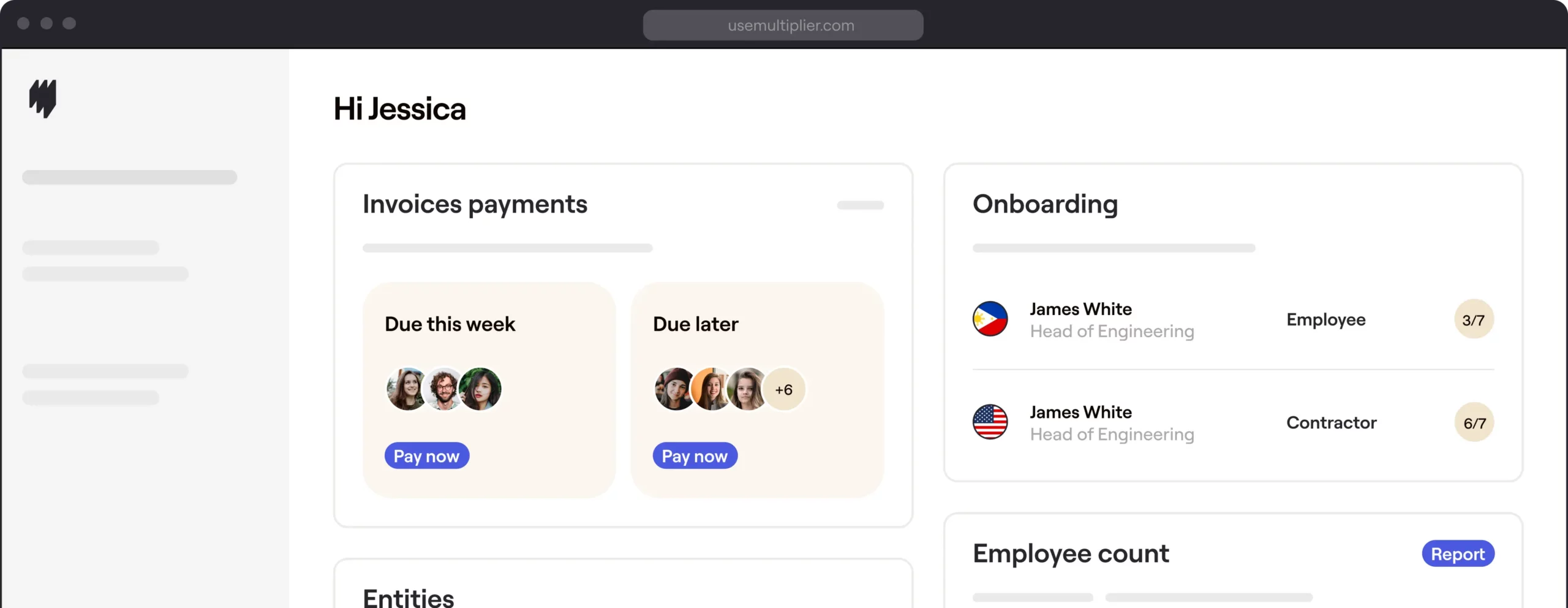
Multiplier’s Contractor of Record evaluates every role against misclassification risk and ensures compliant onboarding from day one — shielding your business from penalties, retroactive claims, and costly legal complications.
Step 2: Understand labor laws relevant to Honduran contractors
Honduran Contractors are not protected under the Honduran Labor Code (Código del Trabajo); instead, their working relationships are governed by civil or commercial law.
However, as discussed in the previous section, if the engagement includes employer-like control, such as fixed hours, supervision, or exclusive work, there is a risk of reclassification, which could lead to financial damages.
To remain compliant, companies must carefully structure each contractor relationship. This includes drafting contracts that emphasize independence, tax responsibility, and non-exclusivity. Engaging local legal counsel is highly recommended, but for many foreign businesses, this can be expensive and time-consuming.
How Multiplier helps reduce risk
Multiplier’s AOR service simplifies contractor management in Honduras by ensuring each engagement is fully compliant with local law. Multiplier evaluates classification risks, generates legally sound service agreements, and includes key clauses around autonomy and tax responsibility.
By using Multiplier, companies avoid costly legal consultations, reduce misclassification risks, and ensure contractors are onboarded in line with Honduran civil law. This approach helps businesses stay compliant, avoid fines or disputes, and scale their contractor workforce with confidence.
Step 3: Choose your hiring model
Hiring independent contractors in Honduras requires you to choose the right engagement model — based on your risk tolerance, operational footprint, and compliance readiness. You typically have four options:
- Hire directly through your foreign entity
- Hire via a registered local entity (if you have one)
- Engage contractors through an AOR (Agent of Record)
- Convert contractors to employees via an EOR (Employer of Record)

For most foreign companies, hiring through an AOR is the most practical and compliant approach — especially when local legal infrastructure is limited. This route helps reduce legal exposure without sacrificing operational agility.
How Multiplier simplifies hiring in Honduras
An AOR solution like Multiplier supports compliant contractor engagements by handling contracts, classification, payment, and region – specific tax obligations. It helps companies avoid the complexity of local legal setup while reducing the risk of misclassification or penalties.
For businesses looking to scale quickly while staying compliant, AOR is a reliable, low-effort path forward — especially in regions like Honduras where missteps can be costly.
Step 4: Find the right contractor in Honduras
Honduras has a growing independent workforce, particularly in customer support, virtual assistance, graphic design, and IT support. While the freelance talent pool is smaller than in some neighboring countries, demand for remote Honduran contractors is rising — especially for Spanish-speaking and bilingual roles.
Tegucigalpa and San Pedro Sula are the country’s largest urban hubs and have the highest concentration of remote-ready talent.
When it comes to sourcing, platforms are gaining traction, but word-of-mouth and referrals still remain strong, especially for administrative and design roles.
Popular sourcing channels include:
- Freelance platforms: Workana, Freelancer, SoyFreelancer (regional)
- Job boards: Computrabajo, Tecoloco, LinkedIn
- Referrals: Local business networks and industry groups are still widely used for trust-based hiring
What does it cost to hire a contractor in Honduras?
Honduras has officially updated its minimum wage rates for 2025, providing a helpful baseline for businesses evaluating contractor compensation. While many skilled contractors charge above minimum wage — especially in digital or specialized fields — the government’s rates offer insight into local labor expectations and economic context.
Minimum wages vary by industry and company size. For example:
- In Manufacturing, minimum monthly wages range from HNL 12,407 (for small firms) to HNL 17,557 (for large enterprises), translating to roughly USD 500–730 per month.
- In Customer Support and Hospitality, wages range from HNL 12,539 to HNL 16,908, or approximately USD 525–710 per month.
- IT and Financial Services command higher wages, with top-tier minimums reaching over HNL 18,000, or around USD 770/month.
- Hourly rates range from HNL 37.72 (USD ~$1.50) in agriculture to over HNL 75 (USD ~$3.20) in technical and service sectors.
Note: These figures provide a general benchmark, but actual contractor rates will typically be higher — especially for skilled, bilingual, or project-based work.
Important: Minimum wage laws apply primarily to employees. Independent contractors negotiate their own rates, which often include a premium for flexibility, autonomy, and self-management of taxes and benefits.
Remember, that your cost of hiring contractors goes beyond their hourly fees. The total cost to company also includes:
- Platform fees (1–3%)
Charged by freelance marketplaces like Upwork or Freelancer per transaction—applies to you, the contractor, or both. - Legal and tax consulting
Needed for drafting compliant contracts under Haitian civil law, avoiding misclassification risks, or tax issues. - Administrative overhead
Includes verifying the contractor’s NIF (Numéro d’Identification Fiscale), collecting compliant invoices, tracking payments, and storing records for potential audits. - Risk of informal payments
Paying contractors in cash or without formal invoices increases the risk of non-compliance. It may trigger scrutiny under anti-money laundering laws and complicate tax reporting.
How Multiplier’s AOR reduces cost and complexity
Multiplier’s Agent of Record (AOR) ensures compliance and prevents costly fines from misclassification and non – compliance. You also avoid hefty fees to legal and tax consultants.
The AOR helps you manage everything from drafting contractor compliance and onboarding to payroll and ongoing record-keeping and documentation, with one predictable, affordable, monthly fee.
Our unified platform and scheduled payments help you save thousands of man hours on administrative back and forth. By working with Multiplier, you save time, resources, and legal risk as you scale across Central America.
Step 5: Create a legally sound contractor agreement in Honduras
After selecting the right contractor and finalizing rates, it’s important to set the terms of engagement in writing. In Honduras, a written agreement is not legally required, but it is a smart move to avoid ambiguity and protect both parties — especially in cross-border relationships.
A strong contractor agreement helps clarify responsibilities, establish independence, and reduce management overhead. For companies working internationally, it also provides documentation that can prevent legal disputes and misclassification claims.
To make your service contract both enforceable and compliant with Honduran civil law, it should cover the following:
- Defined scope of services and expected deliverables
- Payment conditions including frequency, method, and currency
- Start and end dates, along with termination or renewal terms
- Clauses that confirm the contractor’s independence and autonomy
- Confidentiality and data protection clauses, if required
- A statement that the contractor is responsible for their own tax filings with the SAR (Servicio de Administración de Rentas)
There’s no formal requirement to register these contracts in Honduras or use a specific contract template. However, including the right language around autonomy, exclusivity, and tax responsibilities can significantly reduce your legal exposure.
To save time and avoid errors, many businesses choose to work with a partner who understands the local regulatory landscape.
How Multiplier makes compliance easy
Multiplier streamlines contractor onboarding by automatically generating legally compliant contracts tailored to Honduras. Agreements include the necessary terms to ensure proper classification and tax compliance — without the need for outside legal counsel.
You can preview how this works in our Contractor Onboarding Demo, or explore more walkthroughs here.
Step 6: Set up compliant contractor payments in Honduras
Paying independent contractors in Honduras requires careful alignment with local tax practices, currency expectations, and documentation standards. Whether you’re a local entity or an international company, ensuring traceable, regulation-friendly payments is critical to staying compliant.
Here’s what you need to build into your payment process:
- Currency: Contractors in Honduras are typically paid in Honduran Lempira (HNL), though USD is often accepted for international agreements. Always clarify the preferred currency in the service contract.
- Payment methods: Use formal, traceable channels such as bank transfers or other legally recognized electronic methods. These provide proof of payment and are essential for audit purposes.
- Invoices & documentation: While Honduras does not mandate a centralized digital invoicing system like Mexico’s CFDI, contractors must issue valid invoices that comply with Honduran tax laws. These invoices should include their RTN (Registro Tributario Nacional), a unique taxpayer number issued by SAR (Servicio de Administración de Rentas).
- Tax liability: Companies hiring contractors do not need to withhold income taxes. Contractors are responsible for declaring their earnings, paying applicable income tax, and handling social security contributions if they opt into the voluntary program.
Taxes in Honduras for Independent Contractors
Contractors working in Honduras must manage their own tax obligations. Here’s a breakdown:
Tax Type | Rate / Rule | Responsibility |
Income Tax | Tiered, ranging from 15% to 25%, based on total income | Handled by the contractor |
Sales Tax (ISV) | 15% on most services; must be included in formal invoices | Applied by contractor if registered for ISV |
Social Security | Voluntary enrollment in IHSS (Instituto Hondureño de Seguridad Social) | Optional, contractor-managed |
Invoicing | Contractors must issue invoices with a valid RTN number | Hiring entity must collect it for every transaction |
⚠️ Red flag: If a contractor cannot provide a valid invoice or lacks an RTN, it may indicate non-compliance or a potential misclassification. It’s best to resolve these issues before payment is issued.
How Multiplier keeps you compliant in Honduras
Multiplier makes it easy to stay on the right side of Honduran regulations. The AOR platform automates contractor payments in HNL or USD, ensures every invoice includes the correct tax ID and legal formatting, and tracks all documentation in one place. There is no risk of missed tax obligations, paperwork confusion, or delayed payments.
Explore how Multiplier works: Use the contractor onboarding walkthrough to see it in action.
Step 7: Onboard contractors professionally
Start your contractor engagement on the right foot. A well-organized onboarding process builds trust, reinforces professionalism, and aligns expectations — particularly across time zones like Central Standard Time (CST), which Honduras follows year-round.
Effective onboarding should include: team introductions, clarity on communication channels and check-in cadence, documented deliverables and timelines, and mutual agreement on review cycles or performance checkpoints.
Time zone alignment:
- Honduras operates on CST (UTC -6), which offers strong overlap with North American teams, including EST and PST time zones.
- Whether you’re working synchronously or asynchronously, it’s important to define availability windows (e.g., 9am–5pm CST) or set fixed check-in points to maintain momentum.
Contractors in Honduras value clear direction, transparency, and mutual respect. Providing formal onboarding signals that your company is organized, serious about the relationship, and committed to a smooth collaboration.
How Multiplier simplifies onboarding
With Multiplier, your contractors sign localized contracts digitally and set up their payment preferences on a shared platform, making contractor management simple and streamlined.
A structured onboarding flow ensures every document is compliant, every step is tracked, and nothing is missed. This professional set up builds trust, sets clear expectations, and helps your contractor feel supported from day one.
Step 8: Keep records and stay audit-ready in Honduras
When working with independent contractors in Honduras, maintaining proper documentation isn’t just good practice—it’s a legal necessity. According to Honduran tax authorities (SAR), companies should retain tax-related and contractual records for at least five years to remain compliant and audit-ready.
Key documents to store include:
- Signed contractor agreements
- Valid invoices issued with the contractor’s RTN (Registro Tributario Nacional)
- Proof of payments made (bank receipts, wire confirmations)
- Onboarding documentation and identification records
While Honduras doesn’t currently enforce a centralized digital invoicing system (like CFDI in Mexico), contractors are still required to issue compliant invoices under local tax law. Companies should implement a structured system for storing, sorting, and retrieving these records quickly, especially if they manage multiple contractors or are preparing for an audit.
How Multiplier helps you stay compliant in Honduras
Multiplier’s Agent of Record (AOR) model makes documentation management seamless. All contracts, invoices, and proof of payment are securely stored and organized in one centralized platform. You can filter by contractor, country, or timeframe and instantly download audit-ready reports — reducing legal risk and operational overhead.
Now that we’ve covered the key steps to hiring contractors in Honduras — safely, efficiently, and in full compliance — use the checklist below to ensure you’re not missing any critical actions before onboarding your first contractor.
A compliance checklist before you hire contractors in Honduras:
Here is a quick recap on how to stay compliant when engaging independent contractors in Honduras:
1. Sign a compliant service agreement
▪ Clearly define deliverables, timelines, autonomy, and tax responsibility
2. Collect contractor documentation
▪ RTN (Honduran tax ID)
▪ Valid national ID or passport
▪ Payment details (bank account or preferred channel)
3. Ensure invoicing and payments follow local law
▪ Contractor must issue a formal invoice with RTN
▪ Pay via traceable methods (bank transfer preferred)
▪ Set currency (HNL or USD) in advance
4. Onboard professionally
▪ Introduce tools, key contacts, and working expectations
▪ Define work hours or check-in windows (Honduras operates on CST)
5. Store all documents for at least 5 years
▪ Service agreements, invoices, payment proof, onboarding records
Working with contractors in Honduras requires careful attention to compliance, invoicing, and documentation. Doing all this in-house can be complex — especially for growing global teams. Multiplier’s AOR simplifies contractor management from start to finish, ensuring you stay compliant while keeping things efficient and organized.
Confidently hire contractors in Honduras with Multiplier
Whether you’re hiring your first Honduran contractor or building a distributed LATAM team, Multiplier’s Contractor or Record solution helps you:
- Create legally sound contracts in minutes
- Pay contractors in HNL or USD effortlessly and transparently.
- Manage invoices, payments, and reimbursements from a single payment dashboard
- Stay compliant with Honduran tax law and reduce audit risks
Why risk non-compliance or struggle with manual processes? Multiplier takes care of everything, so you can scale your contractor workforce in Honduras without the friction. Ask for a demo today to see how it works.