A decade ago, Aleix R Brunsoms did what many other skilled young Spaniards did: he left the country. The job market where he was starting out was closer to collapse than opportunity, and the roles that matched his skillset were somewhere else.
“There was quite a critical situation in terms of unemployment, especially for the youth. I think it was like 52% unemployment at the time,” Aleix told us for the first episode of The Global Thread, a new Multiplier docu-series about the forces of global work.
Today, Aleix is Director of Strategy at a global company, while working from Spain. His global role meant he didn’t need to leave Spain to find an opportunity that aligned with his career goals, and that shift is exactly what this piece is about.
What Spain loses when its talent leaves
“Brain Drain” is the emigration of skilled workers to other countries, usually chasing higher pay or opportunities that don’t exist in the home market. For Spain, this has been a recurring problem.
An estimated 87,000 highly skilled workers left Spain over the past decade, with around 70% of them pointing out a lack of opportunity or better wages abroad. Spain’s youth unemployment rate sat at around 25% during 2025–2026, which is double the EU average.
Each talented young person who leaves takes their wages out of the local economy, their income tax out of the public purse, and their skills out of the domestic labor pool. A company that may hire this talent doesn’t get built in Spain. That’s the real toll that’s paid, and it continues having a negative impact long after the person has gone.
What changes when talent stays
The same worker could earn at international rates without leaving the country.
When someone earns an income scaled to a global market, but spends it in their hometown, the money doesn’t stop at their own bills.
Economists call this the local multiplier effect: one well-paid job supports further spending at local shops, restaurants, and other services, which supports more local jobs in turn. A single global salary earned by a person in a mid-sized Spanish town does more work than the same salary landing in London or Berlin because the cost base is lower and the spending stays local.
Aleix saw the second-order version of this, too.
“It’s also the business community and entrepreneurship that comes with that. It attracts global businesses to Spain. It’s like a domino effect,” he said.
That effect is visible in the real-world numbers.
Barcelona now ranks 5th in the EU for launching a startup, and Catalan startups raised €1.13 billion in 2025, up 8% compared to the year before. Spain’s wider tech sector includes more than 5,000 startups and 17 unicorns worth a combined €125 billion, about 6.5% of national GDP.
Companies founded in Spain no longer have to relocate to scale internationally, and Spanish workers no longer have to relocate to get hired globally. Both directions of the old brain-drain flow can now run the other way. And, what’s more, they’re both solved in the same way.
The Global Exchange for Work
Holding a global role from Spain sounds simple until you look at the legal implications that go along with it. A foreign company can’t just add a Spanish resident to its payroll as if they were local. It needs a legal entity in Spain, or an alternative way to employ that person compliantly without this registration.
That’s the barrier global employment infrastructure removes. And it’s a real one: according to Multiplier’s Global Hiring Gap report, a survey of 500 senior business decision-makers, only 8% of companies say they’re fully compliant with international tax and labor laws, and 46% have failed to onboard international talent because of compliance issues.
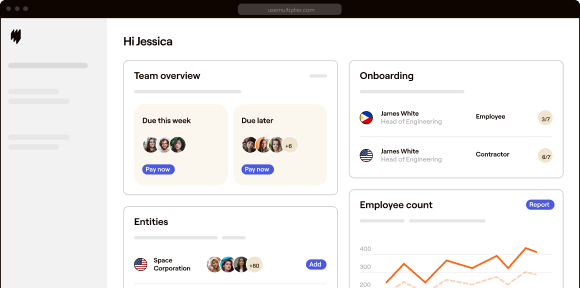
Multiplier’s Global Exchange for Work lets a company in one country employ and pay workers compliantly in another, without the need to set up a local entity for each market. This type of arrangement speeds up the hiring process, lets companies tap into the global talent pool, and lowers the risk of new market penetration, among other benefits.
Multiplier owns a network of 160+ legal entities across the markets it operates in, which means the worker is employed by a real, in-country employer rather than a chain of local partners no one can really account for.
Compliance sits with that entity, not with the hiring company or with the subcontractors. Native payroll engines run the actual pay so that someone taking on a global role from Spain is paid correctly in line with Spanish laws, and on time, following all statutory protections.
For a Spanish founder, the same infrastructure works in reverse: hiring across borders from a base in Spain without opening entities abroad, which is often the only way for a small startup to reach a global market before it has the size to justify local subsidiaries.
The Global Exchange for Work is the connective tissue that makes both scenarios practical and possible.
Keeping the talent and the economy
Thanks to global infrastructure, Spain doesn’t have to choose between keeping its skilled people and growing the economy. A worker who can earn globally and live locally keeps their income, their taxes, and their skills inside the country.
Aleix is one of many people doing exactly that, and the setup that let him come back is now something that any company can use to hire in Spain.
Watch the full episode of The Global Thread to hear Aleix’s whole story.
FAQs
What is brain drain?
Brain drain is the emigration of skilled or educated workers from one country to another, usually for higher pay or better career opportunities. The losing country forfeits not only the workers, but also their future wages, tax contributions, and economic output.
Is Spain still losing skilled workers?
Spain has been a net exporter of skilled young workers for years, driven by high youth unemployment rates and wage gaps with wealthier EU economies. The latest data (2026) confirms that this is still the case.
Does the worker pay tax in Spain or in the company’s country?
A Spanish tax resident owes Spanish income tax and social security regardless of where their employer is based. This is part of why the global work arrangements keep money in the local economy, and part of why the employer needs a compliant in-country setup rather than just a remote contract.
Is hiring globally the same as hiring a freelancer or contractor?
No, and the difference is critical in the legal sense. Freelancers and contractors are self-employed and carry their own tax and benefits. An employee hired through an employer of record is a real employee, with statutory protections, social security, and paid leave, employed by an in-country entity on the company’s behalf. Misclassifying an employee as a contractor can have multiple legal, financial, and reputational consequences for employers who don’t comply with laws.