Many companies still hire the way they always have: post the role, interview local candidates, and make an offer to someone who happens to live nearby. That approach works fine until the role calls for specialized expertise that simply doesn’t exist close to home.
Skift, a travel and tourism advisory firm, has seen first-hand the value of tapping into a worldwide talent pool. Its ten-person strategy team spans six nationalities across Canada, the US, the UAE, India, South Africa, and Spain. As Aleix Rodríguez Brunsoms, Skift’s Director of Strategy, puts it: “I don’t think Skift could be the company that we are without having a global workforce.”
In the first episode of Multiplier’s new docu-series The Global Thread, Aleix sat down to talk to us about how Skift built an international team, how that benefits employers and employees, and why he thinks companies still hesitant about hiring across borders are missing an opportunity.
Specialized talent lives everywhere, not just in one place
Hiring on a global scale gives companies access to the specific expertise a role requires, wherever that expertise happens to live.
According to Skift, tapping into the global talent pool provides access to top-quality candidates that they wouldn’t be able to find otherwise. As Aleix explains, “If we were limited to hire in a single location, we wouldn’t be able to find the diversity and breadth of profiles that we need to do our work.”
A company searching only within its home city is drawing from a small, fixed slice of a much larger pool, but deep, senior-level expertise tends to be scattered across many markets rather than concentrated in one. Companies limiting themselves to the local market are at a real disadvantage, especially now in the face of a global talent shortage.
Hiring globally is especially valuable when seeking to fill specialized roles or industry knowledge, such as the travel market. “When I look at different profiles for future employees in the team, you really need to go out in the job market at the global level to find individuals who have that niche knowledge of the travel industry,” Aleix says.
A distributed team has a positive impact on collaboration
Aleix’s experience points to a less obvious advantage of global work: working across cultures changes how people think and relate to each other.
Asked whether working within a fully Spanish team would have meant missing out on anything, Aleix said, “I would have missed the opportunity to develop more emotional intelligence and empathy. Working within one culture, you tend to see the world only in the way you assume it is. My global team shaped me in a completely different way.”
A single-culture team sees business challenges through one shared lens. A team built across cultures brings multiple frames to the same decision, which tends to produce sharper judgment and fewer blind spots, as well as a wider range of skills. For companies whose work spans multiple markets, that difference in perspective matters.
Is managing a global team worth it?
Global work has many benefits, but it also brings key challenges. Business leaders often cite concerns around teamwork and communication when managing a distributed team. Coordinating across time zones, languages, and legal jurisdictions add additional complexity that a single-office team never has to think about.
But overall, the benefits outweigh the negatives. As Aleix puts it: “To managers who are worried about the complexity and risk of global hiring, I would tell them: you’re missing a great opportunity.”
Hiring globally demands the right infrastructure
Aleix’s path to Skift shows what that opportunity can look like when the right infrastructure is in place. Before his current role, he was working as a contractor, renegotiating his status every few months and managing taxes himself just to work for a company that would hire from anywhere. What changed things was the infrastructure supporting the arrangement.
Once Skift brought him on through Multiplier’s Employer of Record, infrastructure that legally employs a worker on a company’s behalf and handles local compliance, payroll, and benefits, Aleix became a full-time employee with real job security.
Build a global team the right way
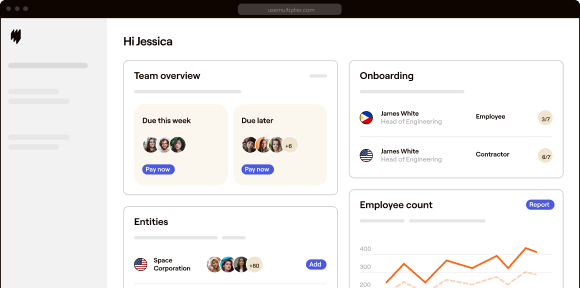
To be effective, global hiring needs the right setup in place to manage the compliance, the payroll, and the legal entities in each country. That’s what Multiplier’s Global Exchange for Work does, the infrastructure that lets companies hire, manage, and pay global teams. Built on owned entities across 160+ countries, in-house legal experts, automated compliance, and native payment rails, Multiplier gives companies the visibility, control, and confidence to expand globally.
For Skift, that infrastructure turned “we need niche expertise wherever it lives” into reality. To hear Aleix’s complete story, watch the full episode of The Global Thread.
FAQs
Does hiring globally mean hiring faster?
Remote hiring cycles run about 15% faster than hiring for in-office roles, since there's no need for on-site interviews, relocation, or visas. Onboarding tends to be faster too, and hiring remotely keeps costs lower.
What's the biggest challenge with managing a distributed team?
Many leaders worry that team cohesion and communication will suffer once hiring spans multiple time zones, languages, and legal jurisdictions. It's a fair concern, and one the right infrastructure and processes can address directly.
How does an Employer of Record support global hiring?
An EOR legally employs workers on a company's behalf in their local country, handling compliance, payroll, and benefits without the company needing to set up its own legal entity there.
Is a distributed team just about reaching more candidates?
Beyond the larger applicant pool, distributed teams bring a range of cultural perspectives that shape judgment and decision-making, not just headcount.