Think of Egypt as your launchpad to Africa and the Middle East — without the complexity
Egypt’s strategic position bridging Africa and the Middle East, coupled with its Free Zones and tax incentives, make it a compelling choice for business expansion. With the Suez Canal driving global trade and cost-effective operations supporting scalable growth, Egypt offers businesses an unparalleled mix of opportunity and infrastructure. Whether you’re leveraging its investor-friendly policies or tapping into its regional trade networks, Egypt provides a solid foundation for sustainable success.
The business benefits of registering your company in Egypt
Egypt is emerging as a top destination for global businesses. Here is why it could be the ideal choice for your business expansion:
International trade advantage
Egypt is a strategic location that connects Africa, the Middle East, and Europe, offering a gateway for regional trade and global logistics. It is an international trade hub and key port with one of the world’s most important maritime passages (Suez Canal).
Growing consumer base
When you expand here, you access a growing market of over 100 million consumers with a rising middle-class driving demand.
Government incentives
Businesses can leverage Egypt’s Free Zones (such as the Suez Canal Economic Zone) for tax incentives, duty exemptions, and streamlined customs procedures. You can also take advantage of government incentives in manufacturing, IT, and logistics (under the Investment Law).
Cost-effective labor
Egypt’s decreasing labor costs give global businesses a cost advantage over Malaysia, the Philippines, and Thailand. The workforce here has excellent textile manufacturing skills and growing IT capabilities even as Egypt’s government improves capacity building and training programs, under ICT 2030.
In short, if you want a dynamic business environment with ready access to a growing talent, Egypt is a great place to expand.
Hire and manage your workforce here through an Employer of Record (EOR) or by setting up a local entity. Choose to register a company here if you must invoice clients locally or work with the Egyptian government. In the next section, we outline how to do this compliantly and efficiently.
How to register a company in Egypt?
Setting up a business in Egypt is a straightforward process when you have the right strategy in place. Here’s a quick, efficient guide to help you get started and expand with ease:
Step 1: Choose your business structure
Your first step is choosing the right business structure. Your options include Sole Proprietorship, Limited Liability Company (LLC), Joint Stock Company (JSC), Branch office or a Representative Office. Let us explore these structures in detail to understand which would suit your business goals.
Sole Proprietorship
A sole proprietorship is the simplest business structure, but is only available to Egyptian citizens or residents, and is typically used for small-scale or low-risk activities. In this structure the owner assumes full personal liability for business debts.
Choose this if: You are an Egyptian national running a small business independently and don’t need legal separation between personal and business assets.
Limited Liability Company (LLC)
Best suited for small to medium-sized businesses, an LLC requires at least two shareholders — local or foreign — and offers limited liability protection. You’ll also need to appoint a general manager who resides in Egypt and holds a valid residency permit.
Choose this if: You want operational flexibility and liability protection, but don’t need to raise capital through public offerings.
Joint Stock Company (JSC)
A JSC is designed for larger businesses wanting to raise capital or list on the stock exchange. It requires at least three shareholders, a minimum capital of EGP 250,000, (with 10% paid upfront), and a board of directors with at least three members.
Choose this if: You plan to scale significantly, attract investors, or eventually go public.
Branch office
A branch office allows a foreign company to operate in Egypt under its parent company’s name. It can conduct commercial activities, generate revenue, and hire employees — but it must stick to the same scope of work as the parent entity. There’s no minimum capital requirement, but you must appoint a resident manager and register with GAFI and the tax authority. The parent company remains fully liable for the branch’s obligations.
Choose this if: You want to run operations directly under your foreign entity without setting up a separate Egyptian company.
Representative office
Also known as a liaison office, you can use this structure for non-commercial activities like market research, promotion, or feasibility studies. It cannot generate revenue or sign contracts. Registration with GAFI is still required and you must appoint a local manager to oversee operations.
Choose this if: You’re exploring the Egyptian market or supporting a parent company’s presence — without engaging in sales or commercial transactions.
Apart from using the above business structures, you can expand into Egypt (from anywhere in the world) using an Employer of Record (EOR). An EOR allows you to hire and pay employees legally in Egypt —without setting up a local entity or managing compliance.
If you choose to register an LLC, JSC, or branch office in Egypt, however, the next step is to prepare and submit your incorporation documents.
Step 2: Submit essential documents
After choosing your structure, submit the following documents to the General Authority for Investment and Free Zones (GAFI) for approval:
- Memorandum of Association (MoA): An MoA outlines the basic identity of your company—its name, objectives, shareholders, and capital. It must clearly state the company’s commercial activity and identify all shareholders and their contributions. Remember, GAFI only accepts Arabic-language submissions.Foreign companies should get their MoA translated by a certified translator in Egypt and reviewed by local legal counsel.
- Articles of Association (AoA). An AoA outlines how your company will operate internally. It should explain management structure, voting rights, profit distribution, rules for meetings or company dissolution. The AoA must comply with Egyptian company laws, and we advise foreign companies to use local legal counsel to draft this.
- Proof of business address. This could be any document confirming your registered office in Egypt. You could use a signed lease agreement or a recent utility bill or property ownership deed (in the company’s or representative’s name). If you submit a lease, ensure that it is drafted in Arabic, registered with the local real estate authority, and valid for at least three months.
At this stage, you should also appoint a legal representative to sign contracts, represent your business before government authorities, and handle official correspondence. For local companies, this could be the partners or founders. But for foreign-owned businesses, the representative must be an Egyptian resident and formally authorized to act on the company’s behalf.
Step 3: Open a corporate bank account
You’ll need a corporate bank account to manage your finances. Banks typically require:
- Company registration documents
- Proof of tax compliance
- Identification documents for company directors
Managing payroll in Egypt doesn’t have to involve the hassle of setting up a local bank account. Multiplier’s global payroll solution offers a smarter alternative, enabling seamless payroll processing across multiple currencies while ensuring compliance with Egyptian tax regulations. By reducing risks and eliminating complexity, Multiplier lets you launch and run operations—without a bank account.
Step 4: Ensure tax compliance
To operate legally, register for a Tax Identification Number (TIN) and VAT if needed. Manage payroll taxes, social insurance, and employee contributions to ensure compliance.
Working with a global payroll provider like Multiplier gives you access to local expertise and simplifies these tasks, helping you stay on track with Egyptian regulations.
Understanding the costs associated with setting up in Egypt is the next step. Let’s break down the expenses to help you plan.
Cost of Starting a Company in Egypt
For businesses planning to set up operations in Egypt, here’s a detailed breakdown of the costs to help you prepare:
1. Registration costs
- State fee: Registering a company with the General Authority for Investment and Free Zones (GAFI) typically costs between $100 and $300, depending on the entity type.
- Initial capital: While certain business types may have no minimum capital requirement, others (e.g., LLCs) often require starting capital of $1,000 or more.
- Legal services: Engaging a local attorney or consultant for registration can cost between $500 and $1,500.
- Business license fees: Industry-specific licenses may range from $100 to $500 annually.
2. Annual maintenance costs
- Accounting services: Professional accounting fees start at around $50 per month, depending on the size and complexity of your business.
- Tax filings: Filing taxes, including VAT and corporate income tax, incurs costs ranging from $200 to $500 per year.
- License renewals: Renewing business or operating licenses costs between $100 and $300 annually.
- Corporate bank account fees: Egyptian banks typically charge $10 to $30 per month for account maintenance.
3. Additional considerations
- Work permits: For expatriate employees, permits range from $500 to $1,000 annually.
- Office space: Leasing office space can cost anywhere from $300 to $1,500 monthly, depending on location and size.
An EOR eliminates many of these expenses by managing payroll, compliance, and legal requirements under a single, predictable fee. It’s an efficient alternative to traditional entity setup, saving you time and reducing overhead.
Let’s compare the costs of standard registration versus an EOR to determine the best fit for your business.
Legal requirements for company registration in Egypt
Here is a quick recap of all the documents and steps you require for starting a business in Egypt:
- Reserve your business name with GAFI
- Draft and notarize the Articles of Association
- Meet capital requirements based on your business structure (e.g., LLC or JSC)
- Appoint a legal representative as an official point of contact with Egyptian authorities.
- Ensure you meet minimum capital requirements
- Register with the commercial registry and obtain a Tax Identification Number (TIN)
- Register for VAT, if applicable
- Enroll in social insurance (NOSI) if hiring locally
- Secure any sector-specific licenses (if operating in regulated sectors like healthcare, finance, education)
What is the difference between standard company registration and EOR in Egypt?
Egypt offers two primary options for establishing a business, each tailored to different needs:
| Aspect | Standard Registration | Employer of Record (EOR) |
| Purpose | Establishes a legal entity, granting full control over operations and finances. | Allows hiring in Egypt without setting up a legal entity; the EOR manages compliance and employment. |
| Control | Provides complete operational and financial control. | Operational control over employees; EOR handles administrative and legal tasks. |
| Compliance | Full responsibility for adhering to Egyptian labor laws, tax regulations, and reporting. | EOR ensures compliance with labor laws, taxes, and reporting on your behalf. |
| Setup Time | Longer, due to documentation, legal procedures, and potential government approvals. | Quick, enabling immediate hiring and operations. |
| Cost | Includes entity setup costs, licensing fees, and ongoing operational expenses. | Service fees to the EOR, which are often more cost-effective than establishing an entity. |
| Scalability | Best for long-term, substantial physical operations. | Highly flexible for workforce scaling without the need for an entity. |
While standard registration provides full operational control, it can be time-intensive and costly. An Employer of Record (EOR) simplifies workforce expansion by managing compliance, payroll, and administrative tasks, making it an efficient solution for businesses looking for a fast and flexible entry into Egypt.
Let’s explore how EOR streamlines your company registration and employee onboarding in more detail.
How EOR simplifies Egypt company registration
Expanding into Egypt doesn’t have to involve long waits or unnecessary complexities. With an EOR, you can jumpstart your operations in 2025, hire local talent, and stay compliant without the headache of setting up a local entity.
Here’s how an EOR accelerates your entry into Egypt:
- Skip the lengthy entity setup process. An EOR becomes your legal employer, so you can focus on scaling from day one.
- Say goodbye to payroll and tax management. The EOR takes care of all administrative tasks, ensuring your operations run smoothly.
- Stay fully compliant with Egypt’s labor laws and tax regulations, avoiding legal risks and penalties.
- Save on setup and operational costs by bypassing the need for local entity registration, allowing you to reallocate resources to growth.
- Scale your workforce quickly and flexibly, adapting to market demands without committing to long-term legal complexities.
- Tap into Egypt’s skilled talent pool without the hurdles of navigating local hiring regulations or complex recruitment processes.
- Offer competitive, locally compliant benefits, all administered by the EOR, so your team is taken care of from day one.
- Minimize compliance risks with an EOR’s local expertise, ensuring your business stays on track while expanding.
An EOR makes entering Egypt easier, faster, and more cost-effective—giving you the freedom to focus on growing your business while EOR handles the legal and operational details.
Cost Comparison: Standard Registration vs. EOR
Here’s a quick look at the cost differences between standard company registration and using an employer of record (EOR):
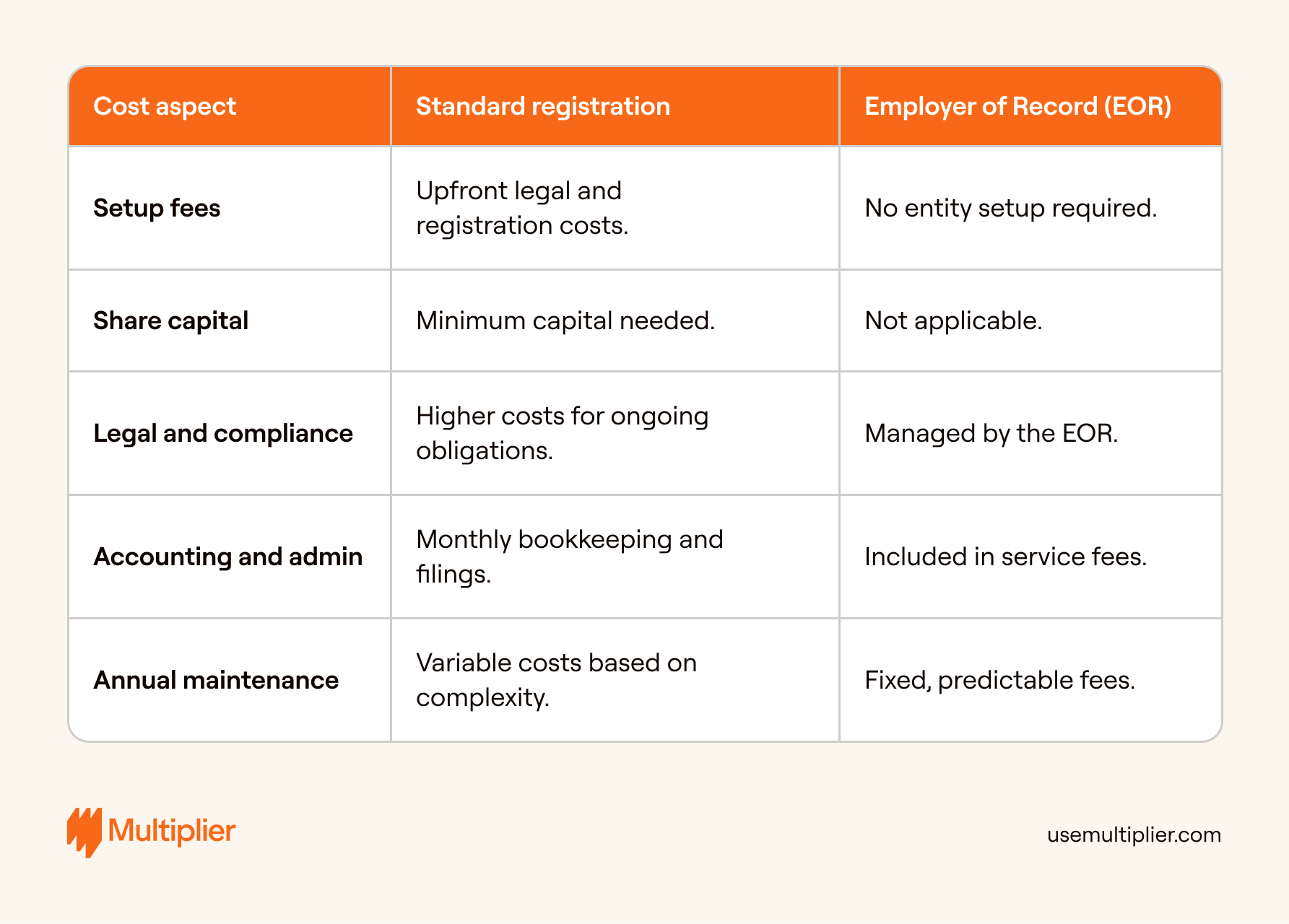
While traditional company registration involves significant upfront and ongoing costs—such as securing capital, handling legal compliance, and maintaining complex administrative systems—an EOR simplifies the process. With fixed, predictable monthly fees, an EOR manages most compliance, payroll, and operational responsibilities, allowing you to focus on growing your business.
By partnering with an EOR like Multiplier, you can accelerate your entry into Egypt, bypass the traditional setup delays, and avoid the complexities of managing local compliance, freeing you to scale quickly and efficiently.
Simplify your expansion into Egypt with Multiplier
Entering the Egyptian market doesn’t have to be complicated. With Multiplier’s Employer of Record (EOR), you can bypass the usual hurdles and focus on scaling your business while we manage the critical tasks.
Tap into Egypt’s talent pool, scale globally:
Easily access Egypt’s diverse workforce with the help of our local HR team. We handle everything from contracts to onboarding, so you can expand with confidence and speed.
Effortless payroll management:
Let us take care of your payroll needs — accurately and transparently. Multiplier ensures full compliance with Egypt’s tax and labor regulations, so your business runs smoothly without interruptions.
Centralized HR operations:
With Multiplier’s platform, managing everything from onboarding and expenses to approvals and time-off requests is simple. Get full visibility and control over your teams in Egypt — all in one place.
Compliance made easy:
Stay on top of Egypt’s labor laws and tax regulations with our dedicated compliance expertise. Whether it’s meeting tax requirements or ensuring employee protections, we handle the details to keep your operations legally sound.
Attractive benefits packages:
Stand out in Egypt’s competitive job market with benefits tailored to local expectations. We manage all benefit-related administration, ensuring your team gets the support they deserve.
Always available support:
With our 24/5 customer support, Multiplier ensures that both you and your employees receive the assistance you need at every step. Your operations are secure with GDPR compliance, SOC 2 certification, and AWS-backed security.
Multiplier transforms your expansion into Egypt into a seamless experience. We handle everything—from managing payroll and benefits to scaling your workforce and ensuring compliance with local laws.
By taking care of the operational complexities, Multiplier enables you to focus on strategic growth, giving you the flexibility to scale rapidly and efficiently in a dynamic market.
Book a Demo with Multiplier EOR.