Hiring an employee in Australia costs 1.25x–1.40x their base salary.
For an AUD $100,000 role in Brisbane, total annual employer cost reaches AUD $125,000–$140,000 once superannuation (11.5% from July 2024, rising to 12% in July 2025), state payroll tax, and mandatory leave entitlements under the Fair Work Act are included. Sydney and Melbourne roles carry a further 10–15% salary premium.
Australia produces high-caliber senior commercial and tech talent. Our Talent trend data shows that companies in the United Kingdom are actively recruiting Australian professionals at premium salaries: A Regional Sales Director commands $12,100 a month and a Chief Revenue Officer $12,500. But, what surprises most international employers is not the salary level, it is the statutory cost sitting on top of it.
Employer costs rise when you add a 12% superannuation guarantee under the Fair Work Act, state-level payroll tax obligations that differ across all six states and two territories, workers’ compensation insurance, and statutory leave entitlements including four weeks of annual leave and a 17.5% leave loading under applicable awards.
From 1 July 2026, the Payday Super reform requires superannuation contributions to be paid on each payday rather than quarterly, adding a new layer of payroll compliance for every employer.
Budgeting accurately means understanding all these numbers before the contract is signed.
This guide covers mandatory employer costs, statutory benefits, city-level salary benchmarks, and a full employment cost breakdown for the Australian market. It also covers how an EOR service like Multiplier can help you scale Australian hiring efficiently using the Employer of Record model.
Understand the difference between cost to hire vs. cost to employ in Australia
The true cost of hiring in Australia goes well beyond base salary. Many employers entering Australia price the hire correctly and the employment wrong. The cost to hire is settled before day one, while the cost to employ is the commitment that follows:
Cost to hire is the one-time expense of sourcing, assessing, and onboarding. In Australia, this typically runs AUD $5,000 to AUD $25,000+, depending on seniority, city, and hiring method.
Cost to employ is the recurring annual burden: base salary plus 12% superannuation, state payroll tax where applicable, workers’ compensation, four weeks statutory annual leave, and any applicable award obligations. In Australia, this typically runs 1.25x to 1.40x base salary for the lifetime of employment.
Depending on role seniority, state of employment, and industry classification, employer expenses typically result in a 25% to 40% increase on top of gross base salary.
Average cost to hire an employee in Australia: Quick benchmarks
Businesses must understand one-time recruitment and onboarding costs before evaluating the broader long-term cost of employment.
2026 quick benchmarks
- Entry-to-mid-level positions: Typically range between AUD $5,000 and AUD $10,000 per hire
- Managerial or specialized technical roles: Typically range between AUD $10,000 and AUD $25,000+ per hire
- Executive leadership: When retained search is involved, costs regularly exceed AUD $40,000
These costs vary based on:
- Role type: Senior commercial roles including Regional Sales Directors, Chief Revenue Officers, and senior software engineers are sourced primarily through retained search and LinkedIn headhunting, with agency fees at the higher end of the 15% to 25% range. Technical roles in cloud, AI, and cybersecurity carry additional premiums due to persistent talent shortages.
- Location (city/state): Sydney and Perth run approximately 9% above the national salary average for professional roles, according to Robert Half’s 2026 Salary Guide, with Melbourne close behind. Brisbane, Adelaide, and Canberra offer meaningfully lower overhead for comparable talent.
- Hiring method: In-house HR teams represent a fixed internal cost. Contingency agencies typically charge 15% to 20% of first-year salary for professional roles; retained search for senior hires runs 20% to 25%.
Cost to hire by city: Illustrative benchmark for a professional employee
The table below estimates one-time hiring and onboarding costs across Australia’s major markets, including sourcing, recruiter fees, interviewing, background checks, and onboarding. Actual costs vary by role seniority, industry, employer brand strength, and use of internal vs. external recruiters.
These benchmarks cover cost per hire only: The one-time recruitment and onboarding expense to secure a signed offer. Before examining how the cost of employment compounds on top of that, it helps to understand exactly what goes into the cost per hire figure.
Understanding cost per hire: Definition and components
Cost per hire is the total cost of recruiting and onboarding one employee and includes both in-house expenses tied to the hiring process (internal costs) and payments to outside vendors and platforms (external costs).
Internal hiring expenses include:
- HR team time: The portion of the internal recruitment team’s salary allocated to a specific open role
- Interview time: The opportunity cost of time that hiring managers, technical reviewers, and senior stakeholders spend on candidate evaluation
- Referral bonuses: Payments to existing employees who successfully recommend a hired candidate
- Recruitment software and tools: Subscriptions to applicant tracking systems (ATS), video interview platforms, and candidate sourcing databases
External recruiting costs include:
- Job board advertising: Paid listings on SEEK, LinkedIn Talent Solutions, Indeed, and sector-specific platforms
- Agencies: Contingency or retained search fees, typically 15% to 25% of first-year salary for professional roles
- Background checks: National Police Check, reference verification, qualification checks, and right-to-work confirmation for visa holders
- Assessment tools: Technical tests, psychometric evaluations, and structured interview platforms
Cost per hire formula
Use this formula to calculate the average amount your company spends to hire one employee, including both internal recruitment costs and external hiring expenses.
Cost per hire covers the full recruitment cycle: Advertising, agency fees, HR time, assessments, and onboarding. It does not include ongoing costs like salary, superannuation, or leave entitlements. Those fall under cost of employment, covered in the sections below.
Understanding cost of employment in Australia
In Australia, a complete hiring budget should account for these four core cost layers:
- Base salary
- Mandatory employer contributions (superannuation guarantee, state payroll tax, workers’ compensation)
- Employee benefits and statutory obligations (annual leave with leave loading, personal and carer’s leave, parental leave, long service leave)
- External operational costs (equipment, compliance, payroll administration, productivity overhead)
What makes Australia’s cost structure particularly distinctive in 2026 is the interaction between a federally mandated 12% superannuation guarantee and eight different state payroll tax systems sitting on top of it. A company with employees in Sydney and Melbourne faces different thresholds, rates, and filing obligations in each state. Add the Payday Super reform taking effect from 1 July 2026, which replaces quarterly super contributions with same-day payday contributions, and the compliance overhead for every new hire is meaningfully higher than in most comparable markets. Let us look at each layer in turn.
1. Base cost of hiring employees in Australia
Base salary is the largest component, and it varies significantly by role, city, and industry. Sydney and Perth sit approximately 9% above the national median for professional roles, while Brisbane and Adelaide offer strong talent pools at more competitive rates.
The Australian Bureau of Statistics reports median full-time adult weekly ordinary earnings of approximately AUD $1,950 per week (AUD $101,400 annually) for November 2025, with technology, finance, mining, and professional services consistently above that benchmark.
Australia base cost of hiring: A worldwide perspective
Australia offers English-language professional talent at salary levels that sit below comparable roles in the US and UK in absolute dollar terms, but above most of Southeast Asia and Eastern Europe. A mid-level software engineer earning AUD $110,000 in Sydney represents approximately USD $71,000 at current exchange rates, compared to USD $120,000 to $145,000 for an equivalent role in the United States. For international companies building Asia-Pacific-facing teams, the timezone, English proficiency, and institutional knowledge the Australian market offers can make that premium worthwhile.
Visit MultiplierTalent Trends to examine compensation trends across 150+ countries for a broader view of global hiring benchmarks.
2. Mandatory employer costs when hiring in Australia
These costs are non-negotiable and set by federal and state law. For a full breakdown of employment contracts, visa work rights, and termination requirements, see our guide on how to hire in Australia.
Superannuation guarantee
Under the Superannuation Guarantee (Administration) Act and administered by the Australian Taxation Office, employers must contribute 12% of each eligible employee’s ordinary time earnings into a complying superannuation fund. This rate is the final stage of the legislated increase and applies from 1 July 2025.
The maximum super contribution base is AUD $250,000 per year from 1 July 2026, meaning employers are not required to pay superannuation on earnings above this ceiling. From 1 July 2026, the Payday Super reform requires contributions to be received by the employee’s fund within seven days of each payday, replacing the previous quarterly payment cycle and introducing substantially higher penalties for late payment.
State payroll tax
Unlike most countries, Australia has no federal payroll tax. Each state and territory administers its own system with separate thresholds and rates. For the 2025/26 financial year, key rates are:
- New South Wales: 5.45% on taxable wages above AUD $1,200,000 annually
- Victoria: 4.85% on taxable wages above AUD $900,000 (with additional surcharges for large employers)
- Queensland: 4.75% on taxable wages above AUD $1,300,000
- Western Australia: 5.5% on taxable wages above AUD $1,000,000
- South Australia: 4.95% on taxable wages above AUD $1,500,000
For international employers with a small initial headcount, state payroll tax thresholds may not be triggered immediately. As headcount grows, particularly across multiple states, registration with each relevant state revenue authority becomes mandatory.
Workers’ compensation insurance
Compulsory in all states and territories, workers’ compensation covers medical costs and lost wages for workplace injuries. Rates are set by each state, calculated as a percentage of payroll, and vary significantly by industry risk classification, typically ranging from 0.5% for professional office roles to 3% or higher for construction, manufacturing, and field-based work.
Australian employment law and the National Employment Standards
The Fair Work Act 2009 and the National Employment Standards (NES) set the minimum employment conditions for all national system employers. These define the statutory entitlements below.
3. Employee benefits and standard allowances in Australia
Beyond mandatory contributions, a set of statutory entitlements and market-standard benefits shape the full cost of employment for professional hires in Australia.
Annual leave
Under the NES, full-time employees accrue four weeks of paid annual leave per year of service. Shift workers who regularly work Sundays and public holidays are entitled to five weeks. Leave loading of 17.5% applies under many modern awards when annual leave is taken, adding to the effective cost of leave. Accrued annual leave must be paid out on termination.
Personal and carer’s leave
Full-time employees are entitled to 10 days of paid personal and carer’s leave per year, which accumulates progressively and carries over year to year. Unlike annual leave, it is not paid out on termination.
Parental leave
Under the NES, employees with 12 months of continuous service are entitled to up to 52 weeks of unpaid parental leave, with the right to request an additional 52 weeks. The Australian Government’s Paid Parental Leave scheme provides up to 22 weeks of government-funded pay at the national minimum wage, paid through the employer’s payroll from 1 July 2025. Employers bear the administrative overhead of processing these payments.
Long service leave
After a qualifying period of continuous employment (typically seven to ten years depending on state), employees accrue an entitlement to extended paid leave. Long service leave is state-based, with rates and qualifying periods varying across jurisdictions. It represents a deferred liability that builds on the employer’s balance sheet with every year of tenure.
Private health and other market-standard benefits
Private health insurance is not as universally provided by employers in Australia as in the US or UK, given Australia’s Medicare system. However, in financial services, consulting, and technology, employer-subsidised health cover, income protection insurance, and salary packaging arrangements (particularly novated leases for vehicles) are standard competitive offerings.
For a full breakdown of statutory entitlements and benefit expectations by sector, see our guide to employee benefits in Australia.
4. External costs when hiring employees in Australia
Hiring a senior commercial role through a Sydney agency at 20% of an AUD $120,000 salary generates a AUD $24,000 recruitment fee before the first candidate interview. These costs sit outside payroll and statutory obligations but represent a substantial component of total first-year employment cost, particularly when building a team across multiple states.
Recruitment costs
- Job board advertising: Paid listings on SEEK, LinkedIn Talent Solutions, Indeed, and sector-specific platforms
- Recruitment agencies: Typically 15% to 25% of first-year salary; average approximately 18% for professional roles
- Internal recruiter time: Allocated HR team cost per open role
- Background checks: National Police Check, Working With Children checks (where applicable), qualification verification, and visa work rights confirmation
Onboarding costs
- Equipment: Laptop, peripherals, and home office setup for remote or hybrid roles, typically AUD $2,000 to AUD $4,000 per hire
- Software licenses: Monthly seat fees for productivity, communication, and operational tools
- Training: Manager and peer time allocated to role orientation, plus any mandatory role-specific certification
Compliance and administrative costs
- Legal review: Employment contract preparation compliant with the Fair Work Act, NES, and any applicable modern award
- Payroll setup: Single Touch Payroll (STP) Phase 2 reporting registration with the ATO, state payroll tax registration where thresholds are met, and workers’ compensation policy setup per state
- Award interpretation: Identifying the applicable modern award for each role and correctly applying penalty rates, overtime, and allowances where relevant
Productivity costs
A new hire in Australia typically takes three to six months to reach full output. The productivity gap during this period, combined with manager oversight time redirected from business priorities to onboarding and induction, is a real cost that rarely appears in hiring budget models but consistently affects them.
Sample cost breakdown: What would it cost to hire an AUD $100,000 accountant in Brisbane?
The example below considers a chartered accountant hired in Brisbane, with standard superannuation, workers’ compensation, leave loading, and typical onboarding costs. Queensland’s payroll tax threshold of AUD $1.3 million means this single hire does not trigger a payroll tax liability.
An AUD $100,000 base salary becomes approximately AUD $117,346 in total annual employer cost (roughly 1.17x at the statutory floor). Add state payroll tax once the threshold is crossed, private health insurance, and enhanced leave entitlements common in professional services, and the real figure moves toward 1.30x to 1.35x for most mid-market hires.
That figure also shifts depending on where in Australia the employee is based, as the next section shows.
Australian employment cost variations by state and city
In Australia, employer expenses vary across states because of differences in:
- State payroll tax rates and thresholds, which range from AUD $900,000 in Victoria to AUD $1,500,000 in South Australia, triggering different tax obligations as headcount grows
- Average market salaries, with Sydney and Perth running approximately 9% above the national median for equivalent professional roles (Robert Half 2026 Salary Guide)
- Industry sector concentration: mining and resources roles in Western Australia, defence and government in Canberra, and financial services in Sydney carry higher base salaries and compensation expectations than comparable roles in Adelaide or Hobart
- Modern award obligations, which vary by industry and add penalty rates, overtime, and allowances above base pay in many sectors
The table below shows how total employer cost plays out across Australia’s major cities for an employee on an AUD $100,000 annual salary.
City-level cost of employment: Illustrative example for an AUD $100,000 annual salary employee
In the table below, we consider total annual employer cost for a full-time professional employee on an AUD $100,000 gross annual salary, assuming 12% superannuation, 1% workers’ compensation (professional roles), applicable leave loading, and standard onboarding. Figures exclude state payroll tax, which applies only above state-specific thresholds. Actual costs vary by industry, award coverage, and benefits package.
How to reduce total employment costs in Australia
Australia’s geographic and state-based structure creates genuine opportunities to manage total employer cost without compromising on talent quality.
- Hire in lower-cost cities: Brisbane, Adelaide, and Canberra offer strong professional talent pools at 5% to 15% lower salary cost than Sydney or Melbourne for comparable roles, with higher state payroll tax thresholds that take longer to trigger as headcount grows
- Salary packaging: Structuring compensation to include pre-tax benefits such as novated leases, additional superannuation contributions, or expense reimbursements reduces taxable income, lowering the effective payroll tax and superannuation base for both employer and employee
- Contractors vs employees: Contractors do not carry superannuation, leave, or payroll tax obligations. That said, the ATO’s personal services income (PSI) rules and the Fair Work Act’s provisions around sham contracting carry significant back-payment risk if classification is incorrect. Engage contractors only for genuinely independent, deliverable-based work
- Employment Allowance equivalent: Unlike the UK, Australia has no employer-side credit equivalent, but smaller employers below state payroll tax thresholds carry a meaningfully lower effective cost per hire than large multi-state employers
- Payroll automation: Reducing manual STP Phase 2 reporting errors, late superannuation payments (which trigger the Superannuation Guarantee Charge), and award misinterpretation through payroll technology cuts administrative cost and ATO penalty exposure
Hire and pay employees in Australia using Multiplier
Managing employer costs in Australia involves far more than calculating a salary. Companies must navigate 12% superannuation contributions now due on each payday under the Payday Super reform, Single Touch Payroll Phase 2 reporting to the ATO on every pay cycle, state payroll tax registrations and filings in every state where employees are based, workers’ compensation policies required by each state authority, and Fair Work Act obligations covering modern award compliance, NES entitlements, and right-to-work verification.
For global businesses, establishing a local entity in Australia adds overhead, slows expansion, and creates long-term compliance risk across multiple state jurisdictions. That is why companies rely on Multiplier’s EOR in Australia to hire with confidence and full compliance certainty, without setting up a local entity.
Here is how Multiplier helps companies manage employer costs in Australia:
- Hire across all states and territories without separate entity registrations: Enter any state without state payroll tax registration, workers’ compensation policy setup, or state revenue authority enrollment
- Generate locally compliant employment contracts: Fair Work Act-compliant contracts aligned to the NES, applicable modern awards, and right-to-work requirements
- Run compliant Australia payroll with automated superannuation and tax calculations: STP Phase 2 reporting, superannuation guarantee contributions paid on each payday under the new Payday Super rules, and PAYG withholding remittances handled accurately on every cycle
- Manage Australia-specific statutory obligations: 12% superannuation, annual leave with leave loading, personal and carer’s leave, parental leave administration, and long service leave accrual tracking
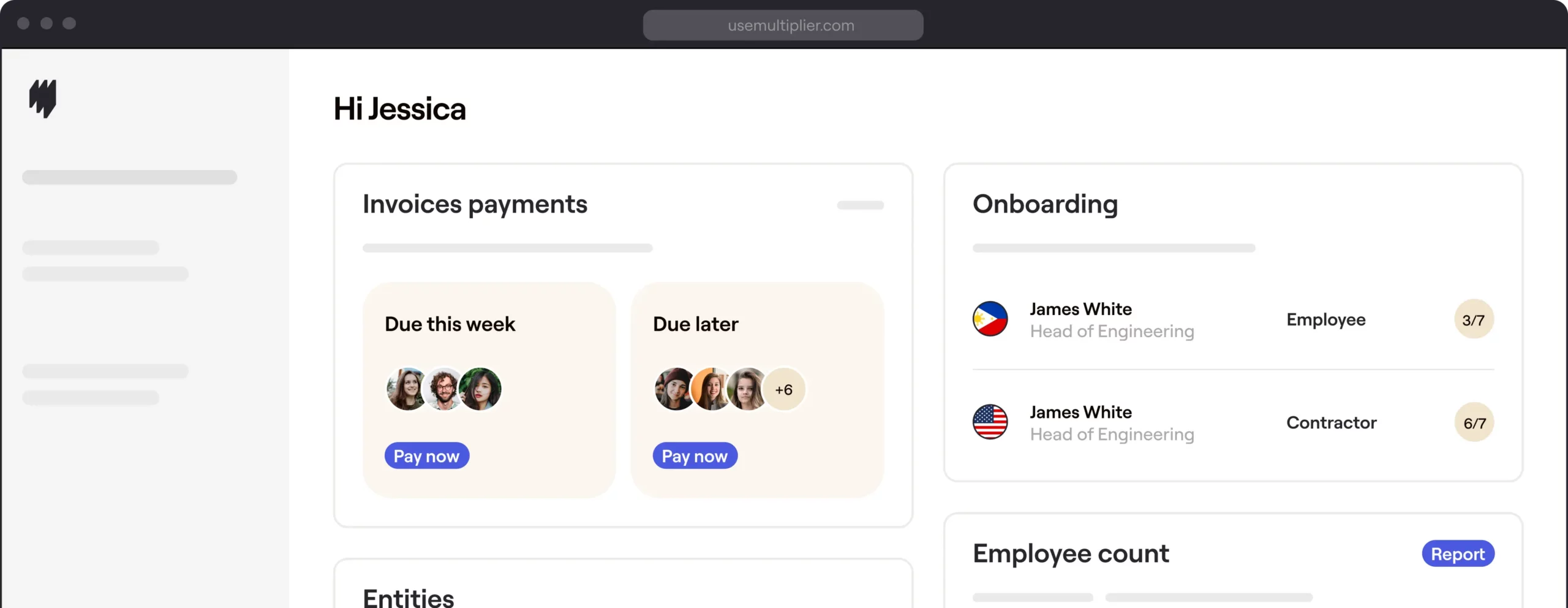
- Centralise payroll, onboarding, attendance, and expenses through one operational system: A central dashboard shows fully burdened cost per employee across all Australian states with headcount scales to every other market without adding operational complexity
- Onboard employees with transparent pricing: Because Multiplier owns the entities directly, there is no entity setup or partner coordination: Onboarding moves in as little as 48 hours
Unlike other EOR providers, Multiplier’s Employer of Record infrastructure is built on owned legal entities, native payroll engines, and in-house compliance expertise operating as one unified system.
Because every layer is owned and operated directly, not coordinated through third-party partners, there is a single chain of accountability for every hire, every payroll run, and every compliance obligation in Australia.
FAQs
How much does it cost to employ someone in Australia?
The total cost of employing someone in Australia is typically 1.25x to 1.40x their base salary. For an AUD $100,000 employee, that means a total annual employer cost of approximately AUD $117,000 to AUD $140,000 once superannuation, workers' compensation, leave entitlements, and standard benefits are included. First-year costs are higher when recruitment fees and onboarding are factored in.
What is the superannuation rate in Australia for 2026?
The Superannuation Guarantee rate is 12% of each eligible employee's ordinary time earnings for the 2025/26 financial year. This is the final legislated rate increase. From 1 July 2026, the Payday Super reform requires superannuation to be paid on each payday and received by the employee's fund within seven days, replacing the previous quarterly payment cycle.
What is state payroll tax in Australia and when does it apply?
State payroll tax is a state-administered tax on employer wages above a set annual threshold. Thresholds and rates differ by state: NSW charges 5.45% above AUD $1.2 million, Victoria 4.85% above AUD $900,000, and Queensland 4.75% above AUD $1.3 million. Employers must register in each state where they have employees and exceed that state's threshold. For international companies with small initial headcounts, the threshold may not be triggered immediately, but liability grows as headcount scales.
What are the minimum leave entitlements for employees in Australia?
Under the National Employment Standards, full-time employees are entitled to four weeks of paid annual leave per year, 10 days of paid personal and carer's leave, and up to 52 weeks of unpaid parental leave after 12 months of service. Leave loading of 17.5% applies under many modern awards when annual leave is taken. Long service leave accrues after seven to ten years of continuous employment, with rates varying by state.
How does hiring in Sydney compare to other Australian cities in terms of employer cost?
Sydney salaries run approximately 9% above the national median for professional roles according to Robert Half's 2026 Salary Guide, with Perth at a similar premium. NSW also has one of the higher payroll tax rates at 5.45%, though the AUD $1.2 million threshold means small teams may not trigger it immediately. Brisbane and Adelaide offer strong professional talent at lower base salaries and higher payroll tax thresholds, making them worth considering for remote-compatible roles.
Book a demo with Multiplier to get a clear picture of your Australia employer costs and start hiring with full compliance certainty.