Over $200 billion in wages cross borders every year. But unlike capital or goods, global work has never had a true exchange — a shared system of rules, ownership, and accountability that makes it safe to transact at scale.
Leaders are hiring right into that gap, right in the middle of unprecedented uncertainty. AI talent is hard to find with increasingly more complex mobility needs. Immigration law is more tightly enforced than ever. And regulatory environments have grown so varied that nearly half of companies have already failed to onboard a global hire.
These aren’t separate problems. They’re part of one – global hiring has outgrown the infrastructure built to support it.
Multiplier built the Global Exchange for Work to close this gap: infrastructure for global employment, built the way stock exchanges and payment networks are built — shared rules, owned infrastructure, one chain of accountability.
Evolving beyond Employer of Record
In under a decade, the explosion of the Employer of Record (EOR) market has permanently reset the rules of global hiring. Countries’ economies are more interconnected than ever before. Companies can spin up teams across a dozen markets in the time it once took to hire a single overseas employee. And talent can land roles with companies they’d never have reached from their home market because the red tape that used to make hiring global talent slow, expensive, and risky has given way.
Today though, that system bends under the pressure of scale and regulatory scrutiny. Traditional EORs have been slow to evolve the model beyond borrowed infrastructure. And just 8% of companies report full confidence in their compliance, according to Multiplier, leaving 92% exposed to compounding risk as they scale.
It’s time to build the global hiring infrastructure that finally closes the gap between opportunity and operational reality.
Think of the way Stripe didn’t build a better bank. They built the infrastructure that made a trusted exchange possible at scale. The Global Exchange for Work does the same for global employment.
Most EOR providers share the same features — and the same infrastructure debt
Global employment today runs on borrowed infrastructure. But it’s a compounding risk. As Sagar Khatri, CEO at Multiplier, puts it: “If you don’t own your infrastructure, you’re paying somebody to use theirs.”
In our Global Hiring Gap report, more than half of companies told us that managing multiple vendors is one of their biggest payroll challenges, a direct consequence of infrastructure they don’t own.
When hiring infrastructure is built as an afterthought, every hire introduces new variables and complexity. Standard EORs coordinate global hiring through third-party partners and local vendor networks they don’t own, which means that when something goes wrong, the chain of responsibility breaks down and the legal burden lands on your doorstep.
For example, if the payroll process for France and Spain look completely different, mistakes in one country mean some employees get paid, while others don’t. Or worse, if a partner is delayed in complying with a new payroll or statutory requirement past a key deadline, your company bears the risk.
This is a significant challenge for the CFO trying to control costs after a hefty fine lands on their balance sheet, or for the CEO entering a new market, now with additional awareness of risk.
That risk can look like:
- Fragmented support: When something goes wrong, local partners point fingers, and the burden of accountability falls on you.
- Operational blind spots, inconsistencies, and errors: The more removed a process or a partner is, the more likely it is to be prone to mistakes and inconsistencies, especially across jurisdictions.
- Payroll inconsistency: Not all payroll partners are the same. Leaving payroll up to chance or a local vendor can mean that payday only runs as smoothly as your subprocessor can manage.
- Compliance exposure: Laws and regulations change every day in different jurisdictions. Without trustworthy experts managing these changes closely, compliance risk can land at your doorstep quickly.
- Forced bundling instead of integrated solutions: Global hiring tools, platforms, and partners that don’t integrate or communicate leave you with blind spots that create costly compliance risks.
Standard EOR features can gloss over these operational realities, settling on industry norms. “If you look at the major providers in the game right now and you compare from a feature perspective, they’re largely similar. There’s really not a significant difference,” says Khatri.
Multiplier is building that difference through stronger infrastructure that puts trust and accountability back into global employment.
So, what is Multiplier’s Global Exchange for Work?
The Global Exchange for Work is Multiplier’s infrastructure model for global employment — built on owned legal entities in 160 countries, native payment rails across 120+ currencies, and a single chain of accountability that replaces the partner-relay model used by most EOR providers.
The Exchange runs on infrastructure and integrations that Multiplier takes full ownership over, creating a unified operational system and a single chain of accountability across every market. “By owning our own infrastructure, we have far more control. We eliminate dependencies. We eliminate third-party risk,” says Sagar Khatri.
That system is built on four layers of architecture:
- Infrastructure — ensuring every global hire is compliant and risk-free. When we hire someone for you in Brazil, we are the employer in Brazil, backed by an in-house legal team tracking regulatory change in every market we operate in. Not a broker coordinating between parties, and not an unseen partner absorbing the risk.
- System of Record — giving you full oversight of your global team’s data, so decisions move as fast as your hiring does. Every market, every employee, every workflow, visible from one place.
- Payments — where money moves freely and safely to your team, worldwide. Payroll runs end-to-end through our own multi-country engine across 120+ currencies. Teams get paid on time, every time, in their local or preferred currency.
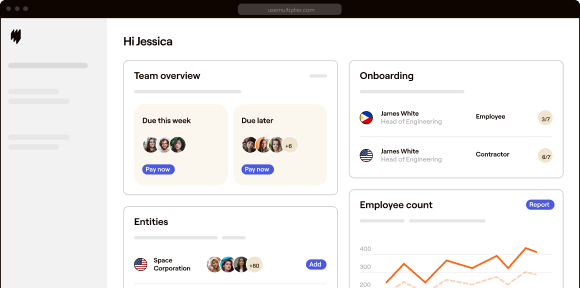
- Product — how your global team easily accesses the exchange. The Multiplier platform connects every layer above into a single interface, so employers can onboard, pay, and manage talent without switching systems.
Together, this architecture promises scale and depth. It empowers you to grow anywhere in the world and stay protected when you get there.
How Multiplier’s Global Exchange for Work solves what EORs can’t
Global employment needs exchange-grade infrastructure — rules, ownership, accountability. Hiring global talent is faster than it has ever been, but the conditions that create risk haven’t gone away.
According to The Global Hiring Gap report by Multiplier, 98% of companies say global hiring is central to their growth strategy, but the infrastructure supporting it is often not ready.
Multiplier was built to address the shaky ground on which traditional EORs are built. Our exchange implements rules of engagement that make transacting safe and profitable, similar to stock and currency exchanges.
In doing so, we’re making global employment accessible in every corner of the world. Businesses of every size can grow and reach their global potential. Ambitious founders can scale empires from any corner of the world despite global uncertainty, and anyone can land a life-changing role without ever leaving home.
Learn more about the Global Exchange for Work here.
FAQs
What is the Global Exchange for Work?
The Global Exchange for Work is the infrastructure layer that makes global employment function like other cross-border markets — with shared rules, owned legal entities, native payment rails, and a single chain of accountability. Built by Multiplier, it connects three participants (companies, talent, and countries) under a unified system where compliance, payments, and risk management are owned end-to-end rather than coordinated across partner networks.
Which companies is the Global Exchange for Work designed for?
Companies whose hiring ambitions are global and whose tolerance for fragmented accountability is not — from Series B startups making their first international hires to enterprises operating across dozens of markets. If your hiring strategy depends on talent that doesn't live where your company is incorporated, the exchange is built for you.
How many countries does the Global Exchange for Work cover?
Multiplier operates owned legal entities in 160+ countries, with native payment rails across 120+ currencies. Coverage isn't the same as country count. The question that matters is whether the infrastructure in each country is owned or relayed; all of Multiplier's coverage is owned.
Is the Global Exchange for Work the same as an Employer of Record?
No. An Employer of Record is a category of service, helping companies employ talent across borders compliantly. The Global Exchange for Work builds on that foundation by connecting employment, payroll, payments, compliance, and mobility into a single infrastructure layer. EOR is one service the exchange enables, alongside the broader systems needed to support global work at scale.
What is infrastructure debt in global employment?
Infrastructure debt is the accumulated risk that builds when companies hire globally through systems they don't own or control. Each new market adds another third-party partner, another compliance regime, and another point of failure, and over time that patchwork creates compounding operational and legal exposure.
How does the Global Exchange for Work differ from traditional EOR in practice?
Traditional EORs coordinate global hiring through networks of local partners and vendors they don't own, which means accountability fragments when something goes wrong. The Global Exchange for Work replaces that relay model with owned legal entities, native payroll engines, in-house compliance expertise, and integrated payments operating as one system under a single chain of accountability.
How does Multiplier's payment engine work across 120+ currencies?
Multiplier runs payroll end-to-end through its own native multi-country engine rather than routing payments through third-party processors in each market. This removes the bottlenecks, inconsistencies, and hidden fees that come with coordinating across disconnected local payroll vendors.