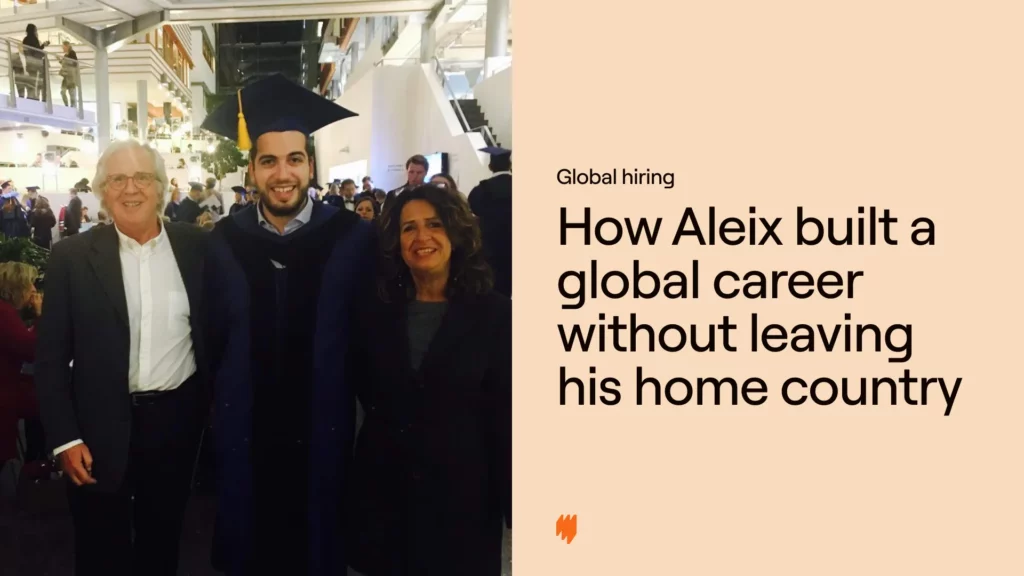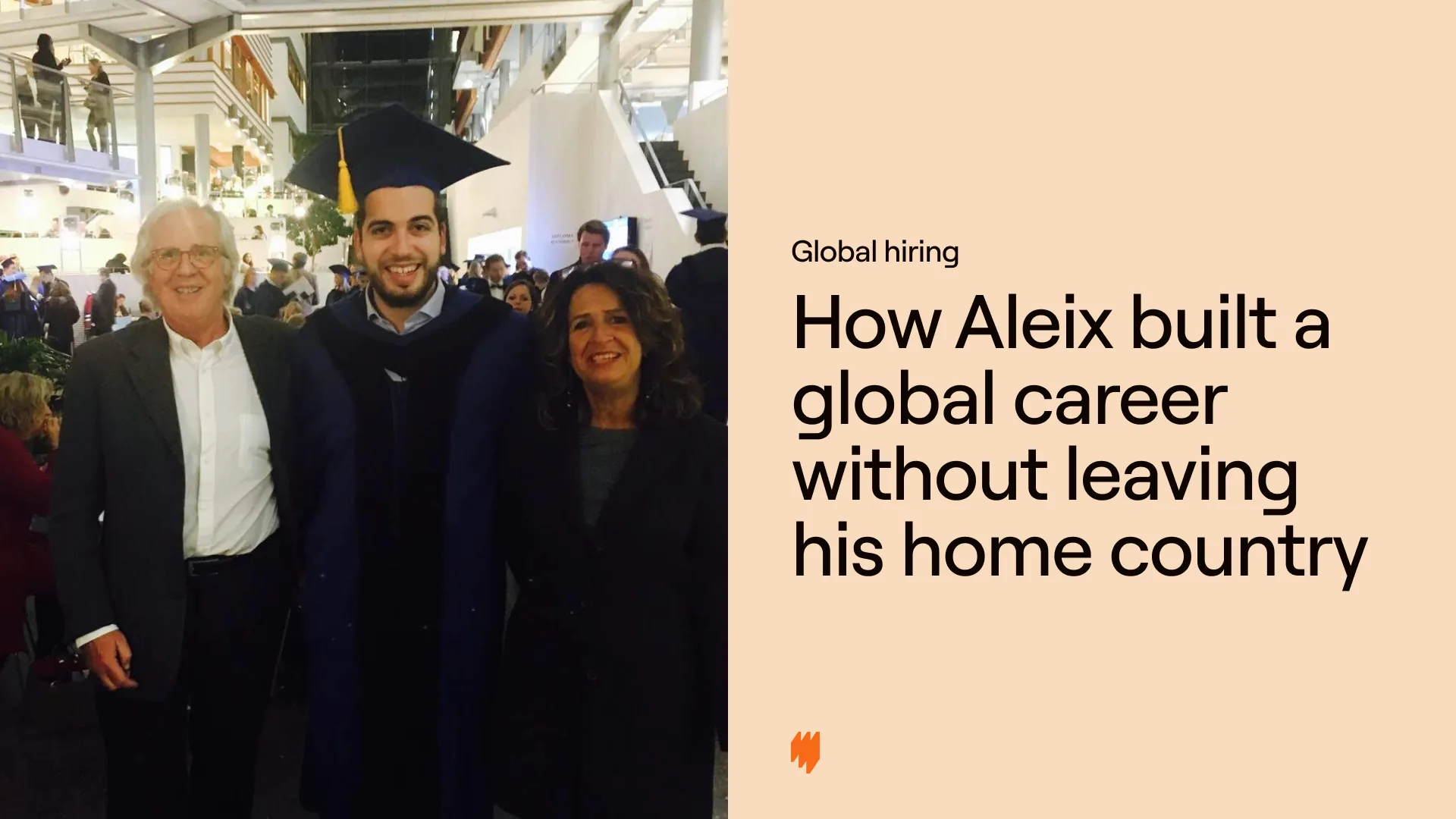
For many people, building an international career means leaving home and heading to New York, London, or another major metropolis. Aleix Rodríguez Brunsoms thought so too. After finishing university in Spain during a youth unemployment crisis that pushed him and many of his peers to look elsewhere, he spent the next decade working across seven countries.
Life eventually brought him back to Spain, and there, he discovered something he hadn’t expected: he didn’t have to choose between the home he loved and the career he’d worked so hard to build. Today, from Mallorca, Aleix leads strategy at Skift, living on his own terms in the country he grew up in.
His story – spotlighted in the first episode of our new docu-series, The Global Thread – shows what’s possible when the forces of global work have no limits. Talent doesn’t have to choose between becoming and belonging, and countries don’t have to lose their best people.
Why Aleix moved abroad for work
Aleix graduated into one of the hardest job markets Spain has seen in recent memory. “There was a quite critical situation in terms of unemployment, especially for the youth,” he said.
Unemployment was particularly high around the 2008 financial crisis, but the situation has only somewhat improved. Spain’s youth unemployment rate is currently 23.4%, higher than the EU average of 15.5%. The tough circumstances that pushed Aleix to leave in search of opportunity are still the reality for many young Spaniards and Europeans today.
Faced with a choice between staying and accepting whatever work he could find, or leaving to build the career of his dreams, Aleix left. Norway was his first stop, and over the next decade, six more countries followed.
The cost of going global without the right infrastructure
A decade later, Aleix moved back to Spain, this time in a global role. But the company he first worked for after returning didn’t have the right infrastructure in place, and he felt the difference immediately.
“So much bureaucracy, like every three months with taxes,” he said. “There was a trade-off between access to this global economy and the bargains that you had to make.”
Without an entity or employment structure to work through, he had no choice but to become a contractor. That meant renegotiating his status every few months, no consistent job security, and managing the tax complexity largely on his own.
It’s a familiar trade-off for anyone who has tried to build an international career without the infrastructure to support it. Access to global opportunity is one thing. Having the stability to actually build a life around it is another. Aleix took the risk anyway, and it paid off, but the arrangement was never sustainable long-term.
The shift from contractor to full-time employee
When Skift, a travel and tourism advisory firm, acquired the company Aleix was working for, they used Multiplier to bring him on as a fully legal, compliant employee. For the first time since returning to Spain, his global role came with real stability.
This arrangement was possible because Skift used Multiplier’s Employer of Record. An EOR lets companies legally employ a worker in their local country, handling compliance, payroll, and benefits so neither the worker nor the company has to navigate that country’s employment law directly.
For Skift, it meant retaining someone whose expertise they’d already invested in. For Aleix, it meant keeping his dream job without giving up stability or constantly managing compliance. “I became on paper a full-time employee with all the job security that that entails,” he remembers.
The value of a global team
Aleix’s career journey with Skift reshaped how he saw the world. Asked whether working within a fully Spanish team would have meant missing out on anything, he didn’t hesitate. “I would have missed the great opportunity to have more emotional intelligence, more empathy,” he said. “I would just see the world in the way that I assume it is, given one culture, one way of seeing it.”
That shift in perspective tracks with the team he works in today. Skift’s ten-person strategy group spans six nationalities across Canada, the US, the UAE, India, South Africa, and Spain. It’s a truly diverse, international team, and Aleix is clear about what it means for the business. “I don’t think Skift could be the company that we are without having a global workforce,” he said.
A single-culture team sees problems through one shared lens by default. A team built across cultures brings multiple frames to the same decision, and for Aleix, that difference is a clear business advantage.
Why companies go global for specialized talent
Aleix’s experience points to something bigger than his own career. Specialized expertise is increasingly hard to find in any single local market, and companies are responding by widening their search.
“If we were limited to hire in a single location, we wouldn’t be able to find the diversity and breadth of profiles that we need to do our work,” Aleix said. This challenge is well-known and widespread. According to Multiplier’s Global Hiring Trends report, 46% of companies are now hiring abroad specifically in search of AI skills, a clear sign that employers care more about specialized knowledge than geography.
It’s also, to some extent, a numbers game. A company searching only within its home city draws from a small, fixed slice of a much larger global pool. Widening that search gives companies access to the specific expertise they need, wherever that expertise happens to live, and lets them hire the best person for the job rather than the best person within driving distance.
The life this made possible
All of this, the global team, the specialized work, the stability that came with it, adds up to something simple: Aleix gets to live exactly where he wants to live.
From Mallorca, he closes his laptop and he’s by the sea. His family is nearby. The career he built across seven countries now runs from the island he grew up on, and none of it required him to choose between the two.
“It means that I don’t have to like any trade-offs between belonging to the place where my family lives,” he said, “and becoming the professional I want to be.” For most of the past decade, that sentence would have described two separate lives. For Aleix, global infrastructure closed the gap between them.
How Spain benefits from remote work
Aleix’s return tells the other half of the story. Global workers’ home countries also benefit when talent comes back, or never has to leave in the first place.
Between 2007 and 2017, in the years following the financial crisis, 87,000 highly skilled workers left Spain, with around 70% citing a lack of opportunity or better wages elsewhere. When skilled Spanish workers tap into remote opportunities rather than moving abroad, Spain benefits. “Being able to capitalize on that foreign talent while being employed here in Spain, that itself is a source of revenue which boosts economic growth,” Aleix explains.
Global work also keeps the economic activity that talent generates inside the country. When skilled professionals can build international careers without relocating, the income, spending, and networks that used to leave with them stay local too. “It’s also the business community and entrepreneurship that comes with that,” Aleix explains. “It attracts global businesses to Spain. It’s like a domino effect.”
A world without limits
Aleix believes global work is the future and that everyone should have the right to pursue their dream career without having to move away if they don’t want to. “It should be a right, to be honest,” he said, reflecting on what global work has given him.
Asked what a world without limits means to him, his answer was clear: “The right to be anyone from anywhere so that you can do literally anything and expand your horizons in any direction that you want. It’s a source of happiness, at least to me, and I believe it’s the future.”
Multiplier directly supports this shift. As the Global Exchange for Work, Multiplier opens the world to companies. Our infrastructure – made up of owned entities across 160+ countries, in-house legal experts, automated compliance, and native payment rails – empowers companies to hire, manage, and pay talent anywhere. It gives talent like Aleix a way to build a global career without leaving home behind.
To hear Aleix’s complete story, watch the full episode of The Global Thread.
FAQs
Does building an international career always mean relocating?
You can build an international career without moving abroad. Professionals can work for global companies while living in their home country, as Aleix does from Spain while working for Skift. The employer simply needs the right infrastructure in place, usually an EOR.
Why are companies increasingly hiring talent abroad?
Specialized expertise is often scarce in any single local market. According to Multiplier's Global Hiring Trends report, 46% of companies are now hiring abroad specifically in search of AI skills, part of a broader shift toward skill-driven, rather than cost-driven, global hiring.
What is an Employer of Record, and why does it matter for global careers?
An Employer of Record (EOR) is a third party that legally employs a worker on a company's behalf in their local country, handling compliance, payroll, and benefits. For workers like Aleix, it replaces the instability of contractor status with real job security, without either party needing to set up a local legal entity.
What does global talent mobility mean for a country like Spain?
When skilled professionals can build international careers without leaving, countries retain the income, spending, and business activity that talent generates, rather than losing it to emigration. Spain's own brain drain, roughly 87,000 skilled workers between 2007 and 2017 according to CEPS, illustrates what's at stake when that talent doesn't stay.