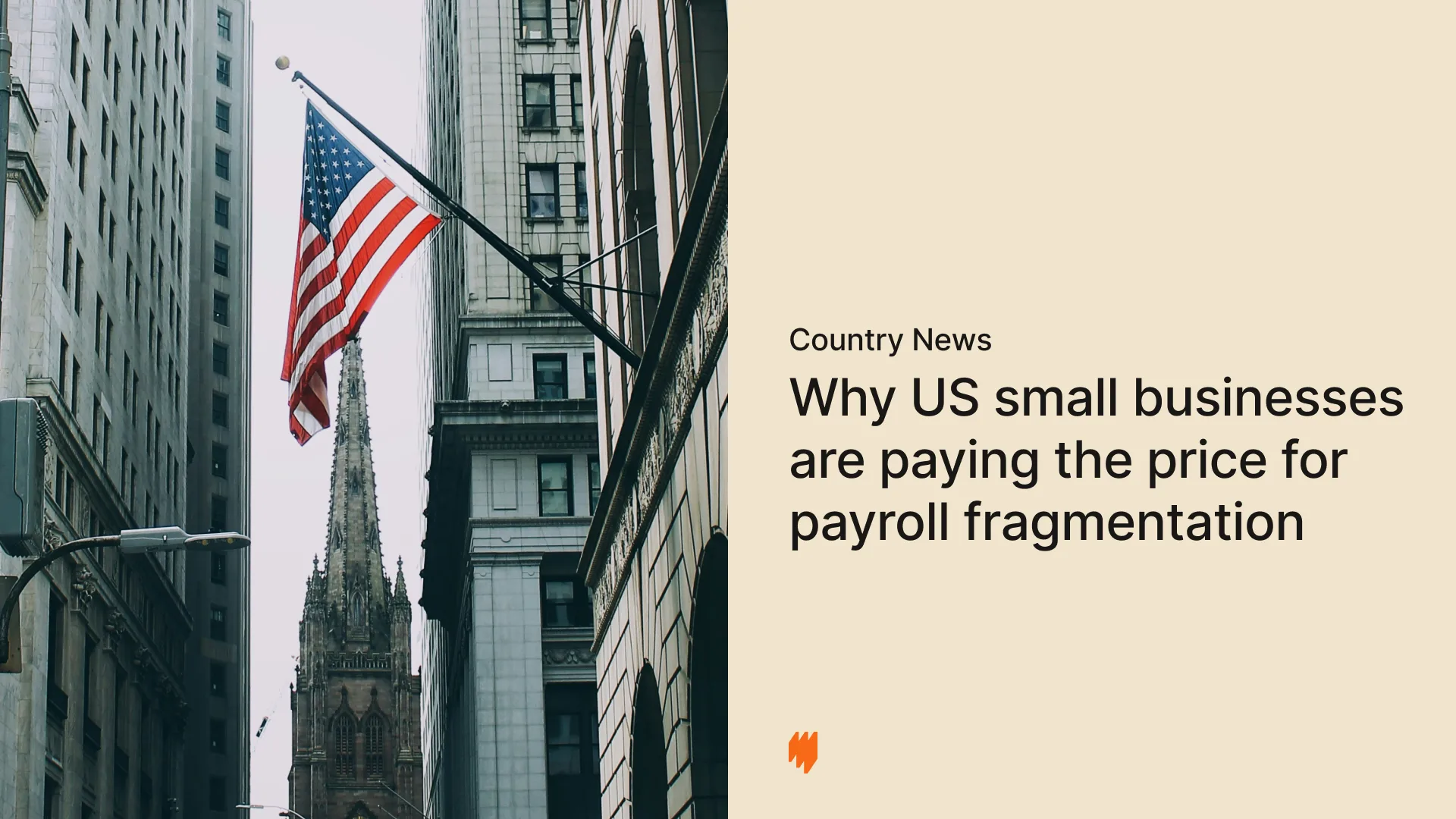
The first international hire is usually the easy one because there’s one market, one vendor, and one set of local rules. But by the third or fourth market, that approach starts to feel the strain of each new country running on its own playbook. This is what’s known as patchwork payroll.
This fragmentation has consequences, whether it’s fines and back taxes, or being forced to resciend an offer because the company can’t meet its compliance obligations on time.
Here’s a look at how this plays out, based on insights from our recent report The Global Talent Squeeze and the lived experience of two CEOs.
The patchwork payroll problem
Patchwork payroll is what happens when a growing business ends up running international payroll through a mix of disconnected vendors and tools, each covering a different market.
It’s a form of decentralized payroll, where every market operates independently with no single system or owner accountable for the whole picture, as opposed to centralized payroll, where one provider or platform handles every market under one system.
57% of US small businesses say coordinating multiple payroll vendors or platforms is a top challenge when paying international employees. Every new market adds another system to manage, payroll tax regulations to comply with, and another set of numbers to reconcile.
Chris Sorensen, CEO of PhoneBurner and ARMOR, has seen this firsthand while growing his teams internationally: “Behind the scenes you’re dealing with different payroll providers, regulations, and timelines. That creates way more moving pieces than most companies expect. It’s not usually one big issue, but a few dozen small ones: holidays are different, payment schedules might be different, tax rules are different. None of them are impossible on their own, but together they take more time than people plan for.”
The way most small businesses are set up to hire internationally works for a market or two, and starts to break down past that.
Why payroll gets fragmented
Payroll fragmentation tends to trace back to three connected patterns.
The first is capacity. Fewer than 20% of small businesses have a dedicated HR leader, which means payroll, benefits, and global hiring usually land on someone else, like a busy founder or COO.
An HR person has the bandwidth to evaluate a new market properly before signing on with a vendor. Someone juggling five other priorities is more likely to reach for whatever solves the immediate problem and deal with the consequences later.
The second is the contractor trap. Treating international hires as contractors or freelancers feels like the simplest way to expand into a new market. There’s no entity to set up, and no employment obligations to navigate. That’s part of why 92% of small businesses use international contingent workers.
But misclassifying a full-time employee as a contractor carries real legal risk, and where that line sits varies significantly from country to country.
Daniel Yeromka, CEO of HostZealot, a Chicago-based IT and hosting company, learned this the hard way: “Local authorities labeled one of our contractors as working a full-time job. A new policy forced us to pay back taxes and huge fines for withholding penalties.”
The third is visibility, or the lack of it. 58% of small businesses report lacking visibility over international hiring spend and workforce data, largely because their systems don’t talk to each other. When payroll runs through five different vendors, there is no way to pull a single, accurate view of global spend.
Together, these three patterns produce something close to a “we can get away with it” mindset. That works fine at a small scale, right up until it doesn’t, which is a large part of why 82% of small businesses have already failed, or expect to fail, to onboard a global hire due to compliance issues.
How to consolidate your payroll stack
The fix is to work with a payroll provider that owns its infrastructure directly in each market. Direct ownership means one compliance owner accountable for that market’s rules, and a local team member who can quickly solve any issues that come up. No middlemen or intermediaries.
That’s what Multiplier does, and it works. Payroll accuracy rate is 99.95%, and for the other 0.05% of the time, it’s clear who’s accountable. If there’s a payroll issue in the Netherlands, a Multiplier team member in the Netherlands owns it.
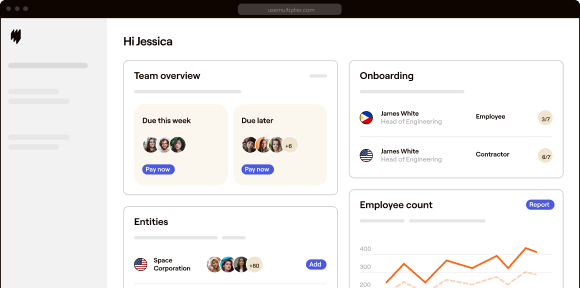
The other half of the fix is visibility. The Multiplier platform syncs natively with HR platforms like Workday and BambooHR. Instead of workforce data scattered across various systems, finance and HR leaders get one single view of global activity.
Daniel’s experience points to the same conclusion: “The problem appeared during our first few expansions because of the complexity of the tax code and reporting requirements. We decided to use EOR services to overcome it. My advice would be not to try to manage international compliance through simple bank transfers and contractor agreements. An EOR or legal counsel works better and costs less than paying endless fines and back taxes.”
Chris emphasizes getting a handle on this early: “Don’t treat payroll as something you’ll figure out later. Spend time upfront choosing partners and processes that can actually grow with you. It’s a lot easier to build the right foundation than to rebuild it once you’ve hired people in a few different countries.”
Close the gap before it compounds
Patchwork payroll rarely feels like a problem while a business is only operating in one or two markets. But after the third or fourth, cracks start to show.
Small businesses that get ahead of this are those that recognize fragmentation as a structural issue and consolidate before it compounds, rather than waiting for a failed onboarding or a compliance gap to force the decision.
For the full breakdown on how globalization, AI, and compliance are affecting US small businesses, read The Global Talent Squeeze.
FAQs
What is patchwork payroll?
Patchwork payroll is what happens when a growing business runs international payroll through a mix of disconnected vendors. Each covers a different market with its own systems, cutoff dates, and reconciliation process, with no single owner accountable for the whole picture.
Why do small businesses rely on international contractors instead of employees?
Hiring someone as a contractor feels like the simplest way into a new market, since it avoids setting up a local entity or taking on employment obligations. But misclassifying a full-time employee as a contractor carries real legal risk, and the line between the two varies by country.
How does an Employer of Record (EOR) help with payroll fragmentation?
An EOR legally employs workers on a company's behalf in markets where that company doesn't have its own entity, consolidating payroll, tax, and compliance for that market under one provider instead of a separate local vendor.
What makes Multiplier's approach different from other global payroll providers?
Multiplier owns its local legal entity infrastructure directly, rather than routing execution through third-party partners. That ownership is what supports a 99.95% payroll accuracy rate and gives businesses one compliance owner per market instead of a chain of intermediaries.