Uganda: paving the way for business in East Africa
Uganda offers a unique gateway to East Africa, combining accessible business processes with untapped market potential for forward-thinking companies. Its straightforward company registration process, tax incentives, and support from the Uganda Registration Services Bureau (URSB) make it an attractive destination for companies seeking to expand. Uganda offers a unique blend of simplicity and growth potential, giving you the freedom to establish and scale in one of Africa’s most dynamic markets.
The business benefits of registering your company in Uganda
Uganda provides a range of advantages for businesses seeking to establish a presence in East Africa. Its pro-business policies, simplified registration process, and strategic regional position make it an attractive choice for companies.
Here’s why Uganda is an excellent choice for expanding your business:
- Access a growing market with Uganda’s expanding consumer base and its role as a gateway to the East African Community (EAC).
- Streamline your registration process with simplified steps supported by the Uganda Registration Services Bureau (URSB).
- Take advantage of tax incentives such as exemptions and tax holidays for key sectors like agriculture and manufacturing.
- Reduce costs with affordable operations, making it easier to establish and scale your business.
- Leverage regional connectivity through Uganda’s central location, enabling access to major African markets.
- Navigate with a supportive regulatory framework, backed by clear legal requirements and resources for startups and enterprises.
Uganda offers a promising, low-risk entry point into the African market for businesses ready to expand their reach.
Next, we’ll explore the available options for registering a company in Uganda, including direct registration and Employer of Record (EOR) solutions, to help you decide what works best for your goals.
A step-by-step guide to registering a company in Uganda
Uganda offers a straightforward registration process, supported by the Uganda Registration Services Bureau (URSB). Follow these steps to establish your business efficiently:
Step 1: Choose your business structure and name
Establishing a legal entity in Uganda can be a lengthy and challenging endeavor, often requiring careful navigation of complex regulatory and administrative hurdles. However, partnering with an EOR lets you bypass these complexities and start operations immediately.
An EOR serves as your official employer in Uganda, managing key functions such as recruitment, onboarding, payroll, tax compliance, and adherence to local labor laws. With these responsibilities off your plate, you can direct your energy toward expanding your business, while the EOR handles the backend operations.
For businesses opting to establish their own entity, selecting the right business structure is a critical step. This decision shapes your legal responsibilities, tax obligations, and the operational flexibility of your organization in Uganda, setting the stage for long-term success.
- Private Limited Company (Ltd): Ideal for small to medium-sized businesses, providing limited liability for shareholders.
- Public Limited Company (PLC): Suitable for larger companies planning to raise capital through public offerings.
- Sole Proprietorship: A simple option for individual entrepreneurs, though it involves unlimited personal liability.
Ensure your business name is unique and adheres to URSB’s guidelines. You can verify name availability through the URSB’s online portal.
Step 2: How to register a company in Uganda through URSB
Uganda Registration Services Bureau (URSB) is the point of entry for any business that wishes to operate in the country legally. If you’re still unsure about how to register a company in Uganda, the URSB process makes it fairly straightforward once you’ve gathered all required documents. So, simply start with:
Name reservation
Start by brainstorming three unique business names in case your preferred choice is unavailable. Once you have your shortlist, submit it for a name search and reservation. This can be done either:
- Online via the URSB portal
- In person at any URSB office, the Uganda Investment Authority One Stop Centre, or even the Uganda Bookshop
After this approval, the name is reserved for 30 days, after which you need to complete the remaining registration steps.
Documents for local company registration
If you’re registering a Ugandan local company, here’s what you’ll need:
- Form A1 – Statement of Nominal Share Capital
- Form A2 – Declaration of Compliance
- Form 20 – Details of directors and company secretary
- Memorandum and Articles of Association – Outline your company’s governance and objectives
- Directors’ national IDs or passports and passport-sized photos
- Proof of name reservation
Documents for foreign company registration
If your company is already registered abroad but plans to operate in Uganda, you’ll need to register as a foreign company. Required documents include:
- Certified copies of your Memorandum and Articles of Association
- Certificate of Incorporation from your home country
- Form 24, Form 13, Form 25, and Form 26
- Ugandan representative’s ID and company address
- Payment of a registration fee (minimum $470)
Submission and approval
When the documents are prepared, you may submit them either through the eCitizen portal of URSB or at a service desk. Once approval is received, a Certificate of Incorporation will be issued to your company, and you will be registered as a legal entity in Uganda.
Step 3: Obtain a postal address from Posta Uganda
Once your company name has been reserved and your registration paperwork is underway, the next thing you’ll need is a verified postal address. It may sound old-school, but in Uganda, this step still matters, and skipping it will stall your registration.
Every business registered with the URSB must list a formal mailing address. Without it, you won’t be able to file Form 18, which tells the government where your business is based.
The process of getting a postal address is handled by Posta Uganda, the national postal service.
Why is this step necessary?
While many communications today happen online, official government correspondence, especially notices related to compliance, tax, or legal matters, may still arrive by post. Think of your postal box as the company’s official mailbox.
It’s also a requirement for:
- Opening a company bank account
- Receiving business permits and trade licenses
- Getting listed for public tenders
- Keeping your URSB file in good standing
If you plan to hire employees or contractors while you set up locally, you can work with Multiplier to handle employment and compliance from day one.
How to get a postal address?
You can register your company’s postal address in two ways:
Option 1: Online registration (Quick and convenient)
Go to Posta Uganda, the official digital platform of the organization.
Here’s what you’ll need:
- A phone number linked to mobile money
- Your preferred post office location
- Internet access and a few minutes of your time
Once you fill out the form, you’ll receive a payment prompt on your phone. Approve the transaction using your MM PIN, and you’re done. Your new postal box number will be confirmed via SMS.
Option 2: In-person at a local post office
Prefer the traditional route? Walk into any Posta Uganda branch and apply at the counter.
Here’s what to carry:
- A copy of your name reservation form or Certificate of Incorporation
- Your identification (national ID or passport)
- Payment (cash or Mobile Money)
You’ll be assigned a postal box on the spot or given a collection time. Don’t forget to ask for the official stamp, URSB needs this when you submit Form 18.
Understanding the cost of registering a company in Uganda
Postal address fees vary depending on the type of business and location:
Business Type | Annual Fee (UGX) |
Registered company (Kampala) | 90,000 |
Registered company (Upcountry) | 60,000 |
Small businesses, shops, individuals | 20,000 |
Keep the receipt. You’ll need to show proof of payment during other stages of registration.
What happens after you register?
Once you’ve secured your postal box and received your confirmation, the next step is to complete Form 18 from URSB. This form captures the company’s physical and mailing address, and must be stamped by Posta Uganda to be considered valid.
No stamp = no certificate of incorporation.
A note for international companies
If you’re setting up a branch in Uganda from another country and don’t yet have a local office, this step might feel like a roadblock. That’s where services like Multiplier’s entity-free hiring solution can help. While you’re setting up your infrastructure, we make it possible to hire employees or contractors legally and pay them compliantly, without needing a local postal box right away.
Step 4: Obtain a Tax Identification Number (TIN)
Tax Identification Number (TIN) is one that is required by the Uganda Revenue Authority (URA) and has to be obtained by all businesses and directors.
Where and how to apply?
TIN applications are processed online via the URA portal. There are two types of TINs:
- Individual (for directors or sole proprietors)
- Non-individual (for companies)
Make sure you have Microsoft Excel installed, as some forms are uploaded in Excel format.
Requirements for non-individual TIN
- Company Certificate of Incorporation
- Form 20
- Contact details (phone, email, physical address)
- Directors’ individual TINs
- Company bank account details
- A referee with an active TIN
Processing typically takes 1–3 business days. Once approved, you’ll receive your TIN via email, allowing you to open a bank account and meet tax obligations.
Step 5: Apply for an investment license (Optional)
In case you intend to invest heavily in Uganda, then obtaining an investment license at the Uganda Investment Authority (UIA) may provide additional benefits as follows:
- Tax incentives
- Quicker access to business visas or work permits
- Easier access to land for industrial use
Minimum investment thresholds
- Local Investors: $50,000
- Foreign Investors: $250,000
Required documents
- Certificate of Incorporation
- Company TIN
- Brief business proposal (at least five pages)
- Bank statement or proof of financing
- Proof of location (e.g., tenancy agreement)
- Shareholder IDs or passports
Fill out a form via the UIA portal. This is an optional step, but it is highly advised by businesses in the manufacturing, infrastructure, and logistics industries.
Step 6: Obtain a trading license
In order to trade within any Ugandan jurisdiction, one has to obtain a license to trade with the state authority, KCCA in Kampala, or municipal local bodies in other jurisdictions.
Application steps
- Fill out a trading license application form (available online via the KCCA website or at your local authority)
- Submit supporting documents:
- Certificate of Incorporation
- Company TIN
- Lease or tenancy agreement
- Memorandum and Articles of Association
A city inspector may visit your business location to verify compliance and assess applicable fees. Once approved and paid, your trading license is issued, valid for one year.
Step 7: Register with the National Social Security Fund (NSSF)
It is not only a box-ticking exercise. NSSF Compliance is very critical to:
- Developing staff loyalty and getting competent applicants
- Obtaining the right to some of the contracts or governmental tenders
- Evading rules, fines, inspections, or deal shutdowns
- It is important to ensure that your employees are long-term financially safe.
Contribution breakdown
In Uganda, the employers and employees are required to make monthly contributions to the NSSF as per law.
This is how it works:
- Employer:10% of the employee’s gross monthly salary
- Employee Contribution: 5%, this percentage comes out of the employee’s salary
How to register with NSSF
The process of registering with NSSF has become easier in recent years, thanks to the digital systems introduced by the fund.
Here’s a step-by-step guide:
- Visit the NSSF website and click on “Employer Registration”.
- Use the OctoPas portal: Designed to streamline employer registration and monthly contributions. You’ll be guided through:
- Creating an employer account
- Submitting company registration details (including your URSB and URA documents)
- Adding employee details, including names, national IDs, and salary info
- Submit monthly returns: Once registered, you’ll be able to upload your monthly NSSF returns through the same portal. You can do this using the Excel templates provided by NSSF, which are filled out and uploaded online.
- Make payments electronically: After submitting your returns, you’ll receive a payment reference number. Contributions can be made via bank transfer or mobile banking, depending on the payment partner.
- Receive acknowledgment: After successful payment, NSSF sends a confirmation acknowledging receipt of funds and updating employee accounts.
Helpful resources
To make things even easier, NSSF has produced a series of video guides on how to:
- Register your company
- Submit employee contributions
- Generate payment numbers
- Manage your employer profile
These are available for free on NSSF Uganda’s official YouTube channel.
Step 8: Make a company seal
According to Ugandan law, each one of the registered companies should be issued with an official company seal with the name engraved on the company seal. This is under Section 117(b) of the Companies Act, 2012.
The seal is used to:
- Authenticate contracts and legal documents
- Sign powers of attorney
- Approve board resolutions
While it may seem old-fashioned, this embossed metal stamp is still essential for official transactions. You can get one made at a licensed legal stationery provider or URSB-approved vendor.
Step 9: Register power of attorney (If applicable)
If your business involves delegating tasks to individuals, especially those not listed as directors, you’ll need to register a Power of Attorney (POA).
This is particularly common for:
- Government tenders
- International transactions
- Acting on behalf of a foreign company
The POA must be:
- Drafted by a legal practitioner
- Authenticated using your company seal
- Registered at URSB to be legally recognized
This step makes sure that any person acting on your behalf does so with full legal authority.
Step 10: Register with PPDA
To provide goods or services to any government ministry or department, you have to apply to be registered by the Public Procurement and Disposal of Public Assets Authority (PPDA).
How to register?
Go to the electronic government procurement (e-GP) site and:
- Create a supplier account
- Complete your profile with company details
Requirements include:
- Certificate of Incorporation
- Trading license
- TIN
- Valid email and phone number
- National ID or passport (for individual providers)
When your company is accepted, it will therefore be on the Register of Providers (RoP) and you are qualified to apply to take any of the government contracts.
Step 11: Register your workplace on OSHMIS
The last step is compliance with workplace safety laws. According to Section 40 of Uganda’s Occupational Safety and Health Act, all companies must notify the Ministry of Gender, Labour and Social Development before operating in any location.
What to do:
- Submit a written notice one month in advance
- Include the workplace location and other particulars outlined in the Act’s Third Schedule
- You can find forms on the Ministry of Gender, Labour and Social Development (MGLSD)
You can suffer the shutdowns or fines in case your workplace is not registered.
What are the options for company registration in Uganda?
Uganda offers two straightforward pathways to establish a business presence, each designed to meet different needs:
Aspect | Legal Entity Registration | Employer of Record (EOR) |
Purpose | Form a registered entity with full operational control. | Hire employees and operate without forming a local entity. |
Control | Provides complete control over business activities and decisions. | Maintains employee oversight while the EOR handles compliance and admin work. |
Compliance | Demands full adherence to Uganda’s registration, tax, and labor laws via URSB and related authorities. | The EOR manages all labor, tax, and legal requirements on your behalf. |
Setup Time | Lengthy process requiring documentation, approvals, and permits. | Fast and efficient, allowing you to hire and operate right away. |
Cost | Includes upfront legal fees, registration charges, and ongoing admin expenses. | Predictable service fees that simplify budgeting and cut setup costs. |
Scalability | Suitable for large-scale, long-term operations requiring a physical footprint. | Highly adaptable for quick workforce scaling and market testing. |
Legal entity registration offers complete control but involves significant administrative responsibilities and higher costs. Alternatively, an Employer of Record (EOR) simplifies your entry into Uganda by managing payroll, compliance, and labor laws — perfect for businesses seeking a fast and flexible way to start operations.
Next, we’ll dive deeper into how an EOR can streamline your onboarding and compliance efforts in Uganda.
How an EOR simplifies company registration in Uganda
Entering the Ugandan market becomes quick and hassle-free with an Employer of Record (EOR). An EOR handles hiring, compliance, and payroll, removing the need to set up a legal entity and simplifying your expansion.
Here’s how an EOR supports your business in Uganda:
- Speeds up entry into Uganda by acting as your legal employer, enabling immediate operations.
- Manages payroll, taxes, and admin, so your team can focus on growth.
- Ensures compliance with Uganda’s labor laws and tax regulations, avoiding penalties.
- Cuts entity setup costs, redirecting resources to key business initiatives.
- Scales your workforce flexibly, adapting to Uganda’s market conditions.
- Simplifies access to Uganda’s talent pool, bypassing onboarding complexities.
- Delivers competitive, compliant benefits to attract and retain top talent.
- Reduces compliance risks, ensuring smooth, confident operations in Uganda.
With an Employer of Record (EOR) handling the heavy lifting of compliance, administration, and local regulations, you can dedicate your energy to expanding your business in Uganda with confidence and efficiency.
Understanding the costs of company registration in Uganda
Before starting your business in Uganda in 2025, it’s essential to understand the costs involved. Here’s a detailed breakdown to help you prepare:
Registration costs
- Business registration fee: Costs range between $30 and $50, depending on the business structure.
- Name reservation fee: A small fee of approximately $5 is required to reserve your company name with the Uganda Registration Services Bureau (URSB).
- Notary and legal fees: Drafting and notarizing required documents may cost between $100 and $300.
- Tax Identification Number (TIN): Issued free of charge by the Uganda Revenue Authority (URA).
Annual maintenance costs
- Trading license renewal: Fees vary by district and business type but typically range from $100 to $300 annually.
- Accounting services: Costs start at $50 per month, depending on the complexity of your business operations.
- Tax filings and compliance: Preparation and filing costs depend on the size of the business, starting at around $500 annually.
- Social security contributions: Employers must contribute 10% of employees’ gross salaries to the National Social Security Fund (NSSF).
Additional considerations
- Sector-specific permits: Businesses in industries like healthcare or manufacturing may incur extra licensing costs.
- Corporate bank account: Initial deposit and monthly fees vary by bank, with an average setup cost of $100.
- Legal retainer services: Ongoing legal support can range from $500 to $2,000 annually.
An employer of record (EOR) helps eliminate unnecessary expenses and administrative responsibilities by handling payroll, taxes, and compliance — all bundled into one straightforward, predictable fee.
Now, let’s compare the costs of traditional company registration with using an EOR.
Comparing costs: Legal entity registration vs. Employer of Record (EOR)
Here’s a comparison of the costs of registering a legal entity and using an EOR:
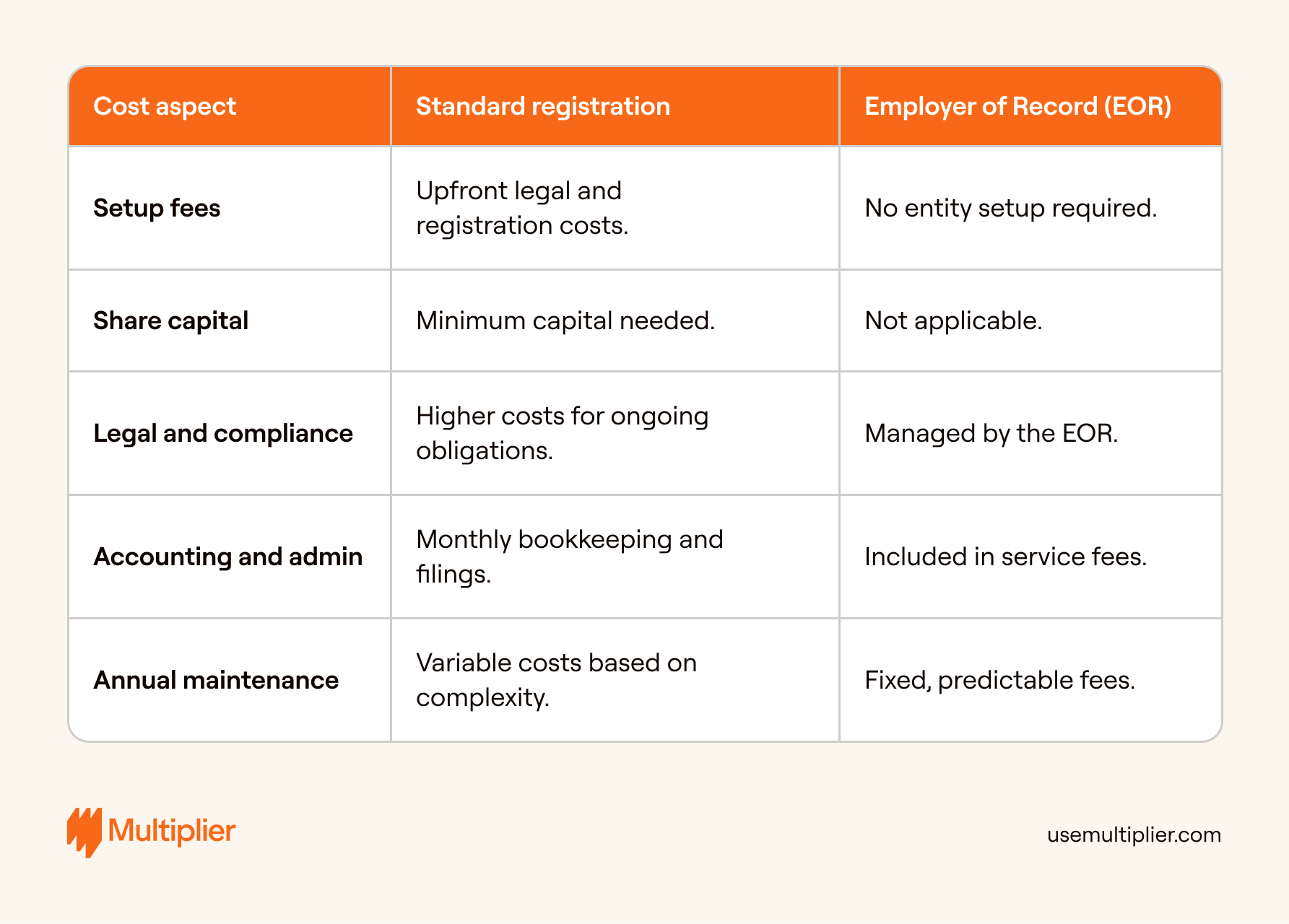
While legal entity registration gives you full control, it comes with higher costs and administrative demands. An EOR simplifies entry by bundling these responsibilities into a single, predictable fee, making it an excellent choice for businesses aiming to enter the market swiftly and efficiently.
Next, we’ll explore how partnering with an EOR can help you streamline business operations in Uganda.
Simplify your Ugandan expansion with Multiplier
Expanding into Uganda is an opportunity to tap into one of East Africa’s most dynamic markets. With Multiplier’s Employer of Record (EOR) service, you can focus on driving your business forward while we handle the complexities of compliance, payroll, and HR administration.
Why Multiplier is your partner of choice for Uganda?
Effortless local onboarding
Seamlessly access Uganda’s skilled and diverse talent pool without navigating the intricacies of local labor laws. From drafting contracts to managing onboarding and compliance, we ensure a smooth process tailored to Uganda’s regulatory environment.
Accurate payroll management
Streamline payroll management in Ugandan Shillings (UGX) or other currencies with absolute precision. Taxes, statutory contributions, and payouts are managed flawlessly, keeping your operations compliant and your employees confident.
Centralized HR Tools
Oversee onboarding, expense approvals, and leave management through a single, intuitive HR platform. Gain full visibility and control over your workforce in Uganda, ensuring efficient operations at every step.
Compliance you can trust
Stay fully aligned with Uganda’s labor laws, tax requirements, and reporting standards. Multiplier’s local expertise mitigates risks, preventing costly errors or disruptions to your business.
Tailored benefits to retain top talent
Offer Uganda’s top talent competitive and compliant benefits packages designed to meet local expectations. From health coverage to retirement contributions, we manage the details, ensuring your employees are supported without adding to your workload.
Reliable support at every turn
With 24/5 dedicated service and enterprise-grade security, you can operate with confidence, knowing your business and data are safeguarded. Whether you’re addressing urgent queries or planning for the future, we’re here to ensure your success in Uganda.
Multiplier takes the hassle out of managing your workforce in Uganda, letting you focus on driving results and scaling your business. With expert compliance, seamless payroll, and a platform designed for deep operational efficiency, we’re your partner in hassle-free growth.
Take the first step toward EOR-supported expansion — Book a demo.