For those engaged in building global teams, 2025 was a turbulent year. From economic volatility to AI disruption to the tightening of borders, companies were forced to adapt their plans more quickly than ever.
2026 doesn’t exactly promise to be any less of a rollercoaster. Building the world-beating global teams necessary to stay competitive next year will require answering the challenges of mobility disruption, fracturing workfaces, and renewed compliance hurdles.
In this article, we share insights from global hiring experts, taking a closer look at the trends to be aware of heading into 2026.
1. Mobility disruption
Global mobility is entering its most transformative phase in a decade, defined by economic shifts, political volatility, and a race among countries and companies to attract high-skill talent. In 2026, successful navigation of mobility disruption will determine which organizations can access, deploy, and retain the world’s best talent.
Talent access challenges
According to Multiplier’s Director of Global Mobility Sonam Haider, global mobility is still feeling the aftershocks of geopolitical instability. “The Middle East crisis created sudden travel issues, evacuations, and shifting visa rules – and while things have stabilized on the surface, the ripple effects are still very present. Add this to the ongoing Russia–Ukraine disruption and the latest U.S. immigration changes like the steep H-1B fee increases, and you can see how governments are reacting quickly to protect their talent pipelines.”
Few policy shifts have been as disruptive as the sharp increase in U.S. H-1B visa fees. The new $100,000 application charge — introduced through executive order — has sent shockwaves through tech ecosystems. Startups, nonprofits, smaller firms, and research organizations warn it will cripple their ability to hire skilled international talent.
As a result, companies are accelerating offshoring strategies, particularly to India. High-end work in AI, product development, and cybersecurity is increasingly being moved to Indian global capability centers (GCCs), with U.S. employers prioritizing stability and cost efficiency.
Governments across Europe, the UK, and Asia are also quietly recalibrating visa frameworks to remain competitive for globally mobile talent. Competition for high-skill workers is sharpening, and 2026 will accelerate that race.
An economic reset

As interest rates decline and the cost of capital falls, companies will regain financial breathing room in 2026: And they’ll use it. 2026 will unlock increased spending power for organizations with the US economy “moving past the high uncertainty phase”. This mood shift will accelerate investment in new markets, new hiring footprints, and larger distributed teams.
The shift is coming at a time when global hiring is becoming easier than ever. As Haider notes: “Governments are modernizing at a pace we didn’t see even five years ago – digital visa platforms, new Schengen systems, and tools like ETIAS are starting to redefine how cases move, how long they take, and how predictable (or not) they become.”
The combination of market sentiment and modernization sets the stage for a boom in more contingent workforces, provided mobility service providers can rise to the challenge.
“Clients expect immigration to feel as seamless as the AI-driven products they use everywhere else,” says Haider. “The push for intuitive, transparent platforms is very real.”
Mobility reality check
According to Haider, in 2026, global mobility teams will face a landscape evolving faster than at any point in recent memory. Success will require:
- Navigating rapid-fire regulatory changes
- Leveraging digital platforms that reduce friction and increase predictability
- Balancing compliance with agility
- Deploying talent across borders with precision and transparency
But while mobility is on the up, 2026 might not herald a true revolution in how workforces are constructed. One report finds little evidence of rapid expansion. Growth is happening, but unevenly and far more slowly than popular narratives suggest. Meanwhile, the World Economic Forum reports that many organizations are delaying hiring and restructuring due to economic uncertainty, with 42% of chief people officers expecting no change in labor market conditions over the next year.
The takeaway: Mobility disruption isn’t yet leading to a fluid, boundaryless talent market. Instead, it’s creating a more selective, strategic, and technologically mediated mobility environment.
2. Creating unity in a distributed workforce
Another of the defining challenges for global organizations in 2026 will be fostering unity across internationally-based teams. As distributed work becomes more and more prevalent as a solution to persistent talent shortages, culture and connection can no longer rely on shared office spaces or incidental interactions. Without these geographic conveniences to fall back on, the next era of global leaders will need better strategies for building cohesion.
But even as they put these in place, other forces are threatening team cohesion. Working out how to integrate AI, dealing with skills mismatches, and stalling talent pipelines are all straining global hiring leaders’ efforts to build unified teams.
AI workflows
2025 saw AI become a commonplace part of the world of work. In 2026, the challenge will be unlocking AI-augmented workflows that reduce uncertainty instead of amplifying it.
Early missteps with generative AI have already produced a wave of “workslop,” as Harvard Business Review describes: Low-quality, automated memos and emails that clutter workflows and undermine productivity. Poorly applied automation becomes a tax on culture.
The primary mistake organizations make is trying to retrofit AI into broken, existing workflows. As our Beyond Borders episode “Reimagining HR in the age of AI” discussed, the right way to leverage AI and reduce uncertainty is to fundamentally redesign processes. Do not use AI simply to automate step X to Y in an existing workflow. Instead, rethink the entire solution from the fundamentals with AI in the picture.
It’s not just a question of using AI the right way, but also normalizing its deployment. Uncertainty is amplified when employees fear AI is meant for job elimination. Leaders must reset this mindset by prioritising productivity, not automation for automation’s sake.
“A lot of people ask me: ‘How is your organization using AI?’” says Multiplier co-founder Vamsi Krishna. “That’s the wrong question to ask. The right question is: ‘How are you empowering your own employees to use AI to become more productive?’”
To successfully leverage AI in 2026, leaders must help their teams overcome the fear of disclosing AI usage. Create safe spaces, like dedicated internal channels, where employees can share discoveries and tools collaboratively, boosting collective productivity.
“If you eliminate fear I’ve seen how impactful it can be,” says Krishna. “My developer team at Multiplier is extremely curious in their experimentation with AI — because they know they’ll always have work to do and products to build. So everyone is very interested and very eager to see how they can speed up the development work, and how they can iterate faster.”
A skills reckoning
But mastering AI can’t come at the expense of nurturing human talent — especially with widening skill gaps appearing as we head into the new year. A DeVry University report highlights a “skills standoff,” where 85% of workers feel confident in their employability even as 69% of employers doubt their workforce readiness. Similarly, a U.S. Chamber of Commerce and College Board study found that 84% of hiring managers believe high school graduates aren’t prepared for work, with 80% saying today’s graduates are less prepared than previous generations.
This skills standoff points directly to the fundamental mismatch between outdated education systems and the demands of the modern global economy. In 2026, employers who can’t find the skills they need will have to make educated bets on finding workers with the right soft skills who can be taught hard skills later down the line.
Prioritizing candidates with traits like communication, problem solving, and comfort with ambiguity helps find people with the versatility required for the modern world of work. “I studied civil engineering, and I started my career as an investment banker”, says Multiplier CEO Sagar Khatri. “Today, I’m the CEO of a software company. Similarly, my co-founder Amrit studied accounting, then he went into HR sales.”
3. Renewed global employment challenges
Finding the right candidates is only half the battle. Global employment will reach a new level of complexity next year thanks to increasingly intricate regulatory, tax, and cultural landscapes. Successfully hiring across borders is fast becoming a practical test of operational maturity. The winners will be the organizations that make global operations simple, even as the world becomes more complicated.
Right now, mastering that complexity is a major operational roadblock. As per Multiplier’s Global hiring gap report, 37% of companies point to compliance complexity as the absolute biggest source of friction in their global hiring operations.
Transparency

Across continents, labor regulation is accelerating faster than most HR or finance teams can keep pace with. Nowhere is this more evident than in the wave of pay transparency laws reshaping employer obligations.
Colorado’s landmark 2021 pay transparency law narrowed the gender wage gap — from women earning 78% of men’s pay in 2021 to 86% in 2025 — demonstrating that stronger reporting requirements can drive measurable progress. In 2026, the global push for transparency is expanding into the EU.
As Johanna Sylvander, Multiplier’s VP of Sales, EMEA, notes: “With the EU Pay Transparency Directive biting from June 2026, any company employing in the EU without a local entity will need formalised, auditable payroll data for their EU staff.”
Unfortunately, many companies are unprepared: Only 47% of employees feel their employers are transparent about compensation. Piecemeal attempts to be more transparent are unlikely to be sufficient to overcome that statistic. Which is where, in 2026, a more comprehensive solution like NRE payroll will come to the fore.
“You can’t show that pay outcomes are structured, comparable, and non-discriminatory if you don’t have a proper payroll footprint,” says Sylvander. “An NRE payroll solution generates compliant local payslips and stores payroll data in a way that can be analysed by role, band, and gender — making it a crucial tool for remaining compliant in 2026.”
The infrastructure of global employment
Companies in 2026 are tasked with simultaneously moving faster, de-risking expansion, and creating a consistent employee experience anywhere in the world. But you can’t rise to that challenge with good intentions alone. That’s why companies operating globally will increasingly turn to integrated infrastructures of Employer of Record (EOR) services, collaboration suites, and learning systems to remove the friction of running a global team.
To keep pace with how work is actually done, organizations need foundations that are purpose-built for global teams: Infrastructure that can scale from a handful of hires to distributed workforces spanning 150+ countries, while keeping contracts, benefits, and payslips locally compliant. Without that backbone, global expansion quickly turns into a maze of entities, fragmented systems, and mounting compliance risk.
These risks have severe real-world consequences. According to Multiplier’s Global hiring gap report, 46% of companies have failed to successfully onboard international talent specifically due to these compliance roadblocks.
Modern global employment infrastructure brings employment, compliance, HR, and payroll together into one coherent operating layer. Instead of juggling multiple vendors and local providers, companies can centralize capabilities in a way that delivers real-time visibility, consistent controls, and a single source of truth for workforce data. With 2026 threatening mounting uncertainty, continuous compliance checks, strong misclassification safeguards, and enterprise-grade security will be vital.
Preparing for 2026
With mobility disruption, workforce cohesion challenges, and incoming regulation changes all becoming more prominent in 2026, the construction of global teams will require more agility than ever.
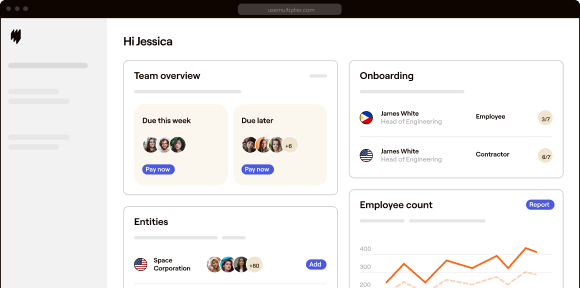
But it’s a challenge worth rising to. The benefits of global teams are within reach provided the right technology is in place. Multiplier is precision-built for hiring, managing, and paying global teams in 150+ countries. We integrate EOR, COR and Global Payroll solutions with world-class compliance and human-first support to bring you the leading Global Teams Platform defining the future of work.