In Guatemala, paying independent contractors involves engaging self-employed individuals who provide services under civil or commercial arrangements, without being classified as employees under the Labor Code. These individuals typically operate under their own name or business entity, register with the Superintendencia de Administración Tributaria (SAT), obtain a Número de Identificación Tributaria (NIT), and issue official electronic invoices (Factura Electrónica en Línea, or FEL) to comply with local tax regulations.
Guatemala has become an increasingly attractive destination for hiring contractors, particularly in sectors such as IT services, customer support, and digital operations. With a growing young workforce, competitive labor costs, and strong proximity to North American markets, the country offers valuable opportunities for businesses seeking flexible talent. The rise of freelancing and independent work arrangements reflects Guatemala’s evolving labor market, where contractor engagement is playing a larger role in economic participation.
Contractors are generally responsible for managing their own tax obligations and may operate under different tax regimes, such as the small taxpayer regime or the general VAT regime, depending on their income level and activity. The Superintendencia de Administración Tributaria (SAT) oversees contractor registration, tax identification (NIT), and invoicing compliance, including the use of Factura Electrónica en Línea (FEL) for formal transactions.
- Paying contractors involves more than simply transferring funds. Businesses must ensure:
- Proper classification of workers to avoid misclassification risks
- Compliance with Guatemalan tax regulations applicable to independent service providers
- Contractors issue valid FEL electronic invoices to support the transaction
- Verification of the contractor’s NIT and active SAT registration status
- Maintenance of compliant contracts and audit-ready documentation
Before initiating payments, companies must confirm that contractors are properly registered with the SAT and hold a valid NIT. If you are still in the onboarding phase, see our guide on hiring contractors in Guatemala. While enforcement may vary, misclassification or non-compliance with tax laws can result in penalties, disallowed expenses, and potential legal exposure.
This guide provides a step-by-step overview of how to pay contractors in Guatemala compliantly, including classification considerations, tax obligations, invoicing through FEL, payment methods, and strategies to reduce compliance risks in cross-border engagements.
What is contractor payroll in Guatemala?
Contractor payroll in Guatemala refers to payments made to independent service providers engaged under civil or commercial agreements rather than employment contracts. Unlike employees, contractors are not covered by Guatemala’s Labor Code and operate as independent taxpayers. They are responsible for registering with the Superintendencia de Administración Tributaria (SAT), issuing compliant electronic invoices, and managing their own tax filings.
Difference between contractors (prestadores de servicios) and employees
Independent contractors in Guatemala must register with the Superintendencia de Administración Tributaria (SAT) and obtain a Número de Identificación Tributaria (NIT), the country’s official tax identification number. They operate independently, either as individuals or registered business entities, and bear full responsibility for their tax obligations.
A legitimate contractor typically:
- Has a valid NIT and active SAT registration
- Issues compliant electronic invoices (Factura Electrónica en Línea — FEL) through the SAT system
- Manages their own work processes and schedule
- May use their own tools and equipment
- Operates independently without subordination or day-to-day control typical of an employment relationship
These factors indicate an independent contractor relationship; however, the key legal criterion in Guatemala is the absence of subordination. Even if a worker is registered with the SAT and issues invoices, they may still be classified as an employee if an employment relationship exists in practice.
Employees, by contrast, work under employer direction, with defined schedules and supervision structures as established in Guatemala’s Labor Code. They are entitled to statutory protections, including severance, social security enrollment, and paid leave, which do not apply to independent contractors.
Key compliance checks before paying contractors in Guatemala
Run through this checklist before processing any contractor payment. Gaps here can result in audit findings, rejected deductions, and financial penalties.
- Verify classification: Confirm the contractor operates independently under a commercial arrangement. Guatemala does not have a highly detailed statutory test for independent contractors; instead, authorities assess the actual working relationship to determine whether employment obligations apply, with particular focus on the presence or absence of subordination.
- Tax identity: Request proof of the contractor’s NIT and confirm active registration with the SAT. The Registro Tributario Unificado (RTU) can be used to verify the contractor’s tax status before payment.
- FEL invoice validation: Confirm receipt of a valid Factura Electrónica en Línea (FEL) before releasing funds. SAT generally requires electronic invoicing for professional service transactions, and payments without proper supporting documentation may be challenged as deductible business expenses.
- Payment traceability and compliance: Use formal, traceable payment methods such as bank transfers or reputable financial platforms, and ensure the contractor is properly registered with the SAT. This helps reduce audit and compliance risk.
- Recordkeeping: Retain signed service agreements, FEL invoices, proof of payment, and contractor SAT details for at least four years (commonly extended to five years as a best practice), in line with Guatemalan tax record retention requirements.
Missing any of these steps creates audit risk. Treat this checklist as a pre-payment control, not an optional review.
Paying contractors compliantly in Guatemala: Key considerations
Contractor payment in Guatemala can be made via local bank transfer, international wire, or digital payment platforms. While payments may be denominated in Guatemalan Quetzales (GTQ) or USD, with the currency specified in the service agreement, they must align with SAT’s invoice documentation requirements under the FEL system.
Before any payment is released, businesses must collect a valid FEL invoice, confirm the contractor’s NIT, and verify that the invoice reflects the correct service description, payment amount, and applicable tax breakdown.
Legal classification rules in Guatemala
In practice, Guatemala applies a substance-over-form approach to worker classification. Authorities look beyond the written contract and assess the actual working relationship, with particular emphasis on the presence or absence of subordination.
Key factors considered include:
- The degree of company control over how work is performed
- Work scheduling and supervision structures
- Who supplies the tools or equipment
- Whether the individual is economically dependent on a single client
- The extent to which the individual is integrated into the company’s core operations
If the working relationship reflects characteristics of employment, such as fixed working hours, ongoing supervision, exclusivity, and operational integration, authorities may reclassify the arrangement as an employment relationship.
While Guatemala does not have a highly prescriptive statutory test for independent contractors, authorities may challenge arrangements that misrepresent an employment relationship as independent contracting. Where a role involves continuous supervision or deep integration into business operations, an employment contract is generally the more appropriate and compliant structure.
Misclassification risks and penalties in Guatemala
Misclassifying employees as independent contractors in Guatemala can result in significant financial and legal exposure. While fines may apply under Guatemala’s Labor Code, varying based on the nature and severity of the violation, the more substantial risks typically arise from retroactive employment obligations.
These may include:
- Retroactive social security contributions to the Instituto Guatemalteco de Seguridad Social (IGSS)
- Back payment of statutory employee benefits, including severance (indemnización)
- Potential tax reassessments, including disallowed deductions, penalties, and interest imposed by the SAT
- Reputational damage and increased regulatory scrutiny
In practice, employers are typically expected to demonstrate that a contractor relationship is genuinely independent.
Contractor registration requirements
Contractors must register with the Superintendencia de Administración Tributaria (SAT) and obtain a Número de Identificación Tributaria (NIT) before issuing invoices. This is a fundamental requirement under Guatemala’s tax framework. Operating without active SAT registration prevents contractors from issuing valid Factura Electrónica en Línea (FEL) invoices, which may result in payments being challenged as deductible business expenses.
Common tax regimes include:
- Régimen General: Applicable to business activities and professional services, with income tax (ISR) obligations and full accounting requirements
- Régimen de Pequeño Contribuyente: A simplified regime available to eligible small taxpayers, offering reduced administrative burden and simplified tax payments
Contractors providing VAT-applicable services must also register for Impuesto al Valor Agregado (IVA) with the SAT. In addition, they are required to maintain access to the SAT’s Agencia Virtual to manage electronic tax processes, including invoicing and compliance filings.
Contractors must ensure that their Registro Tributario Unificado (RTU) information remains accurate and up to date. Any changes to address, business activity, or registration details must be reported to the SAT promptly.
Before processing payments, businesses should verify the contractor’s NIT through the SAT’s official RTU verification system and confirm that their registration status is active. This helps ensure compliance with Guatemalan tax regulations and reduces the risk of audit issues or disallowed expenses.
Independent contractor taxes in Guatemala
Independent contractors in Guatemala are responsible for managing their own tax obligations. In most standard arrangements, companies do not withhold income tax from payments to resident contractors. However, understanding applicable tax rules—including when withholding may apply—is essential to avoid downstream compliance risks.
- Income tax (ISR) obligations:
Contractors must file income tax (ISR) returns in accordance with their registered tax regime, which may involve monthly and/or annual filings. Tax treatment varies depending on the regime. Contractors under the General Regime are subject to standard income tax rules and full accounting obligations, while those under simplified regimes may be taxed on gross income at fixed rates with reduced administrative requirements. - Value Added Tax (IVA) requirements:
The standard VAT rate in Guatemala is 12%. Contractors providing VAT-applicable services must charge IVA on top of their service fee, collect it from clients, and remit it to the SAT. Where applicable, the IVA amount must be clearly stated on the FEL invoice. - Withholding tax considerations:
For most resident contractors, businesses are not required to withhold income tax. However, payments to non-resident contractors for Guatemalan-source income are typically subject to a final withholding tax of 15%. In certain domestic scenarios, withholding obligations may arise depending on the contractor’s registered tax regime and the nature of the service. Businesses should confirm requirements based on the contractor’s SAT registration before finalising payment terms. - Social security contributions:
Where a contractor relationship is correctly classified, businesses are not required to make employer contributions to the Instituto Guatemalteco de Seguridad Social (IGSS). Social security obligations generally apply only to employment relationships, and independent contractors manage their own participation, if applicable.
Why this is important for multinational corporations:
Global corporations may prevent tax misclassification, compliance infractions, and financial penalties by understanding Guatemala’s contractor tax and regulatory obligations. Payments are kept legally compliant and audit-ready by verifying contractor SAT registration, validating FEL invoicing, and maintaining accurate records. When engaging and paying contractors in Guatemala, strong compliance also protects companies from unexpected tax liabilities and regulatory exposure.
FEL invoicing requirements
In Guatemala, contractor payments are generally supported by a valid Factura Electrónica en Línea (FEL), the electronic invoicing system regulated by the Superintendencia de Administración Tributaria (SAT). FEL serves as the primary form of tax documentation for commercial transactions. Without a compliant FEL document or equivalent valid tax support, payments may be challenged as deductible business expenses and may not meet SAT’s documentation requirements for professional service transactions.
A valid FEL invoice must include key details such as a clear description of the services rendered, the total payment amount, the contractor’s NIT and the paying company’s NIT, and a tax breakdown reflecting applicable IVA where relevant. The invoice must also be digitally certified through SAT’s authorised FEL infrastructure. While IVA is included where applicable, income tax (ISR) is generally managed separately by the contractor and is not typically itemised on the invoice.
Timing is an important compliance factor. Contractors are generally expected to issue FEL invoices at the time of service delivery or in accordance with agreed billing terms, and in practice, companies typically require a valid FEL invoice before releasing payment. Processing payments without proper supporting documentation can create deductibility concerns and gaps in audit records.
To issue FEL invoices, contractors must be registered with the SAT and authorised within the FEL system, including maintaining an active Registro Tributario Unificado (RTU) and access to the Agencia Virtual, and the necessary credentials to generate electronic tax documents. All Electronic Tax Documents (DTEs) should be retained in line with tax recordkeeping requirements, typically for at least four years (often extended to five as a best practice), making document storage an essential part of the contractor payment process.
Contractor agreements in Guatemala
A written service agreement is a critical component of engaging contractors in Guatemala, serving as key evidence that the relationship is commercial rather than employment-based in the event of a dispute or audit. While Guatemalan law does not prescribe a specific format, the agreement should clearly establish contractor autonomy and the non-employment nature of the engagement. Contracts are typically executed in Spanish to ensure enforceability and reduce interpretation risks in local proceedings.
A compliant contractor agreement should define the scope of work, deliverables, payment terms, currency, and invoicing schedule, along with confidentiality obligations and dispute resolution mechanisms. It should also include a clear intellectual property assignment clause, as ownership may not automatically transfer to the company without explicit agreement.
Businesses should avoid including terms that imply subordination, such as fixed working hours, exclusivity requirements, direct supervision, or economic dependency. These elements may increase the risk of reclassification as employment under Guatemalan labor law. A well-drafted agreement not only supports compliance but also sets clear expectations and protects both parties from the outset.
A contractor agreement template may be used by multinational corporations to create service agreements that are compliant and lessen their legal risk.
How a COR can help onboard and pay contractors
A Contractor of Record (COR) simplifies contractor onboarding, ensures compliant agreements, manages cross-border payments, and reduces misclassification risk, helping global businesses engage Guatemalan contractors confidently and efficiently.
Solutions to pay contractors compliantly in Guatemala
Businesses managing contractor payroll in Guatemala can choose several compliant approaches, each with different operational and regulatory responsibilities. Paying contractors involves more than transferring funds; companies must ensure proper worker classification, SAT registration verification (NIT), FEL invoice validation, tax compliance, and audit-ready documentation retention.
- Direct payment: In-house management requires companies to manually verify FEL invoices, confirm SAT registration (NIT), match payments to invoice details, and maintain supporting records, placing the full compliance burden on internal teams.
- Local entity: Establishing a Guatemalan entity provides greater operational control but involves local tax registration, ongoing SAT filings, legal presence, and higher administrative overhead.
- Contractor of Record (COR): A COR manages the full contractor lifecycle, including onboarding, compliant contract generation, FEL invoice validation, and payment processing, significantly reducing administrative workload and misclassification risk.
The right approach depends on your compliance capacity and scale of operations. The next section explains how Multiplier simplifies contractor payments in Guatemala.
How Multiplier supports contractor payroll in Guatemala
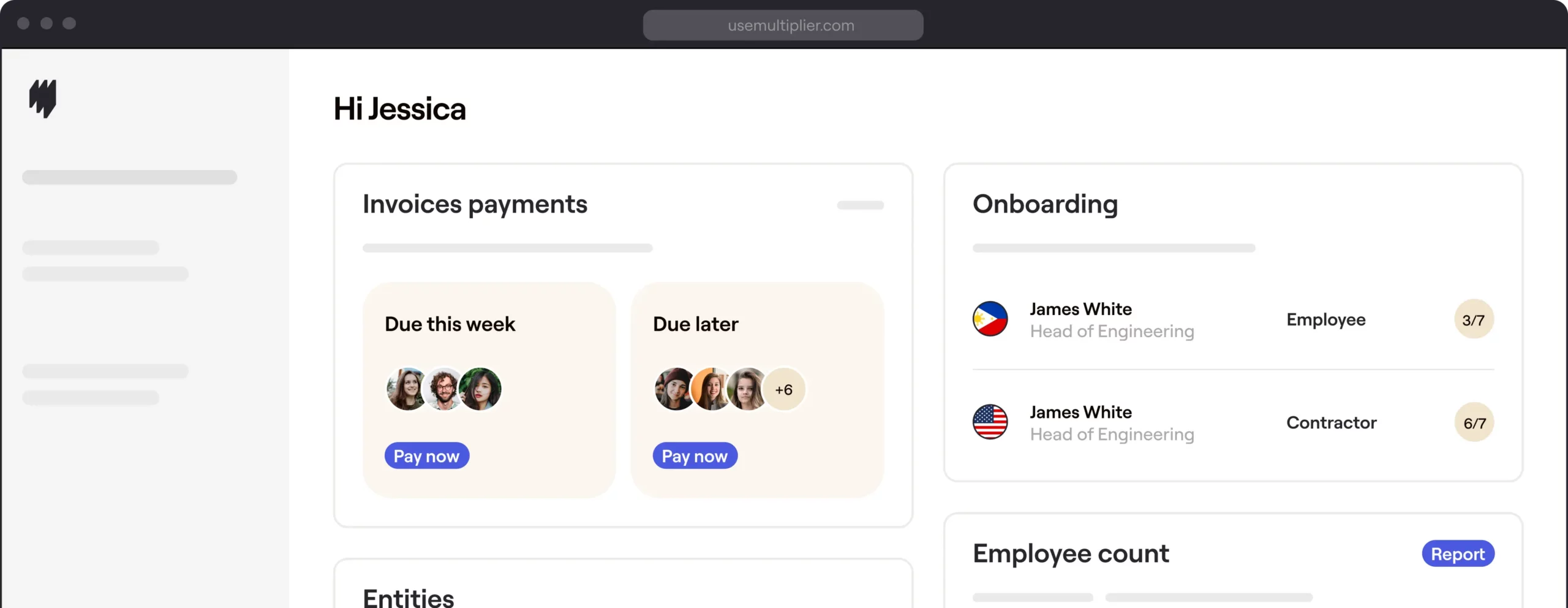
Multiplier’s Contractor of Record service covers every stage of contractor engagement in Guatemala, from onboarding and compliant contract generation to FEL invoice collection, cross-border payment processing, and five-year audit-ready recordkeeping, all on a single platform.
Our platform supports:
- Contractor registration verification and onboarding
- Bilingual service agreements aligned with Guatemala’s Civil and Commercial Codes, including IP and misclassification protections
- Automated international wire transfers and local GTQ bank payments
- FEL invoice collection and validation
- Audit-ready documentation and five-year records retention
- Cross-border payment compliance monitoring
Ready to pay Guatemalan contractors without the compliance complexity? Book a demo with Multiplier today.
FAQs
How do electronic invoices (FEL) impact contractor payments in Guatemala?
FEL (Factura Electrónica en Línea) is mandatory for most contractor transactions in Guatemala. Payments are typically only processed after receiving a valid FEL invoice, as it serves as the official tax document required for deductibility and compliance with SAT regulations.
Can companies pay contractors in Guatemala without a local entity?
Yes, companies can pay contractors in Guatemala without establishing a local entity. However, they must still verify NIT registration, validate FEL invoices, and ensure proper documentation to remain compliant with local tax and audit requirements.
What happens if a contractor does not issue a valid FEL invoice?
If a contractor fails to provide a valid FEL invoice, the payment may not qualify as a deductible business expense. This can lead to tax adjustments, penalties, and compliance risks during SAT audits.
Are payments to Guatemalan contractors subject to withholding tax?
Generally, payments to resident contractors are not subject to withholding tax. However, payments to non-resident contractors for Guatemalan-source income are typically subject to a 15% withholding tax.
How does Multiplier help ensure compliant contractor payments in Guatemala?
Multiplier streamlines contractor payments by verifying SAT registration, collecting and validating FEL invoices, and maintaining audit-ready documentation. This reduces compliance risks while simplifying cross-border payment operations.
Can Multiplier manage both onboarding and payments for contractors in Guatemala?
Yes, Multiplier provides end-to-end support, including contractor onboarding, compliant agreement generation, FEL invoice handling, and global payment processing, ensuring a consistent and compliant contractor lifecycle.
Why do businesses use Multiplier instead of managing contractor payments internally?
Businesses use Multiplier to reduce administrative burden and compliance risks. It centralizes contractor management, ensures proper documentation, and supports compliant payments aligned with Guatemala’s regulatory requirements.