If you’re managing a global workforce today, you know it’s not the same game it used to be. Remote work, borderless talent pools, and constantly evolving labor laws mean your HR strategy has to be sharper and faster than ever. In fact, 77% of organizations struggle to hire full-time employees, underscoring the significant challenges associated with global recruitment and retention.
That’s where Professional Employer Organization (PEO) and Employer of Record (EOR) models come in. They both help you manage payroll, benefits, and compliance, but they do it in very different ways. Picking the wrong one can cost you time, money, and even create compliance risk.
In this guide, we’ll break down what each model does, how they differ, and when you should choose one over the other as a global HR professional. Consider it your roadmap for global expansion, where Multiplier helps simplify the process along the way.
Understanding global HR challenges
Before we dive into PEO and EOR service models, it’s essential to understand the key challenges global HR leaders face when managing employees across multiple countries:
1. Compliance complexity
Every country and sometimes each region has its own labor laws, tax rules, benefits, and data protection requirements. For example, working hours vary widely: in Finland, they range from 37.1 to 44.8 hours per week, while in France, they are 35–43 hours per week.
2. Payroll and benefits administration
Processing payroll across multiple countries isn’t just about paying employees on time; it’s also about ensuring compliance with local regulations and labor laws. You need to manage local currency payments, tax rates, social contributions, statutory benefits, and mandatory bonuses such as the 13th-month pay in the Philippines. Mistakes can be costly and erode employee trust.
3. Contracts, terminations, and labor disputes
Employment contracts, notice periods, severance pay, and dispute resolution procedures vary significantly across different jurisdictions. In China, labor laws strictly define contracts and working conditions, whereas in Europe, directives such as the Working Time Directive are followed. Missteps here can create legal exposure and employee dissatisfaction.
4. Data security and privacy
Protecting employee data is non-negotiable. Breaches trigger fines and reputational damage. For context, in 2024 alone, regulators across Europe issued fines totaling €1.2 billion, bringing the total since the GDPR’s introduction in 2018 to €5.88 billion.
5. Managing distributed teams and maintaining culture
Remote and geographically dispersed teams come with challenges. Cultural differences, time zones, and engagement gaps affect collaboration, productivity, and overall morale. HR leaders must find ways to maintain culture and connection across borders.
Why choosing the right HR model matters
Choosing the right model matters because it helps you achieve four key outcomes:
- Risk mitigation: Stay ahead of compliance issues, reducing the likelihood of fines, lawsuits, or reputational harm.
- Efficiency and speed: Streamline hiring, onboarding, payroll, and benefits, especially when paired with modern HR tech.
- Scalability: Adapt to local regulations and workforce structures — remote, hybrid, or onsite — while keeping global standards consistent.
- Operational consistency: Unified policies boost fairness, morale, and reporting.
Did you know?
67% of organizations find navigating labor laws and regulations across multiple countries the biggest obstacle to implementing global talent management tools.
What is a PEO, and how can it help you?
A PEO is a third-party HR provider that partners with your company through a co-employment agreement. You keep control over day-to-day HR decisions — like hiring, performance management, and workplace policies, while the PEO handles core administrative functions:
- Payroll
- Benefits
- Compliance with labor laws
- Workers’ compensation
- Risk mitigation
How the partnership works
With a PEO, there are essentially two employment relationships:
- Your company ↔ employee: You manage daily tasks, workflow, and key workforce decisions.
- PEO ↔ employee: The PEO acts as the administrative employer of record, handling payroll, taxes, and compliance obligations under its own tax ID.
In other words, you direct the work; the PEO ensures the legal and administrative boxes are checked.
Things to keep in mind
Domestic vs. international PEOs:
- Domestic PEOs (especially in the US) generally don’t require a legal entity in each state. They operate under the co-employment arrangement for you.
- International PEOs may have varying requirements: Some need a local entity, while others function as the employer of record without entity setup.
Liability: Risk is shared. You retain liability for day-to-day management and certain legal obligations, while the PEO takes on much of the administrative compliance burden. It eases your workload, but it doesn’t eliminate all risk.
What is an EOR, and how is it different?
An EOR becomes the legal employer for your team in another country.
What that means for you: You still manage day-to-day work, but the EOR handles hiring, payroll, contracts, benefits, and compliance. They assume all legal responsibility.
Key advantages for you:
- No need to set up a local entity
- Onboard employees fast
- Reduce legal risk significantly
Essentially, if you want to hire globally without establishing a presence in every country, an EOR is your shortcut.
PEO vs EOR: A comparative analysis
Let’s break down the key differences between PEO and EOR so you can quickly see which model fits your global HR needs.
Aspect | PEO | EOR |
Employment structure | Co-employment: You share responsibilities with the PEO | EOR is the sole legal employer |
Legal entity requirement | Required: You must set up or already have a local entity | Not required: The EOR employs via its own legal entity |
Legal employer | You remain a legal employer (shared responsibility) | EOR is the legal employer, assumes full liability |
Compliance and risk | Shared; you still hold significant legal and tax risk | EOR takes full compliance and legal risk for employees |
Control over HR | You control hiring, daily decisions; PEO does admin/payroll | EOR controls contracts, compliance, taxes; you direct work |
Cost structure | Lower monthly fee; extra setup/admin and compliance costs | Higher monthly fee; all-inclusive, fewer hidden costs |
Onboarding speed | Slower; requires entity setup, regulatory registration | Faster; EOR already has infrastructure in place |
Scalability | Less flexible; must set up entities country by country | Highly scalable; hire quickly in new markets |
Suitable for | Companies with a local entity and established operations | Fast market entry, pilot hiring, remote/global workforces |
Now that you understand how PEOs and EORs differ, let’s explore how to decide which model is the right fit for your company.
Should you choose a PEO or an EOR?
Here we help you make a practical choice between PEO and EOR, using a simple yes/no checklist to guide your decision based on your company’s structure, speed, and risk preferences.
- Do you already have a legal entity in the target country?
- Yes → PEO might be the right fit for you
- No → EOR is likely the better choice
- Do you want to handle compliance risk yourself?
- Yes → PEO might be the right fit for you
- No → EOR is the safer option
- How quickly do you need to hire?
- Less than one month → EOR will get you onboarded faster. Multiplier’s EOR services, for example, can help you onboard your employees in just a few hours.
- More than three months → If your hiring timeline is greater than three months and you plan to establish a long-term presence with a local entity, a PEO could be a good fit.
- Are you testing a new market or hiring a small team?
- Yes → EOR is ideal for fast, low-risk expansion
- No → PEO works if you have a long-term local presence
Tip: Start at the top and follow the branches based on your situation. By the end, you’ll have a clear recommendation that aligns with your global growth strategy.
Use cases: When should global HR teams use a PEO vs. an EOR?
Choosing between a PEO and an EOR depends on your company’s structure, hiring goals, and the level of compliance responsibility you want to retain. Let’s look at scenarios where each model makes the most sense.
When to use a PEO
You’d typically lean toward a PEO if your company already has a legal presence in the country and wants support rather than full legal coverage.
Example scenarios:
- Established local entity, growing workforce
You have a subsidiary in Germany with 50 employees. A PEO handles payroll, benefits, and HR administration, while you stay in control of contracts and internal policies. - Outsourcing HR while retaining control
Your HR team in Canada is stretched to the limit. You want compliance and payroll support without giving up legal responsibility. A PEO keeps you compliant and in the driver’s seat. - Long-term presence in a single country
You’re expanding in India with plans to scale over three to five years. A PEO takes care of routine HR tasks, freeing you to focus on strategic decisions and growth.
When to use an EOR
An EOR makes sense when you don’t have a local entity, want to hire quickly, or need to minimize compliance risk.
Example scenarios:
- Hiring in a new country without a legal entity
You’re a US-based SaaS startup looking to hire your first employee in Brazil. Setting up a local entity would take months. An EOR enables you to legally onboard an employee in days without waiting for entity setup. - Testing a new market before committing
Your marketing team wants to test demand in Japan with just a couple of employees. Using an EOR lets you hire and operate legally with minimal risk and investment. For example, fintech platform Aspire partnered with Multiplier to onboard over 80 employees from India, achieving 100% compliance, streamlining global payroll, and experiencing over $1 million in annual savings. - Scaling quickly in multiple countries
Suppose your company wants to expand across Europe, hiring small teams in France, Spain, and Italy simultaneously. An EOR allows you to hire in multiple markets at once, with payroll, contracts, and compliance managed locally for you. - Reducing compliance liability
If you’re unsure about local labor laws, benefit requirements, or termination policies, an EOR takes on the legal responsibility, so you avoid fines and penalties while staying compliant.
Cost comparison: Is a PEO more affordable than an EOR?
Costs often determine which model companies choose. Below is a side-by-side breakdown showing how PEOs and EORs differ in fees, setup, compliance, and hidden expenses—so you can see where each model may save or cost you more.
Aspect | PEO | EOR |
Monthly fee | $40–$250 per employee per month (typically 2%–12% of monthly payroll) | Major global providers charge $400-700 per month per employee, but affordable options typically cost $200-350 per month per employee. |
Entity setup | Required; legal incorporation/registration costs $8,000 – $10,000 per country, plus $500–$2,000 in legal fees | Not required |
Compliance and risk costs | For example, many US states impose their own penalties in addition to federal consequences. California, New York, and Massachusetts are particularly strict, with misclassification fines reaching up to $25,000 per violation in some cases. | EOR assumes full legal compliance; included in the monthly fee with no risk of fines or audits for you |
Payroll and benefits admin | Included, but may require internal staff and oversight; broker fees extra | End-to-end included; no internal payroll/admin team needed |
Hidden costs | Set-up delays (two to three months), extra costs from compliance errors, and management time | Minimal; predictable billing, all standard HR costs included; hidden fees are rare with reputable EORs |
Here’s where Multiplier makes the PEO vs EOR decision simpler and smarter.
Why Multiplier is the smarter choice for global HR leaders
Global expansion should be about opportunity, not paperwork. But legal risk, payroll complexity, and compliance gaps can slow you down. That’s where Multiplier steps in, combining the speed of an EOR with the administrative depth of a PEO.
Here’s why global HR leaders like you choose it:
- Acts as the legal employer in 160+ countries
Hire, onboard, and manage employees or contractors in 160+ countries without setting up local entities. - Handles payroll and benefits locally
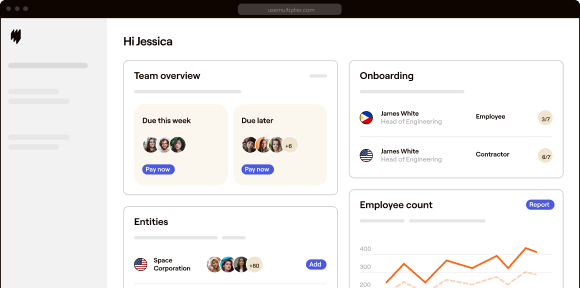
Run payroll in 120+ currencies with localized benefits, insurance, statutory filings, and taxes. Everything is managed in-country with automated payments. No dealing with vendors or internal teams. - Offers a centralized platform for complete visibility
Onboarding, contracts, payslips, renewals, expenses, and compliance updates all live in one dashboard. No fragmented systems, just a single source of truth for your global workforce. - Reduces legal and compliance risk
Multiplier assumes full employment liability, tracks regulatory changes in real time, and provides audit trails. With in-house compliance experts, you stay ahead of labor laws, GDPR, and data regulations, minimizing the risk of penalties. - Scales with your business
From a single hire to hundreds across markets, Multiplier adapts to your pace. Add or remove countries instantly and pay teams flexibly, including crypto payments in select regions. - Supports both EOR and contractor management
Sometimes you need a full-time hire, other times a contractor fits the bill. Multiplier enables you to run payroll, compliance, and contracts for both types of workers seamlessly, all within a single platform.
Bottom line: With Multiplier, scaling is flexible. Your data, workflows, and employee access stay intact whether you stick with our EOR or move entities in-house and choose a PEO model.
Choosing between PEO and EOR
The right choice ultimately depends on your resources and growth plans. Both reduce risk, speed up hiring, and ensure compliance.
- PEO: Ideal if you already have a local entity and need payroll, benefits, and HR support
- EOR: Best when hiring in new markets without the cost and complexity of setting up entities
With Multiplier, you don’t have to choose. We offer a comprehensive solution that combines PEO-style payroll and full-service EOR in one platform.
Book a demo today.
FAQs
What is the main difference between a PEO and an EOR?
A PEO (Professional Employer Organisation) co-employs workers — your company remains the legal employer and shares liability. An EOR (Employer of Record) becomes the sole legal employer, taking full compliance, payroll tax, and labour law responsibility. An EOR requires no local entity; a PEO typically does.
Can a company switch from a PEO to an EOR mid-contract?
Yes. You can transition, but it requires coordination to transfer employment contracts, benefits, and payroll. Planning ahead ensures minimal disruption for your employees and smooth compliance with local labor laws.
What happens to employee benefits when switching from PEO to EOR?
Benefits are typically transferred or re-enrolled under the EOR. You may need to align coverage with local regulations, but the EOR ensures continuity and compliance so employees remain protected.
Is an EOR more suitable for global hiring than a PEO?
If you’re hiring in new countries without local entities, need speed, or want to reduce compliance risk, an EOR is usually the better choice for global hiring compared to a PEO.
Are PEO services still useful for international companies?
Yes. PEOs help companies with local entities manage payroll, benefits, and HR administration efficiently while retaining control over employment contracts and policies in familiar markets.
Does an EOR cost more than a PEO?
EOR monthly fees can be higher, but they consolidate payroll, benefits, and compliance, saving you setup costs, administrative overhead, and legal risk, often making them cost-effective for global expansion.
How quickly can I hire through an EOR?
Very fast. You can onboard employees in days rather than months, as an EOR like Multiplier utilizes its local entities and handles contracts, payroll, and compliance from the outset.
Which is better for US companies hiring internationally — PEO or EOR?
For US companies hiring outside the US, an EOR is almost always the right choice. A PEO in a foreign country requires you to already have a legal entity there. An EOR like Multiplier lets you hire in 160+ countries without setting up a local subsidiary — onboarding in as little as 48 hours.