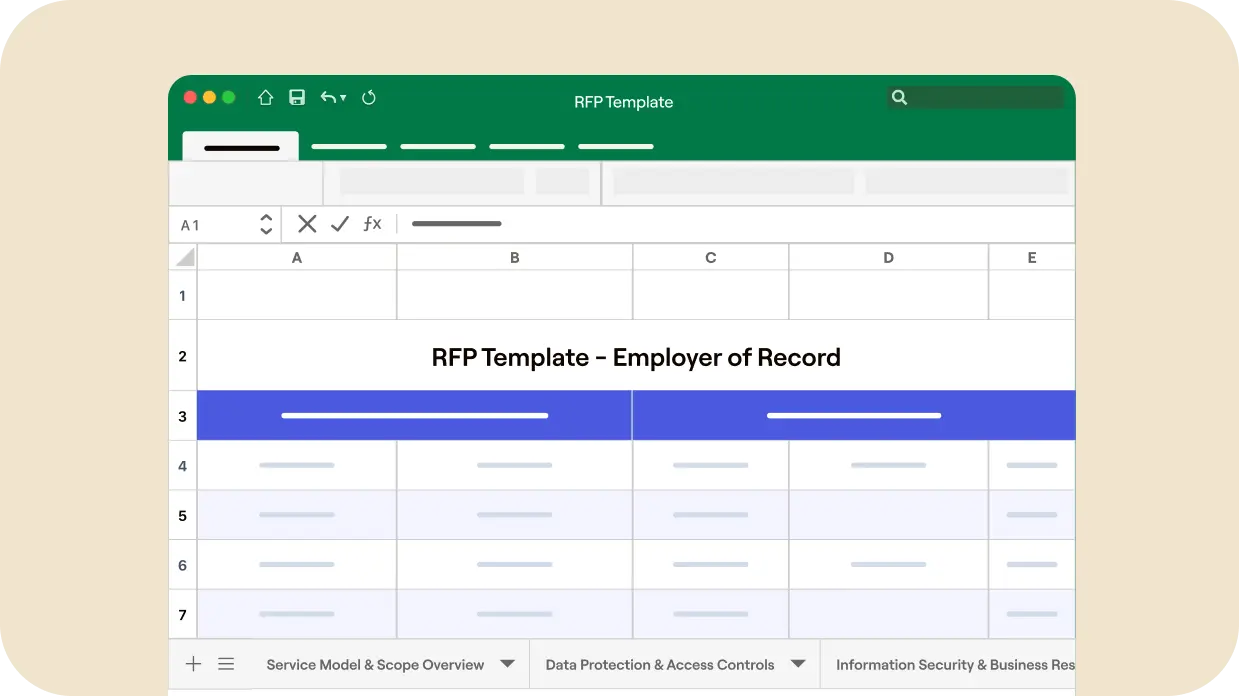
When it comes to global hiring, the stakes are high. A single compliance misstep or a delayed payroll can erode trust and disrupt your expansion plans.
A reliable Employer of Record (EOR) service minimizes that risk. Acting as the legal employer for your international hires, an EOR manages compliance, payroll, benefits, and onboarding, helping you accelerate market entry and focus on growth.
But finding the right partner requires more than a feature comparison. You need clarity and a process that stakeholders, across HR, compliance, and finance teams, can trust.
That’s why many companies turn to an RFP when evaluating EOR providers. A well-designed RFP aligns teams, sets clear expectations for vendors, and creates a documented, defensible decision-making process that global expansion requires.
Why RFPs matter in the EOR selection process
A well-defined EOR RFP template replaces chaotic vendor selections with strategic decision-making. You’re not just collecting proposals, you’re creating a documented, defensible process your teams can trust.
- Your RFP clarifies internal goals and needs before you speak to vendors.
- It ensures you evaluate EOR providers on a level playing field, comparing apples to apples instead of getting lost in sales pitches.
- It reduces costly oversights, aligns internal stakeholders, and surfaces risks before they become problems months into a partnership.
- It ensures vendor responses are specific, actionable, and easier to evaluate.
And, because compliance penalties and payroll errors can escalate quickly across markets, a structured evaluation process is your best protection. It helps you identify EOR partners who truly understand regulatory requirements, not those who claim compliance expertise.
Key components of an effective EOR RFP
Building a strong RFP requires specific sections that serve a distinct purpose in your evaluation process.
Company background and objectives
Give vendors a clear snapshot of who you are. Include your company size, industry, and the markets you currently operate in. Explain why you’re pursuing international hiring and which countries or regions you plan to expand into. Most importantly, define what success looks like in your EOR partnership.
Example: How do you explain ‘company background’ in the RFP?Including your organization’s size, business model, existing presence, and expansion objectives helps vendors personalize recommendations to your business needs. For example: “We are a fast-growing SaaS startup with 120 employees across the U.S. and Canada. We plan to hire 15 engineers in Mexico and Singapore over the next 12 months. Our primary goals are to onboard quickly, avoid setting up local entities, and ensure full compliance with local labor and tax regulations. |
Scope of work
Be clear about headcount expectations, both initial and projected. Specify employee types you plan to hire, whether contract, full-time, or hybrid arrangements. List the countries you need support in and your anticipated timelines. Detail your onboarding, benefits administration, payroll processing, and employee termination needs.
Example: How do you ask EOR vendors for ‘scope of work’?Try to avoid generic statements. Instead, give specific details, so vendors can provide accurate pricing and identify potential challenges early. For example: “We plan to hire 20 software engineers in Brazil and Mexico in the next six months.” |
Compliance and legal requirements
Compliance represents the highest risk area. Your RFP should request specific documentation, including licenses, compliance audit records, and sample employment contracts. Ask EOR service providers how they’ve handled recent regulatory changes in your target countries. Request examples of navigating labor law updates.
Example: How to explain compliance requirements in your EOR RFP?Explaining jurisdictions and compliance areas where you need clarity helps vendors respond with precise, country-specific details. Example: “In Germany, we require guaranteed adherence to mandatory benefits, statutory notice periods, and precise taxation. Please outline your legal entity presence and compliance processes for Germany.” Hiring in Germany? Our Germany EOR guide explains what your EOR provider should handle here. |
Payroll and service level agreements (SLAs)
Define performance expectations clearly. Specify required onboarding timeframes, typically ranging from 24 hours to two weeks, depending on country complexity. Ask for detailed payroll accuracy requirements and delivery schedules. Include customer support response and resolution metrics that align with your business needs.
Example: What service levels should you expect from EOR vendors?Leading organizations now expect 99.9% payroll accuracy and same-day response times for critical issues. Your SLAs should reflect your operational reality. If you operate across multiple time zones, specify support coverage expectations. Compared to other EOR vendors, Multiplier provides best-in-class service levels around payroll accuracy, onboarding timelines, and customer support. Talk to our team to learn more. |
Pricing structure
Request transparent pricing that leaves no room for surprises. Ask for breakdowns by country or headcount tiers. Ask for a detailed explanation of setup fees, monthly per-employee fees, and potential add-ons. Include costs related to benefits administration, terminations, or regulatory changes.
Example: What should EOR pricing look like?The cost of EOR services ranges from $300 to $700 per employee per month (or 3%-12% of gross payroll). But base fees tell only part of the story. Your RFP should uncover all potential costs including currency conversion fees, benefit markup, and termination expenses. When comparing vendors, look for transparent pricing models versus hidden costs. Finance teams, for instance, love Multiplier’s flat pricing structure as it helps them forecast costs confidently as headcount scales. |
Evaluation criteria
Let vendors know how they’ll be assessed. Weigh experience in target countries heavily, as local expertise drives compliance success. Evaluate the platform’s capabilities and its integrations with your existing systems. Review client references or case studies from similar companies. Assess compliance expertise and responsiveness throughout the RFP process.
Example: What are typical evaluation weightages in an RPF template?Consider these evaluation categories with suggested weightings: cost reasonableness (30-35%), compliance and service performance (30-35%), experience in target markets (20%), technology and integration capabilities (15%). To assess technology, compliance capabilities, and global coverage, refer to our EOR services page for a snapshot of what a mature provider typically offers. Or read our research-led evaluation of the top 20 EOR vendors globally. |
Submission guidelines
Include clear response deadlines, typically allowing two to three weeks for comprehensive proposals. Specify format and documentation requirements to ensure easy comparison. Provide primary contacts for questions and answers. Share your evaluation and shortlisting timelines so vendors understand the urgency.
Your submission guidelines set the tone for the partnership. Vendors who miss deadlines or ignore formatting requirements during the RFP process will likely show similar patterns as partners.
EOR RFP checklist: 5 must-ask questions during the EOR RFP processBy this stage, your RFP has enough detail for vendors to respond meaningfully. Here is a quick checklist to keep your process structured and ensure no critical requirement slips through. Q1: What’s the ideal timeline for running an EOR RFP?
Q2: How do we assess a vendor’s compliance capability? Ask for:
Q3: What’s most important in evaluating pricing proposals? Look beyond the monthly fee. Assess:
Q4: How do we ensure data security? Ask vendors to outline:
Q5: What are common pitfalls to avoid?
|
Best practices for crafting and issuing EOR RFPs
Creating a strong RFP doesn’t have to overwhelm your team. These five proven practices streamline the process while ensuring comprehensive vendor evaluation.
Define requirements clearly
Vague statements may lead to generic proposals. Replace “we want global support” with specific requirements: “we plan to hire 20 software engineers in Brazil and Mexico in the next six months, with potential expansion to Colombia by Q4.”
Beyond headcount, define your benefits philosophy, compliance risk tolerance, and integration requirements. If you need same-day onboarding for urgent hires, state it explicitly. If you require integration with specific HRIS platforms, name them.
Address legal and compliance head-on
Ask EOR vendors for documentation, including licenses, compliance audit records, and sample employment contracts. Request specific examples of handling regulatory changes in your target countries. Inquire about data security certifications like ISO 27001 and GDPR compliance measures.
Collaborate with key stakeholders
Loop in HR, legal, and finance early to ensure their priorities are reflected. HR leaders need to evaluate onboarding support, benefits handling, and employee lifecycle management across countries. Finance teams focus on returns (ROI), budget predictability, and hidden cost markers. Legal departments assess compliance documentation and risk mitigation strategies.
Creating an RFP committee with representatives from each function can prevent gaps in evaluation and ensure buy-in on the final decision. Schedule regular checkpoints throughout the RFP process to maintain alignment.
Set realistic timelines
Give vendors two to three weeks to respond, and plan enough time for review, scoring, and interviews. Rush the process, and you’ll receive incomplete proposals or miss strong candidates who can’t meet unrealistic deadlines.
Your internal timeline matters too. Allow one to two weeks for initial scoring, another week for demos or presentations from shortlisted vendors, and a final week for reference checks and negotiations. This measured approach prevents costly mistakes while maintaining momentum.
Encourage two-way communication
Include a question and answer window for vendors to ask clarifying questions. This leads to better proposals and fewer assumptions. Schedule a bidders’ conference call where all vendors hear the same clarifications simultaneously.
The best RFP processes feel collaborative, not adversarial. When vendors understand your culture and priorities through open communication, they tailor solutions to your specific needs rather than pitching generic services.
How MoEngage evaluated and selected the right EOR partnerMoEngage, a fast-scaling SaaS company with 700+ employees—needed to hire across new markets quickly but didn’t want the cost and complexity of opening entities. They had experimented with other EOR vendors but found their systems rigid and the support insufficient. When they re-evaluated the market, three factors shaped their final decision:
Real-world teams evaluate EORs not just on features, but on partnership quality, clarity, and operational ease across markets. Read more: How Moengage achieved 100% global compliance with Multiplier. |
Download Multiplier’s RFP template
Selecting the right EOR partner is a strategic decision, and a well-designed Employer of Record (EOR) RFP Template ensures you select a partner who supports your people, protects your company, and scales with your global ambitions.
We’ve designed our RFP template to help all your teams align and achieve their goals:
- HR leaders can evaluate onboarding support, benefits handling, and employee lifecycle compliance across countries.
- Finance leaders can compare transparent pricing, SLAs, and hidden cost markers.
- Operations leaders will assess risk handling, operational handoff quality, and multi-country scaling support.
- Procurement teams use this structured format to meet internal compliance and ensure fair vendor selection.
Adapt the template to your specific needs. Follow the best practices outlined in this guide and approach your RFP process with clarity, collaboration, and confidence.
Get your free EOR RFP template now.
Download Multiplier’s RFP EOR template
Choosing an EOR partner? Consider Multiplier
Finding the right EOR partner is ultimately about confidence. You want 100% assurance that compliance risks are covered, and your team can expand without friction. That’s where Multiplier stands apart.
Multiplier is built for companies that want reliability, support, and scale. We understand the complexity behind global hiring and take accountability for it, so your teams don’t have to. That’s why Multiplier is trusted by 1,000+ fast-growing and enterprise teams and recognized with a 4.7/5 G2 rating.
Why businesses trust Multiplier EOR across 150+ countries
“Multiplier enables us to quickly access new markets and resources which gave us the opportunity to generate revenue faster by hiring the right people at the right time.” Bassil Akra |
If you’re evaluating EORs, Multiplier gives you the balance of expertise, technology, and partnership quality required to scale globally with confidence.
With Multiplier, global expansion becomes:
- Safer: Expert local compliance in every jurisdiction you hire in.
- Faster: Onboarding in under 48 hours, contracts generated in minutes.
- Simpler: One unified platform for HR, payroll, benefits, and documentation.
- More predictable: Transparent, flat pricing without hidden markup surprises.
- More responsive: 24/7 support, dedicated onboarding teams, and in-country specialists.
Are you looking for an EOR partner that can scale reliably with your business needs? Book a demo today, and discover how Multiplier can help you scale teams across every market.
Common queries during the EOR RFP process
What's the ideal timeline for running an EOR RFP?
At Multiplier, we have found that the RFP process timelines often vary depending on your company size and requirements. Typically, planning and drafting takes one to two weeks. The proposal window should run two to three weeks. Evaluation and selection requires one to two weeks. Onboarding takes one week or more depending on vendor readiness. This six to eight week timeline balances thoroughness with maintaining momentum.
How do we assess a vendor's compliance capability?
Some critical aspects you must consider are: proof of in-country legal presence in each target market, and examples of navigating recent labor law updates. You must also review employee protection clauses, IP agreements, and contract templates. Check references specifically about compliance challenges and resolutions. Verify insurance coverage, including general liability and workers' compensation.
What's most important in evaluating pricing proposals?
Businesses that choose Multiplier over other EOR vendors cite transparent pricing as a key deciding factor as it helps ensure cost predictability. Beyond the monthly fees, you must assess what's included versus add-on services. Evaluate predictability of costs as headcount scales. Understand country-specific nuances in benefits and taxes. Calculate total cost of employment, not just service fees. Factor in potential savings from avoided penalties and administrative efficiency.
How do we ensure data security?
SOC-2, SOC-3 , GDPR compliance and ISO certifications are important when evaluating your EOR vendors. You must also ask vendors to outline data storage locations, particularly for GDPR-compliant regions. Review access controls and employee privacy protections. Understand data retention and deletion policies. Confirm encryption standards for data in transit and at rest.
What are common pitfalls to avoid?
Rushing the process leads to missed warning signs. Not aligning internally on goals creates evaluation confusion. Choosing based solely on cost ignores compliance and service risks. Overlooking compliance documentation exposes you to regulatory penalties. Failing to check references misses real-world performance insights. Accepting vague responses on critical requirements sets up future disappointments. Read more in our guide to common pitfalls during EOR selection.