Why Pakistan is the perfect hub for regional business expansion
Pakistan’s prime location at the crossroads of South Asia, the Middle East, and Central Asia offers businesses unparalleled access to a vast regional market. The nation’s commitment to digital transformation and trade-friendly policies fosters a dynamic environment for growth. With competitive operating costs and a focus on innovation, Pakistan provides the tools and opportunities for businesses to thrive in the global business environment.
The business benefits of registering your company in Pakistan
Pakistan is quickly becoming a hub for global business, offering unique advantages that simplify operations for HR leaders and decision-makers.
Here’s why Pakistan is an excellent choice for business expansion:
- Maximize profits with one of the region’s lowest operating and labor costs.
- Unlock tax benefits and incentives in special economic zones (SEZs).
- Reach over 240 million consumers in a fast-growing market.
- Operate confidently with clear regulations and an expanding digital infrastructure.
- Use Pakistan’s prime location to trade across South Asia, Central Asia, and the Middle East.
- Build teams quickly with access to skilled talent in tech, manufacturing, and more.
Next up, we’ll break down your company registration options, from standard setups to Employer of Record (EOR), so you can find the right fit for your business.
Step-by-step guide to registering a company in Pakistan
Setting up a business in Pakistan is straightforward if you approach the process with the right steps. Here’s how to get started:
Step 1: Choose the right business structure
Setting up a legal entity in a new country like Pakistan requires thoughtful planning. The right business structure not only shapes your operational flexibility and liability exposure but also determines your regulatory obligations and tax outlook.
If you prefer a faster route to expansion, an Employer of Record (EOR) solution can be a strategic choice. An EOR allows you to hire talent, manage payroll, and stay compliant, without the need to set up a legal entity. This enables you to enter the market quickly while focusing on core business priorities.
However, if establishing a local entity is part of your long-term strategy, the first step is choosing the appropriate legal structure. Pakistan offers several types of business entities, each suited to different ownership models, risk appetites, and scale. Key options include:
Sole proprietorship
A straightforward setup ideal for solo entrepreneurs. You retain full control but are personally liable for all business debts and obligations.
Partnership
Suitable for two or more individuals working together. Partnerships come in various forms, such as general or limited partnerships, with shared profits, responsibilities, and varying levels of liability.
Private Limited Company (LLC / Pvt Ltd)
A popular structure for startups and SMEs. It offers limited liability protection to shareholders and is legally separate from its owners, ensuring better credibility and access to funding.
Single Member Company (SMC)
A variant of the private limited company, designed for solo founders. It combines limited liability with complete ownership, making it an attractive option for individual entrepreneurs wanting formal business structure.
Branch office
Ideal for foreign companies seeking to establish a footprint in Pakistan without incorporating a separate legal entity. Operations are limited to the scope approved by the regulatory authority.
Public Limited Company
Suitable for large businesses intending to raise capital from the public. It involves rigorous compliance and regulatory oversight, but offers scalability through public shareholding.
Cooperative society
Designed for groups with shared economic or social goals. Members enjoy equal voting rights, and the structure supports democratic management and mutual benefit.
Choosing the right structure depends on your growth vision, operational model, and risk appetite. Align your choice with both short-term objectives and long-term expansion goals to ensure a compliant and scalable presence in Pakistan.
Step 2: Submit essential registration documents
After choosing your business structure, you must file the necessary documents with the Securities and Exchange Commission of Pakistan (SECP):
- Memorandum of Association (MoA): Outlining your company’s objectives.
- Proof of registered office: Confirming the physical location of your business.
- Identification of documents: For directors and shareholders.
These documents establish your company’s legal identity and ensure regulatory compliance.
Step 3: Open a corporate bank account
A corporate bank account is vital for managing financial transactions, paying employees, and ensuring smooth operations in Pakistan. Required documents typically include:
- Company registration documents
- Identification of directors
- Proof of tax compliance
Opening a local account can be time-intensive, especially for international businesses unfamiliar with local banking processes. An EOR partner simplifies this by managing the local payroll for you, eliminating the need for complex banking arrangements.
Step 4: Ensure tax compliance
To operate legally in Pakistan, your business must register with the Federal Board of Revenue (FBR):
National Tax Number (NTN)
Required for corporate tax compliance.
VAT registration
Mandatory if your turnover exceeds the specified threshold.
Employee tax deductions
Ensure proper withholding for social security and other obligations.
Understanding and adhering to local tax laws can be daunting. With an EOR, you gain access to local compliance expertise, ensuring compliance with tax regulations and labor laws without adding complexity to your operations.
Next up: Dive into the financial considerations of registering a company in Pakistan. We’ll break down the costs involved and what you need to budget for a successful setup.
The real cost of registering a business in Pakistan
Establishing a business in Pakistan involves several steps and associated costs. Here’s a detailed breakdown to guide you through the process:
1. Registration costs
Name reservation fee
Before registering your company, you must reserve its name with the Securities and Exchange Commission of Pakistan (SECP). The fee for online submission is PKR 200, while physical submission costs PKR 500.
Incorporation fee
The incorporation fee depends on your company’s authorized capital:
- For an authorized capital up to PKR 100,000:
- Online submission: PKR 1,800
- Physical submission: PKR 3,500
- For every additional PKR 100,000 of authorized capital up to PKR 10 million:
- PKR 500 for both online and physical submissions
- For authorized capital exceeding PKR 10 million:
- PKR 250 for each additional PKR 100,000
Digital signature certificate (DSC)
Obtaining a DSC is mandatory for online registration. The cost varies depending on the provider but typically ranges from PKR 1,000 to PKR 2,000.
2. Annual maintenance costs
- Filing fees: Companies are required to file annual returns with the SECP. The fee for filing Form A (annual return) is PKR 500 for online submission and PKR 1,000 for physical submission.
- Tax registration: After incorporation, register your company with the Federal Board of Revenue (FBR) to obtain a National Tax Number (NTN). This process is free of charge.
- Professional tax: Depending on your business activities and location, you may need to pay professional tax, which varies by province.
- Employee-related contributions: If you have employees, register with:
- Employees’ Old-Age Benefits Institution (EOBI)
- Provincial Social Security Institution
- These registrations are mandatory and may involve nominal fees.
3. Additional considerations
Legal and consultancy fees
Engaging legal or consultancy services for drafting the Memorandum and Articles of Association or other legal documents can incur additional costs, typically ranging from PKR 10,000 to PKR 50,000, depending on the complexity of the work.
Bank account opening
While opening a corporate bank account is generally free, maintaining a minimum balance is often required, which varies by bank.
Miscellaneous expenses
These may include notary fees, stamp duties, and other incidental expenses, which can amount to approximately PKR 5,000 to PKR 10,000.
By understanding these costs and requirements, you can effectively plan your business setup in Pakistan, ensuring compliance and smooth operations.
Let’s take a closer look at the cost of standard registration vs EOR.
What is the difference between standard company registration and EOR in Pakistan?
Pakistan offers two key options for establishing your business, each tailored to meet specific operational needs:
Aspect | Standard registration | Employer of Record (EOR) |
Purpose | Establishes a legal entity, giving you complete control over finances and operations. | Enables hiring in Pakistan without setting up a local entity, as the EOR manages compliance and employment tasks. |
Control | Grants full control over day-to-day operations and financial decisions. | Focus on operational oversight while the EOR handles administrative and legal responsibilities. |
Compliance | Requires adherence to Pakistan’s tax laws, labor regulations, and reporting standards. | Ensures compliance with all local laws, including labor and tax regulations, through the EOR’s expertise. |
Setup time | Takes longer due to the need for documentation, government approvals, and other legal procedures. | Quick and efficient, allowing immediate hiring and operations without the wait for entity setup. |
Cost | Includes initial setup fees, legal expenses, and ongoing operational costs. | Involves service fees that are often more cost-effective than setting up and maintaining a legal entity. |
Scalability | Ideal for businesses planning long-term physical operations in Pakistan. | Highly flexible, allowing businesses to scale up or down quickly without committing to a permanent presence. |
While standard company registration provides full control, it comes with extensive documentation, higher costs, and time-intensive processes like navigating SECP and FBR regulations.
For businesses looking to scale quickly and adapt to market demands, an Employer of Record (EOR) offers a faster, more efficient alternative. An EOR like Multiplier transforms entry into Pakistan into a streamlined, efficient process — providing the support you need to thrive in a competitive market.
Next, we’ll explore how EOR can make building a workforce and labor law compliance in Pakistan effortless, empowering your business to grow without limits.
How EOR simplifies registering a company in Pakistan
Expanding into Pakistan in 2025 doesn’t need to be a complex or time-consuming process. With an Employer of Record (EOR), you can bypass the lengthy setup and compliance hurdles, and focus on high-value expansion initiatives for your new market.
Here’s how an EOR streamlines your entry into Pakistan:
- Start operations immediately with the EOR acting as your legal employer.
- Offload payroll, tax filings, and compliance to the EOR, giving your team more time to focus on business growth.
- Stay compliant with Pakistan’s labor laws and tax regulations without the risk of penalties.
- Skip the costs of establishing and maintaining a local entity, simplifying your market entry.
- Scale your workforce effortlessly based on project needs or market demands.
- Access a skilled talent pool in Pakistan without dealing with the complexities of local hiring.
- Ensure smooth onboarding and benefits administration that align with local requirements.
- Minimize legal risks by leveraging the EOR’s local expertise and knowledge.
An EOR streamlines your entry into Pakistan, delivering a faster, hassle-free, and more cost-effective solution for expanding while ensuring full compliance and operational efficiency.
Cost comparison: Standard registration vs. EOR
Expanding into Pakistan involves key cost considerations. Here’s a comparison of standard company registration versus using an Employer of Record (EOR):
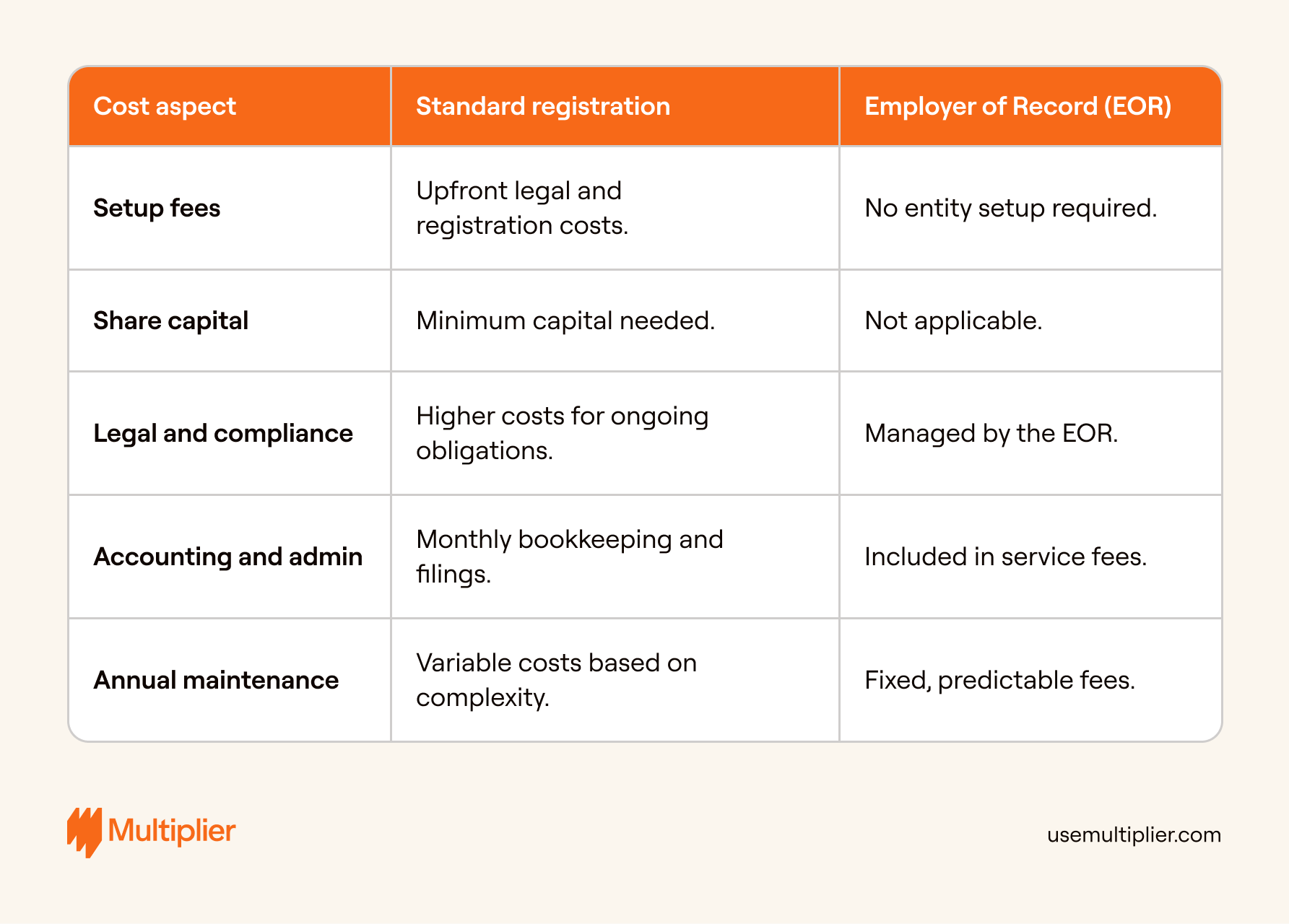
The traditional registration route requires higher upfront costs and continuous administrative duties. In contrast, an Employer of Record (EOR) offers a more efficient solution with predictable monthly fees that cover most of the compliance and operational tasks.
Partnering with an EOR like Multiplier simplifies your entry into Pakistan, reduces complexity, and allows you to focus on scaling your business quickly. Let’s see how.
Take the stress out of your expansion into Pakistan with Multiplier
Expanding into Pakistan is a strategic move, but it doesn’t have to be bogged down by complexity and delays. With Multiplier’s Employer of Record (EOR) solution, you can hit the ground running. We handle the legal, payroll, and compliance complexities, allowing you to focus on the real work — scaling your business.
Why choose Multiplier for your Pakistan expansion
Seamless hiring, global growth
Tap into Pakistan’s talent pool quickly and efficiently. With Multiplier, there’s no waiting for entity setup or navigating complicated local hiring processes.
Effortless payroll and compliance management
Payroll should never be a headache. We ensure everything — from taxes to employee payouts — complies with Pakistan’s regulations. Leave the details to us, so you can focus on strategy.
Streamlined HR operations
No more juggling multiple systems. Multiplier integrates all your HR functions in one place — onboarding, leave management, expense approvals — so you have real-time visibility and full control over your teams.
Reliable compliance with local laws
Pakistan’s regulatory environment is complex, but with Multiplier, you can be confident that every step is in line with local labor laws, tax regulations, and employee protections.
Benefits that resonate with local talent
We ensure your benefits packages match local expectations, giving you a competitive edge in attracting top talent. All the administrative work is handled by us, so your employees feel valued from day one.
Round-the-clock support, secure operations
Whether you’re across the globe or next door, our team is available to support you and your employees 24/7. With SOC 2 certification and AWS-backed security, we ensure your operations and data are always secure.
Multiplier empowers your expansion into Pakistan with speed, security, and flexibility, so you can scale without the usual headaches.
Book a demo today and discover the fastest, smartest way to expand your workforce in Pakistan.