What Are Employee Benefits in Germany?
Employee benefits are additional compensation to an employee’s base salary. These could be financial benefits such as social security contributions, pension, leaves, or fringe benefits like a company phone, car, meal coupons, or employee discounts.
Statutory benefits: Social security, health insurance, paid annual leaves, and maternity/parental leaves.
Voluntary benefits: Year-end or Christmas bonus (Weihnachtsgeld), flexible working hours, supplemental private insurance, and other perks (as per company policy).
Employee benefits in Germany are a mix of statutory and voluntary benefits offered by an employer. A good benefits and compensation package contributes to a work-life balance and helps attract and retain qualified employees.
| Benefit type | Statutory minimum | Typical market practice | Multiplier-administered option |
|---|---|---|---|
| Minimum wage | EUR 13.90/hour, effective Jan 2026 | Matches statutory minimum in most roles; higher for skilled/technical roles given competitive labor market | Compliant payroll calculation per current rate |
| Annual leave | 20 days (5-day week) / 24 days (6-day week) | 25–30 days at most full-time employers | Compliant leave-policy administration |
| Sick leave | 6 weeks full pay, then Krankengeld (70% gross/90% net) via health insurer | Matches statutory minimum in most cases | Compliant sick-leave and Krankengeld coordination |
| Severance | No general statutory right (individual dismissal) | Common non-binding guideline: ~0.5 months’ salary per year of service, typically via settlement | Compliant termination processing and settlement guidance |
| Social security | 20 to 22% of gross salary employer contribution across five pillars | Matches statutory minimum; supplementary private pension sometimes offered at senior levels | Compliant EPF-equivalent contribution processing per current rates and ceilings |
Hiring in Germany with an EOR
Hiring employees in Germany through an EOR requires a specific compliance consideration: a permit under the Arbeitnehmerüberlassungsgesetz (AÜG), or German Employee Leasing Act. An EOR arrangement is considered employee leasing, wherein workers are formally hired by one company but directed via another.
The law regulates EOR agency work and requires a relevant permit before employees can be assigned to a client company. So if you’re considering remotely hiring employees in Germany through an EOR, check that the provider’s AÜG authorization is current. The permit is usually granted for one year.
The law also states that leased or temporary employees can be assigned to the same client company for a maximum of 18 consecutive months before they must be hired directly.
Compensation Laws in Germany
Multiple statutory acts/codes in the national labor law regulate Germany’s employee benefits and compensation. The law also fully covers expats working in the country.
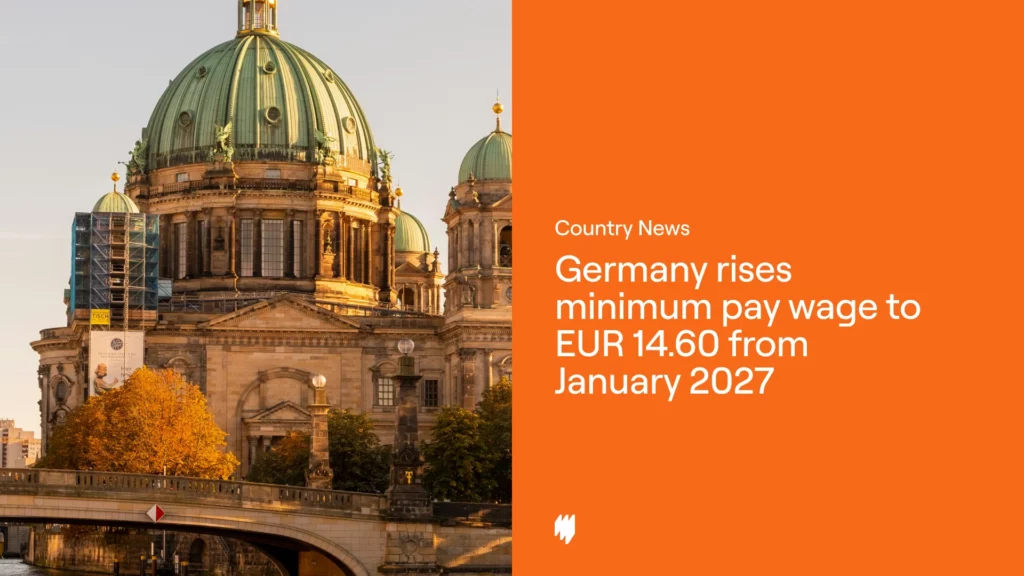
- As per the Minimum Wage Act (Mindestlohngesetz – MiLoG), the statutory minimum wage in Germany is EUR 13.90 per hour from January 2026. Industry collective agreements can set higher minimum pay floors. The minimum wage is scheduled to rise to EUR 14.60 from January 1, 2027.
- Under the German Working Time Act (Arbeitszeitgesetz), a legal workday in Germany is capped at 8 hours. The weekly maximum is 48 hours across a 6-day workweek.
It is permissible to extend working hours up to 10 hours a day under the collective bargaining agreement. However, the average shouldn’t exceed 8 hours per day over an extended six-month period.
- The notice period when terminating employees depends on the employee’s years of service with an employer.
- There is no legal right to severance in Germany. But it is common for employers to pay through mutual termination agreements.
What are the Mandatory Benefits Employers Offer in Germany?
Employers in Germany are legally required to provide statutory benefits such as minimum wages, health insurance, paid annual vacation, pension, and parental leave.
Leave Entitlements
Under the Federal Leave Act, full-time employees are entitled to a minimum of 20 days of paid annual leave. For companies following a 6-day work week, a minimum of 24 days per year.
Additionally, there are 9 public holidays. The total varies by state as per regional holidays. Germany also offers a paid sick leave of six weeks.
Maternity and Parental Leaves
Standard of 14 weeks (Six weeks before birth, Eight weeks after birth). Mothers receive their full salary through health insurance contributions.
Parental leave: Germany offers job-protected time off work up to 3 years per child for each parent. This is an unpaid leave; instead, it offers protection against dismissal.
Social Security
Employers and employees both contribute to a statutory 5-level social security plan covering health, long-term care, pension, unemployment, and accident insurance. About 40% of an employee’s gross salary, shared equally (20-21% roughly) by employer and employee, goes towards these contributions.
Retirement pensions
Germany has a multi-layered social security towards retirement savings. There is a Statutory State Pension, a voluntary employer-sponsored pension, and a state-subsidized pension scheme via individual savings.
The gross monthly pension for someone earning the exact national average wage based on contributions for 45 years is approximately EUR 1913.40.
Social Security and Pension in Germany
Germany’s social security system is a public insurance scheme split into 5 pillars, each funded equally by employers and employees.
- Health insurance (Krankenversicherung): Anyone staying in Germany must have health insurance. The system includes both public and private insurance. Around 14.6% of gross salary, shared equally between employer and employee, is contributed towards health insurance.
- Pension insurance(Rentenversicherung): A pay-as-you-go public system that funds retirement savings in Germany. It applies to standard employees, trainees, and even some self-employed individuals. 18.6% of gross salary is split equally by employee and employer.
The legal retirement age in Germany is 65 years, but it is transitioning to 67 years. The change is undertaken gradually. Anyone born in 1964 or later has to work until 67 to get a full retirement pension.
- Unemployment insurance: This provides income support to individuals who are unemployed with no fault of their own. Administered by the Federal Employment Agency in Germany, it applies to most full-time and standard part-time workers. The total rate is 2.6% of gross earnings, with employer and employee each paying 1.3%.
The benefit depends on income, social security contributions, and family status. The unemployment insurance amount received is:
- 60% of employee’s previous net salary
- 67% if employee has dependent children
- Accident insurance: A mandatory state program that covers employees from workplace accidents and illness. The insurance premium is 100% provided by the employers. In the event of an accident, the worker is entitled to benefits that pay a percentage of their salary while they are recovering.
The coverage also extends to accidents at work or school or on the way to/from the school as well as occupational illnesses. The conditions of which must be listed in the Ordinance on Occupational Diseases.
- Long-term care insurance: The 5th pillar of the social security scheme is automatically linked to an individual’s health insurance (public and private). 3.4% of salary paid by employers and employees in equal parts goes towards long-term care nursing needs. The benefits received depend on the level of care required.
Depending on the extent to which someone’s independence and abilities are restricted, they are assigned different levels of care (Pflegegrade)
The total social security contributions in Germany:
| Type of insurance | Employer contribution | Employee contribution |
|---|---|---|
| Health insurance | 7.3% | 7.3% |
| Pension insurance | 9.3% | 9.3% |
| Unemployment insurance | 1.3% | 1.3% |
| Accident insurance | No fixed national rate; varies as per industry risk | Nil |
| Long-term care insurance | 1.8% | 1.8% (family with 1 child) 2.4% (childless employees) |
Health Insurance in Germany
Health insurance is a statutory benefit in Germany’s five-pillar social security system. 14.6% of an employee’s gross monthly salary is split into 7.3% equal contributions between employer and employee towards this insurance. The system covers medical treatments and also provides sickness allowance (Krankengeld) if an employee remains unable to work due to an illness.
There are 42 days (six weeks) of paid sick leave in Germany. Beyond this period, the health insurance fund pays the sickness allowance up to 70% of gross income, capped at 90% of net income. This benefit is paid for a maximum of 78 weeks
It is common for employers to ask for a medical certificate confirming the illness.
Multiplier’s Localized Benefits can help you with VMI and other supplemental cover for your German team. Talk to our team to scope a plan.
Working Hours in Germany
The standard working hours in Germany are 8 hours per day, a 48-hour work week, spanning five days (Monday to Saturday). In certain industries, collective agreements allow extending working hours to 10 hours. But over a period of six months, the average shouldn’t exceed 8 hours/day.
Leave Benefits in Germany
Employee benefits in Germany offer generous paid time off. There are annual leaves, public holidays, paid sick leaves, maternity leave, and additional parental leave provisions.
Annual leave: A statutory minimum of 20 days for a five-day working week and 24 days if a six-day work week. It is common for employers to provide 25-30 days of paid vacation per year.
Public holidays: There are 9 public holidays (Feiertage) observed nationwide. But the number may vary as federal states add their regional holidays. On average, there are 9-12 public holidays annually.
Sick leave: Employees are entitled to six weeks (42 days) of leave with full remuneration for illness recovery. If the leave extends beyond this period, the sickness allowance (Krankengeld) from the health insurance applies.
Maternity leave: Maternity Protection Act (Mutterschutzgesetz or MuSchG) mandates 14 weeks of paid leave for pregnant employees. Regardless of their nationality or contract type, a pregnant woman should not work in the last six weeks before delivery unless she is willing to do so.
As per the law, 6 weeks of leave are before the delivery and the remaining 8 weeks after childbirth. This can be extended to 12 weeks in case:
- Premature birth
- Multiple birth
- If the child is diagnosed with a disability
In case of a miscarriage after 12 weeks of pregnancy, a leave of 2 to 8 weeks can be taken.
The law also protects the well-being of a breastfeeding mother. She should not be allowed to work beyond 8.5 hours or a total of 90 hours in a fortnight.
Parental leave (Elternzeit): Either parent can take time off work individually or shared up to the child’s third birthday. This is an unpaid leave but guarantees job protection during the period. A notice for parental leave must be submitted to the employer 7 weeks in advance.
Employees can also choose to work part-time (32 hours/week) during a parental leave. During this period, parents can apply for government-funded parental allowance (Elterngeld) to make up for the lost income. It is typically paid for 12-14 months, depending on how parents share the benefit.
Termination and Severance Pay in Germany
Germany is very strict with employee termination. It is primarily governed by the Protection Against Dismissal Act (Kündigungsschutzgesetz, KSchG) after an employee completes a 6-month probationary period. At-will dismissal is not permitted in the country.
A termination must be socially justified and requires a written notice in physical form. Emails or digital scans are invalid.
Employer-initiated terminations require a statutory notice of four weeks. But the length of notice increases progressively as follows:
| Years of Employment | Notice Period |
|---|---|
| Less than 2 years | Four weeks to the 15th or end of calendar month |
| 5 years | 2 months |
| 8 years | 3 months |
| 10 years | 4 months |
| 12 years | 5 months |
| 15 years | 6 months |
| 20 years | 7 months |
There is no universal law for severance in Germany. But if employment ends due to company restructuring or mass layoffs, the company’s work council (Betriebsrat) negotiates a social plan for redundancy compensation.
Out-of-court settlements are quite common with severance of 0.5 months’ gross salary per year of service.
How Are Employee Benefits Taxed in Germany?
Employee benefits in Germany can be tax-free or treated as taxable income, depending on the type of benefit and conditions under which it is provided. The tax treatment thus differs from benefit to benefit.
Non-cash benefits (Geldwerte vorteile) that qualify under the German Income Tax Act (EStG) with their total value up to EUR 50 per month are excluded from taxable income. This is the monthly exemption limit, so if the value exceeds it, the entire benefit is taxable.
Supplementary benefits like gift cards or vouchers must meet statutory requirements and be provided in addition to regular salary. Other benefits, including employer-provided meals, accommodation, transport, or employee discounts, may have separate valuation, exemptions, or preferential tax treatment.
For employers, the mandatory social security contributions are tax-free.
How to Design an Employee Benefits Program for Employees in Germany?
Many companies stop at the law-mandated benefits and compensation. But to retain existing employees and attract new qualified ones, a good balance between statutory and additional perks helps.
Step 1: Identify your goals and budget
Start by identifying your objective for the benefits plan. Is it to attract employees, or is it to stay competitive in the marketplace? Decide on a budget for employee benefits.
Step 2: Consider your employees’ needs
Conduct an internal survey to find out what your employees expect from a benefits package. Compile the results and compare with your existing plan to identify what needs to be changed/replaced with something better.
Step 3: Formulate the benefits plan
Design a new benefits and compensation plan based on your findings from the research. Some things to consider:
- The age demographic of your maximum employees
- Replace underutilized benefits
- Costs to execute the new benefits package
- Employee-funded contributions (if any)
At this stage, analyze if you can formulate this on your own or need help from experienced third-party providers.
Step 4: Share Plan with Teams
Share your ideal plan with employees and get their feedback. Communicate the changes made and new things introduced.
Step 5: Evaluate Periodically
Keep reviewing your benefits plan from time to time. With new upgrades and dynamic employee markets, your benefits plan can seem redundant over the year.
How Multiplier Helps You Manage Employee Benefits in Germany
Multiplier’s Germany EOR has the mandatory AUG license required to hire in the country. As with the regulatory compliance, Multiplier has the local expertise around social contributions, tax filings, payroll and benefits in Germany.
Withholding social contributions, offering common competitive benefits to enrolling your team in a Voluntary Medical Insurance, you can do all of this without setting up a separate entity in Germany. With Multiplier’s expertise of the market, you can draft and extend employment contracts to your potential employees in just a few days.
Hire and manage benefits in Germany with Multiplier
Multiplier’s EOR handles social contributions, tax filings, and statutory benefits compliance in Germany, with no local entity required.
Talk to our team or explore Germany EOR.
FAQs
What are the mandatory employee benefits in Germany?
Germany's key statutory employee benefits include mandatory social security contributions (pension, health, unemployment, long-term care, and accident insurance), statutory paid annual leave, sick pay, and maternity/parental leave protections under national labor law.
What is the minimum wage in Germany in 2026?
As per the Minimum Wage Act, the statutory minimum wage in Germany is EUR 13.90 per hour from January 2026.
Does an EOR need a license to hire in Germany?
Yes — EOR providers must hold a valid AÜG (Employee Leasing Act) license issued by the Federal Employment Agency.
What is the employer social security contribution rate in Germany?
An employer contributes approximately 21-22% to social security contributions under the five-pillar system: health insurance (7.3%), pension insurance (9.3%), unemployment insurance (1.3%), accident insurance, and long-term care insurance (1.8%).
Is severance pay mandatory in Germany?
There is no general statutory right for individual dismissals, but most contested
terminations settle using a common ~0.5-months-per-year-of-service guideline.
How much sick leave are employees entitled to in Germany?
Employees get up to six weeks at full pay with a medical certificate; after six weeks, employees receive Krankengeld (sickness benefit) from their health insurer.
What is the statutory notice period for terminating an employee in Germany?
Notice periods increase with tenure, from two weeks during probation up to seven months after 20 years of service.
How much maternity and parental leave is available in Germany?
Mutterschutz provides fully paid maternity leave (6 weeks before birth, 8 weeks after); either parent may then take Elternzeit until the child's third birthday, with the Elterngeld subsidy available.
How much annual leave are employees entitled to in Germany?
Statutory minimum is 20 days for a 5-day workweek (24 days for a 6-day workweek); most full-time employers offer 25–30 days in practice.
How can an Employer of Record help manage employee benefits in Germany?
Multiplier's licensed EOR administers social security contributions, tax filings, leave and severance processing, and supplemental benefits enrollment — no German entity required.