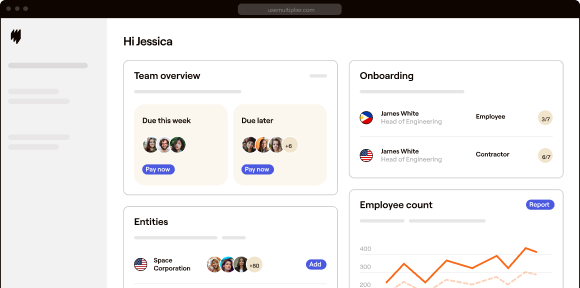
Workforce planning helps finance leaders to compare potential hiring decisions and outcomes, identifying warning signs before they become expensive problems
Finance teams have historically built plans around stable assumptions.
But with economic uncertainty and global volatility the new normal — from geopolitical tensions and tariff escalations, to labor market shifts and AI — the rules of the game have changed.
As a result, finance leaders are now prioritizing planning for external challenges (such as inflation, tariffs, and regulations), and adopting new technology (including AI).
Volatility triggers financial resilience push
Speaking to The Exchange, finance leaders from across the globe set out the challenge that rising volatility poses to their function.
“Economic factors like tariffs and inflation are putting pressure on supply chains making revenue forecasts more difficult,” says Dave Sackett, VP of Finance at US-headquartered Persimmon Technologies. “A finance leader must prepare for uncertainty by hedging risk and reviewing the reasonableness of new proposals.”
Ivana Siregar, who lives in Indonesia and serves as Head of Finance at Singaporean firm Fullerton Health, agrees that uncertainty has “become part of the normal operating environment for finance leaders.”
“In Indonesia, we have to navigate global geopolitical tensions, trade-policy changes, commodity prices, interest rates, and the biggest one, FX volatility, while also dealing with domestic factors such as purchasing power, regulatory changes, and government policy priorities,” she explains. “Changes in global commodity prices, capital flows, and trade policies can transmit relatively quickly into the Rupiah, input costs, financing, and investment decisions.”
The finance leader adds that these issues, i.e. “weaker currencies, energy costs, labor availability, trade restrictions, or regulations,” will vary significantly from country to country.
Accordingly, global employers are expanding the scope of their scenario planning to bolster their preparations.
Over half of finance leaders surveyed by Deloitte (58%) said they were planning to build stronger anticipation and response capabilities within their department to improve organizational resilience, including advanced scenario planning and more agile governance models.
“Finance needs to understand both the global picture and the local transmission mechanism. For me, this fundamentally changes the role of finance,” Siregar says.
She suggests the need for a shift toward agile scenario planning as a tool for decision making in areas including workforce management. “We cannot simply explain what happened or produce an annual budget. We need to help management understand what could happen, what the financial impact could be, and what options we have to respond.”
Expand scenario planning capabilities
Finance teams must now invest more time and resources into planning for different contingencies.
As David Chojnowski, Walmart’s Corporate Controller and Chief Accounting Officer, told Deloitte: “Scenario planning is something we’ve always done, but the current environment has caused us to really accelerate the way we do it. In the past, we may have run scenarios monthly; now, we’ve been running models and doing analysis almost daily.”
Sackett echoes this verdict, noting that planning exercises should include how certain scenarios may impact headcount.
“Companies should have financial models to prepare for workforce planning well into the future,” he says. “Have scenarios for increased business and decreased business. What roles, and how many, will be required?”
Siregar agrees, and suggests that planning exercises should focus on exploring how, under different conditions, the company can derive the greatest business value from the people, technology, and resources it has.
“I believe the starting point is changing the mindset around forecasting,” she explains, noting that workforce planning must be seen as “a decision-making tool based on current assumptions.”
“This is particularly important where changes in purchasing power, FX, interest rates, regulation, and trade policies can quickly affect business performance,” Siregar continues. “Rather than trying to predict one ‘correct’ outcome, I would build a base, downside, and upside scenario, and connect each to workforce requirements.”
The role of workforce planning
Workforce planning is an important part of scenario planning for finance leaders. Types of scenarios include:
- If revenue accelerates, what capabilities and capacity do we need?
- If growth slows, which activities can be automated, redesigned, or deferred?
- If AI or technology changes how certain work is performed, what new skills will we need?
Employers increasingly must have a clear view of such problems, and what their response would be should such a situation arise.
Siregar explains that workforce planning should not be reduced to an efficiency exercise focused on reducing costs, or replacing jobs with AI.
Instead, the objective is to maximize the value and impact of the workforce on business performance: “If technology removes repetitive work, the question should be: How can we redeploy that capacity toward higher-value activities that drive revenue, customer experience, productivity or better decision-making?”
The finance leader offers an example from a previous role. “The objective was to eliminate repetitive work, improve reconciliation and reporting, and allow finance people to focus more on analysis and business partnering,” she recounts. “I measured workforce planning not only through cost per employee or headcount, but through measurable outcomes such as productivity, revenue per FTE, margin contribution, process efficiency, working-capital impact, and ultimately return on people and technology investment.”
Cross-team visibility matters
Successful scenario planning starts with cross-team visibility.
For finance leaders in global firms, it means having a real-time pulse on inputs including global headcount costs, voluntary attrition rates, and localized wage inflation across dozens of countries, simultaneously.
“Establish a single workforce-finance data framework covering headcount, payroll, benefits, vacancies, turnover, recruitment costs, productivity, and skills, and connect these with revenue, OPEX, EBITDA, and cash-flow assumptions,” Siregar recommends as a first step.
Sackett adds that “meeting with department leaders” is a key to creating alignment, and ensuring the necessary inputs are in place to test different scenarios.
“Finance and HR should collaborate on budgeting the headcount and managing the company,” the VP asserts. “HR can provide inputs to help finance plan budgets and forecasts.
“Maintaining accurate payroll data and making payments on time is also critical,” he continues.
Siregar similarly advises to “involve finance, HR, operations, commercial, and technology teams from the beginning.”
“Finance brings the financial model, HR brings workforce and talent data, operations validates capacity requirements, and technology assesses automation and productivity opportunities,” she notes. “I see finance and HR as two sides of the same business equation. Finance understands affordability and financial impact, while HR understands people, capabilities, organizational structure, and workforce dynamics.”
Fragmented data adds to complexity
Technology can connect HR, finance, and countless other data points, but system integration alone doesn’t guarantee success.
“You need clean master data, consistent definitions, transparent assumptions and regular Finance-HR reviews,” Siragar states. “Ultimately, the goal is to make decisions comparable, transparent, and financially sustainable while remaining locally appropriate.”
Workforce planning is more complex in multinational or global organizations, where costs cannot always be readily compared due differences in minimum wages, employment regulations, social security requirements, taxation, working conditions, and employee benefit structures.
Moreover, the rising uncertainty of operating conditions and volatility of economies and supply chains means that models must be capable of factoring an extensive range of constantly shifting inputs.
Chojnowski, for example, told Deloitte that Walmart has used AI to make its scenario planning models more sophisticated, enabling the commerce giant to feed in data points on pricing, inventory, supplier dynamics, and customer trends.
“We’re able to use AI to understand market trends and correlate those trends and other competitors’ decisions with ours in a way that we haven’t been able to in the past,” he said.
Sackett also observes that “many companies are looking into efficiency improvements of using AI to help manage risk.”
Consistent frameworks & local differences
Consistent frameworks, cross-team alignment, and local responsiveness enable finance leaders to conduct more effective planning and informed decision-making.
At Fullerton, for example, an employee in Singapore may appear to receive significantly higher benefits in absolute monetary terms than an employee in Indonesia. However, the two markets have very different wage levels and regulatory environments.
“Simply comparing the nominal benefit amount can create a misleading conclusion about whether employees are being treated equitably,” Siregar explains. “This is where finance and HR need to establish consistent framework for measuring workforce value and total employment cost, while recognizing local differences,”
“Instead of comparing benefits by absolute value, consider metrics such as total compensation as a percentage of local market salary, benefits relative to local cost of living, statutory versus discretionary benefits, and overall employer cost per FTE (Full Time Equivalent),” she suggests.
This balance is the key to successful workforce planning that enables agility and responsiveness to volatility — agreement on a common definition and consistent analytical framework, with allowances country-specific assumptions for local regulation and market conditions.
Doing so allows leadership teams to understand the relative cost and value of its workforce across markets, and make more informed investment decisions, a growing priority for all finance departments.
As Siregar concludes: “Modern finance leadership is ultimately about resilience, agility, and informed decision-making under uncertainty.”