Hiring a Q60,000 GTQ employee in Guatemala costs an employer roughly Q81,000 to Q86,000 GTQ per year once you factor in mandatory social security, statutory 13th- and 14th-month salaries, the monthly bonificación, and a severance provision. That is before one-time recruitment and onboarding, which push the first-year figure higher.
Guatemala is one of Central America’s most active nearshore hiring markets, with a growing pool of bilingual technology, finance, and customer-support talent and wage levels well below United States and Western European benchmarks. The base salary on an offer letter, though, is only part of the picture. Guatemalan labor law layers several mandatory contributions and bonuses on top of pay, and getting the classification of each one wrong is a common source of budget overruns and compliance exposure.
This guide breaks down what it actually costs to employ someone in Guatemala in 2026. It covers statutory employer contributions, mandatory bonuses, leave obligations, salary benchmarks, and the one-time costs of recruiting and onboarding, then works through a full sample budget for a mid-senior hire. Multiplier runs payroll and compliance in more than 150 countries, and the figures below are drawn from current Guatemalan legislation and official wage data. To model a specific role instantly, use Multiplier’s employee cost calculator.
How much does it cost to hire an employee in Guatemala? (Quick benchmark)
Total employer cost in Guatemala breaks into two parts: the ongoing mandatory burden that sits on top of every salary (about 34% to 43% of base), and one-time recruitment and onboarding costs incurred in the first year. The table below gives an illustrative first-year picture by seniority. Salary figures are annual gross in quetzales and reflect local-market pay rather than remote-for-foreign-employer rates, which run considerably higher.
| Role tier | Typical gross salary (annual) | Mandatory employer add-on | One-time recruitment | Illustrative Year 1 total |
|---|---|---|---|---|
| Entry-level / support | Q54,000 – Q96,000 | 34–43% | 10–15% of salary | Q78,000 – Q149,000 |
| Mid-level professional | Q120,000 – Q264,000 | 34–43% | 15–20% | Q179,000 – Q430,000 |
| Senior / specialist | Q264,000 – Q480,000 | 34–43% | 20–30% | Q407,000 – Q830,000 |
The mandatory add-on percentage is broadly constant across seniority because it is driven by statutory rates and bonuses that scale with salary. What changes most by seniority is the one-time recruitment cost, which rises sharply for scarce senior and specialist profiles.
Cost by region: where formal employment concentrates
Guatemala sets its minimum wage on a two-tier geographic basis under Acuerdo Gubernativo 256-2025, effective 1 January 2026. Circunscripción Económica 1 (CE1) covers only the department of Guatemala, including Guatemala City and surrounding municipalities, and carries the higher wage floors. Circunscripción Económica 2 (CE2) covers the other 21 departments.
The department of Guatemala also concentrates the majority of the country’s formal-sector, professional, and technology roles, which means employers competing for skilled talent there should expect to pay a premium over both the statutory floor and salaries in the rest of the country.
| Region | Non-agricultural minimum (monthly, incl. Q250 bonificación) | Context |
|---|---|---|
| Department of Guatemala (CE1) | Q4,252.28 | Highest wage floor; heaviest concentration of formal, professional, and tech employment; strongest competition for skilled talent |
| Rest of country (CE2), 21 departments | Lower floors, from Q3,471.10 for export/maquila | Lower wage floors; emerging back-office and support hubs; less competition for talent |
Professional and technology salaries sit well above these minimums in both regions. The floors matter mainly as a compliance baseline and as an indicator of the regional cost gradient.
What is the total cost of employment in Guatemala?
The gap between base salary and true employer cost in Guatemala comes from a predictable set of statutory items. For a professional earning Q60,000 gross per year (Q5,000 per month), the components stack up as follows.
| Component | Amount (annual) | Notes |
|---|---|---|
| Gross base salary | Q60,000 | Q5,000 per month |
| Employer IGSS + IRTRA + INTECAP (12.67%) | Q7,602 | Calculated on ordinary salary |
| Aguinaldo (13th month, December) | Q5,000 | One month of salary |
| Bono 14 (14th month, July) | Q5,000 | One month of salary |
| Bonificación incentivo (Q250 per month) | Q3,000 | Flat monthly amount, not subject to IGSS or income tax |
| Severance provision (1 month per year) | Q5,000 | Accrued; paid on termination without just cause |
| Total employment cost | Q85,602 | Roughly 43% above base salary |
Excluding the severance provision, which only crystallises on a no-fault termination, the recurring mandatory cost is about Q80,600, or 34% above base. Provisioning for severance from day one, which most careful budgets do, brings the figure to about Q85,600, or 43% above base. Add one-time recruitment and onboarding, and the first-year total climbs further, as the sample breakdown later in this guide shows.
A useful rule of thumb: because of the two annual salaries (Aguinaldo and Bono 14), an employee in Guatemala is paid across roughly 14 months of salary each year, before social security and the bonificación are even counted.
Salary benchmarks in Guatemala
Local-market salaries in Guatemala are competitive within Central America and low relative to the United States pay for equivalent roles. The ranges below are indicative monthly gross figures and vary meaningfully by source, employer type, and experience, so treat them as a starting point rather than a fixed rate. Note that talent hired to work remotely for a foreign company commands substantially more than the local-market figures shown here, with senior remote developers earning Q40,000 or more per month.
| Role | Typical local-market gross (monthly) | Source |
|---|---|---|
| Software engineer (mid-level) | Q12,000 – Q22,000 | Payscale, Glassdoor |
| Senior software engineer | Q22,000 – Q40,000 | Payscale, livinginguatemala |
| Corporate accountant | Q6,000 – Q14,000 | livinginguatemala |
| Marketing manager | Q10,000 – Q20,000 | livinginguatemala |
| Customer-support / BPO agent | Q4,500 – Q8,000 | livinginguatemala |
| Finance / operations lead | Q15,000 – Q30,000 | livinginguatemala |
For context on the currency, one United States dollar was worth about 7.6 quetzales in early August 2026, so a Q60,000 annual salary is roughly USD 7,900.
Mandatory employer costs when hiring in Guatemala
Four categories of cost are legally required of every employer in Guatemala. Classifying any of them incorrectly, or treating a mandatory item as optional, is a frequent cause of underestimated budgets.
Social security (IGSS, IRTRA, INTECAP): The employer contributes 12.67% of gross salary, split into 10.67% to the Instituto Guatemalteco de Seguridad Social (IGSS), 1% to the workers’ recreation institute (IRTRA), and 1% to the technical training institute (INTECAP). The employee separately contributes 4.83%, deducted from pay. Registration with IGSS is mandatory from the first employee.
Aguinaldo (13th-month salary): A full month of salary paid in December, mandated by law for all employees.
Bono 14 (14th-month salary): A second full month of salary, paid in July. Aguinaldo and Bono 14 are distinct obligations, and together they add the equivalent of two months of salary each year.
Bonificación incentivo: A flat Q250 per month paid on top of salary to all full-time employees, established under Decreto 78-89. It is not subject to IGSS contributions or income tax. For workers paid well above the minimum, this amount is often folded into the negotiated monthly package, but it remains a legal requirement.
Severance (indemnización): On termination without just cause, the employer owes one month of salary per year of service under Article 82 of the Labor Code. This is not a running cost, but prudent budgets provision for it as it accrues.
| Contribution | Rate / amount | Basis | Notes |
|---|---|---|---|
| IGSS | 10.67% | Ordinary gross salary | Employer share; funds health, maternity, pensions, accidents |
| IRTRA | 1% | Ordinary gross salary | Workers’ recreation institute |
| INTECAP | 1% | Ordinary gross salary | Technical training institute |
| Aguinaldo (13th month) | One month | Salary | Paid in December |
| Bono 14 (14th month) | One month | Salary | Paid in July |
| Bonificación incentivo | Q250 / month | Flat | Not subject to IGSS or income tax |
| Severance | One month per year | Salary | Payable on termination without just cause |
Guatemala does not levy a separate employer payroll or income tax beyond these contributions. Personal income tax (Impuesto Sobre la Renta, ISR) is the employee’s liability. The employer withholds it, but the first Q48,000 of annual income is exempt, with 5% applying up to Q300,000 and 7% above that.
Statutory leave obligations
| Leave type | Minimum entitlement | Who pays | Notes |
|---|---|---|---|
| Annual leave | 15 working days after one year of continuous service | Employer | Generally taken as a single block |
| Sick leave | Paid; employer covers the first days, then IGSS covers a portion for certified illness | Employer, then IGSS | Requires a medical certificate; IGSS benefit depends on contribution history |
| Maternity leave | 84 days (30 before, 54 after birth) at full pay | IGSS | Employment protected during leave; nursing breaks apply afterward |
| Paternity leave | 2 days | Employer | Set by the Labor Code |
| Public holidays | National public holidays set by the Labor Code, plus one local holiday for the municipality | Employer | Work on a holiday is compensated at a premium |
Employee benefits and optional employer costs
Beyond the statutory floor, employers competing for skilled talent in Guatemala, particularly in the capital, often add market-driven benefits. These are not legally required, and treating them as mandatory is a common budgeting error, but they matter for attracting and retaining professionals.
| Benefit | Mandatory? | Typical employer cost | Market norm |
|---|---|---|---|
| Private health insurance | No | Varies by plan | Common for professional and senior roles to supplement IGSS coverage |
| Pension / retirement top-up | No (IGSS pension is statutory) | Varies | Rare in the local market; more common at multinationals |
| Performance / annual bonus | No (separate from statutory Aguinaldo and Bono 14) | Varies | Discretionary; used to stay competitive |
| Transport or meal allowance | No | Modest monthly stipend | Frequently offered for office-based roles |
| Training and upskilling | No | Varies | Valued in the technology and finance talent pools |
External and hidden hiring costs
The mandatory and optional costs above are the recurring picture. Recruiting and onboarding a new hire also carry one-time costs that belong in any honest first-year budget.
Recruitment costs
| Method | Cost | Notes |
|---|---|---|
| Local job boards | Modest per-posting fee | Cost-effective for entry and mid-level roles |
| Recruiter or agency | 15–25% of first-year salary | Standard success-fee range; higher for scarce senior profiles |
| Internal referral bonus | Varies by company policy | Often the lowest-cost channel |
Onboarding and equipment
| Item | Cost range | Notes |
|---|---|---|
| Equipment (laptop and setup) | Q6,000 – Q16,000 | One-time hardware cost per professional |
| Software licences | Per-seat, ongoing | Depends on the role’s tool stack |
| Training and ramp-up | First 2–4 months of reduced output | An indirect cost while the hire reaches full productivity |
Sample cost breakdown: hiring a Q60,000 mid-senior role in Guatemala City
To bring the components together, consider a company onboarding a mid-senior professional in Guatemala City on a Q60,000 gross annual salary (Q5,000 per month), on an open-ended contract in a standard office environment.
| Component | Amount | Notes |
|---|---|---|
| Gross base salary | Q60,000 | Q5,000 per month |
| Employer IGSS + IRTRA + INTECAP (12.67%) | Q7,602 | On ordinary salary |
| Aguinaldo (13th month) | Q5,000 | Paid December |
| Bono 14 (14th month) | Q5,000 | Paid July |
| Bonificación incentivo (Q250 / month) | Q3,000 | Flat, not subject to IGSS or ISR |
| Severance provision (1 month per year) | Q5,000 | Accrued for no-fault termination |
| Recruitment (one-time, ~15%) | Q9,000 | Year 1 only |
| Onboarding and equipment (one-time) | Q8,000 | Year 1 only |
| Year 1 total | Q102,602 | Roughly 71% above base with one-time costs included |
| Ongoing total (Year 2 onward) | Q85,602 | Roughly 43% above base |
The recurring cost of this hire settles at about Q85,600 per year, or 43% above the negotiated salary, driven mainly by the two annual salaries and the 12.67% social security burden. The elevated Year 1 figure reflects one-time recruitment and onboarding rather than an ongoing rate.
Estimate your total cost of employment
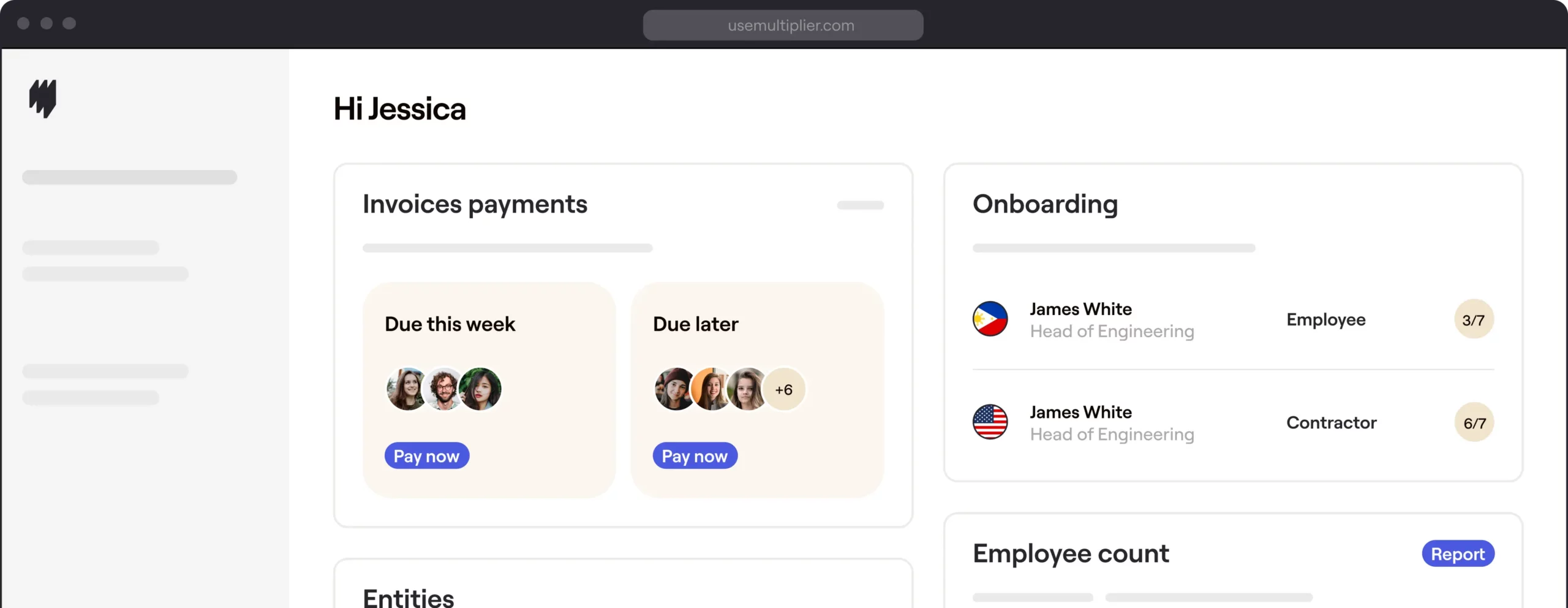
To model any role in Guatemala without building a spreadsheet by hand, use Multiplier’s employee cost calculator for an instant breakdown of salary, employer contributions, and statutory costs.
How to reduce hiring costs in Guatemala
- Weigh an employer of record against entity setup: Establishing a local entity in Guatemala carries registration, legal, accounting, and ongoing administrative costs. For small or early-stage teams, an employer of record in Guatemala avoids that fixed overhead entirely.
- Consolidate payroll and compliance: Running payroll through a single provider rather than a patchwork of local vendors reduces reconciliation work and the risk of missed statutory filings. Multiplier folds contributions, bonuses, and Guatemalan payroll into one monthly invoice.
- Benchmark to the local market: Anchoring offers to Guatemalan salary data rather than to expatriate or foreign-market packages keeps compensation competitive without overpaying.
- Right-size the benefits mix: Distinguish clearly between statutory obligations and optional benefits, and design a consistent benefits tier rather than negotiating perks case by case.
- Consider location within Guatemala: Because the department of Guatemala carries the highest wage floors and the strongest competition for talent, hiring skilled remote workers based in other departments can lower the wage premium while keeping the same talent pool.
Why companies use Multiplier for hiring in Guatemala
Hiring in Guatemala means staying current with IGSS contributions, the Aguinaldo and Bono 14 schedules, the bonificación, ISR withholding, and severance rules, all of which change over time. Multiplier handles this as the legal employer of record in Guatemala, so a company can hire without setting up an entity.
- Owned-entity model: Multiplier owns 160+ legal entities and is the employer of record in the countries it operates in, rather than routing employment through third-party local partners. That means statutory liability is assumed directly, not passed between a vendor and its local partner.
- Compliant local contracts: Employment agreements are generated to Guatemalan labor law, with mandatory contributions and bonuses built into payroll.
- Transparent pricing: Multiplier offers transparent pricing with no hidden fees, ensuring that all-in employer costs are disclosed upfront before signing, with no onboarding penalties.
- Dedicated support: One dedicated Customer Success Manager per account, backed by 24/7 human support rather than a rotating ticket queue.
Companies looking for an employer of record service can use Multiplier to hire, onboard, and pay employees in Guatemala and 150+ other countries from a single platform.
FAQ
What is the average cost to hire an employee in Guatemala?
For a Q60,000 gross annual salary, an employer typically pays around Q81,000 to Q86,000 per year in mandatory costs, about 34% to 43% above base once IGSS, the Aguinaldo and Bono 14, the bonificación, and a severance provision are included. One-time recruitment and onboarding raise the first-year figure.
What employer contributions are required in Guatemala?
The mandatory employer social security contribution is 12.67% of gross salary: 10.67% to IGSS, 1% to IRTRA, and 1% to INTECAP. Employers must also pay the Aguinaldo (13th-month salary in December), the Bono 14 (14th-month salary in July), and the Q250 monthly bonificación incentivo.
Is there income tax for employers in Guatemala?
There is no separate employer income or payroll tax beyond social security and the statutory bonuses. Personal income tax (ISR) is the employee's liability, withheld by the employer. The first Q48,000 of annual income is exempt, with 5% up to Q300,000 and 7% above.
How much is severance pay in Guatemala?
On termination without just cause, the employer owes one month of salary per year of service under Article 82 of the Labor Code. Severance is not owed when an employee is dismissed for a legally recognised just cause or resigns.
What benefits must employers provide in Guatemala?
The statutory minimum is IGSS enrolment, the Aguinaldo, the Bono 14, the Q250 bonificación, 15 working days of annual leave after one year, maternity leave of 84 days funded through IGSS, and paid sick leave. Private health insurance and other perks are optional and market-driven.
Can I hire in Guatemala without setting up a legal entity?
Yes, using an employer of record such as Multiplier lets a company hire employees in Guatemala compliantly without registering a local entity, with the provider acting as the legal employer and handling payroll, contributions, and compliance.
How does Multiplier simplify hiring costs in Guatemala?
Multiplier consolidates salary, employer contributions, statutory bonuses, and compliance into a single monthly invoice with costs disclosed before signing. As the owner of its local entities, it assumes statutory liability directly and provides a dedicated customer success manager per account.
Ready to hire in Guatemala without the overhead of an entity? Book a demo with Multiplier to model your total employment costs and onboard compliantly from day one.