South Africa has a sizable independent workforce. According to the latest Quarterly Labour Force Survey from Statistics South Africa, informal sector employment represented 19.5% of total jobs in the fourth quarter of 2024, making it the country’s second-largest source of employment after the formal sector.
As businesses expand remote and distributed teams across the country, careful contractor management has become essential. This guide covers classification rules, tax responsibilities, invoicing, and documentation needed to hire contractors compliantly in South Africa.
What is contractor management in South Africa?
Contractor management in South Africa involves hiring, onboarding, paying, and overseeing independent providers in line with SARS tax rules and local labor considerations.
It requires determining the correct worker classification, preparing compliant agreements, validating tax details, processing accurate invoices, and maintaining regulatory documentation that supports contractor status.
A structured contractor management system helps organizations avoid misclassification and reduces exposure to penalties, interest, and back payments.
Key compliance requirements for managing contractors in South Africa
Contractor compliance in South Africa involves contractual, tax, and regulatory considerations. Organizations must ensure that the engagement structure reflects independence and that documentation aligns with SARS requirements.
Independent contractors vs employees in South Africa
South African classification hinges on who controls the work, where the work is performed, and how dependent the contractor is on a single client. Employees are subject to PAYE, UIF, SDL, and COIDA coverage, while contractors handle provisional tax and operate independently. Misclassification may expose organizations to penalties, backdated deductions, and compliance investigations.
Should you hire a contractor or an employee in South Africa?
This contractors vs employees in South Africa guide explains legal obligations, costs, benefits, and compliance risks to help you choose the right classification.
Service agreement in South Africa
A written service agreement is recommended for contractor engagements in South Africa. It sets expectations for deliverables, timelines, confidentiality, IP rights, and termination terms, offering protection for both parties.
Scope of work
- The scope should define deliverables, performance standards, timelines, and acceptance criteria.
- Clear deliverable-based outcomes support independent status and reduce classification risk.
Income tax
- Independent contractors manage their own income taxes through the provisional tax system, filing IRP6 declarations and making biannual payments.
- Employees, on the other hand, fall under PAYE administered by the employer.
Withholding tax obligations
- Some payments to non-resident contractors may be subject to withholding tax depending on the nature of services and treaties.
- Where withholding applies, companies must remit the tax and provide supporting documentation.
VAT registration
- Contractors that meet the VAT registration threshold must register and follow SARS VAT rules.
- VAT invoices must include VAT numbers, invoice dates, service descriptions, and the VAT portion.
Contractor invoices in South Africa
- Invoices must be submitted before payments can be processed.
- Each invoice should contain contractor information, a service description, fee amounts, VAT details if applicable, and payment terms.
Tax and finance rules in South Africa
- SARS requires contractors and businesses to maintain tax documentation for audits.
- Contracts, invoices, PAYE records where applicable, VAT documents, and payment histories must be kept securely.
For global HR managers, the checklist below turns South Africa’s contractor compliance rules into a practical, documentation-first framework to reduce audit and misclassification risk.
Contractor compliance in South Africa: HR managers’ checklist
Use this checklist to maintain compliance when hiring contractors in South Africa:
☐ Tax identification number
Verifies the contractor’s tax status with SARS.
☐ VAT registration certificate (if applicable)
Required when contractors meet VAT registration criteria.
☐ Written service agreement
Defines deliverables, payment terms, confidentiality, and termination.
☐ Contractor invoices
Mandatory for payment processing and tax reporting.
☐ Bank account details
Needed for accurate payments.
☐ Withholding tax records
Required when withholding applies to non-resident contractors.
Note: You can download this checklist as an Excel sheet for documentation tracking and audit readiness.
Manage global contractors effortlessly
Watch how Multiplier helps you manage global contractors while simplifying compliance, payments, and oversight across countries, including South Africa, in this short walkthrough.
8 Best practices for contractor management in South Africa
Providing practical, actionable guidance helps you streamline operations and reduce compliance risk. Here are eight proven strategies:
1. Centralize contractor documents for clear oversight
Store agreements, tax details, and invoices in a single system for accuracy and consistency. Centralized documentation improves compliance and helps teams respond quickly during SARS reviews.
2. Standardize onboarding to reduce gaps
Create a consistent onboarding process that captures tax details, agreements, and banking information. Standardization helps HR and finance teams maintain complete and compliant records.
3. Use precise contracts to reinforce independence
Structured service agreements with clear deliverables, payment terms, and IP clauses help maintain contractor status. Accurate agreements also limit employer-style control that could trigger reclassification.
4. Pay contractors on time to maintain project continuity
Timely payments support strong working relationships and predictable project delivery. Reliable payment cycles also reduce disputes and help maintain a professional partnership.
5. Maintain detailed invoices aligned with SARS standards
Invoices should clearly reflect service dates, descriptions, and VAT information when applicable. Accurate invoices streamline tax reconciliation and simplify financial reviews.
6. Keep contractor and employee workflows separate
Avoid applying employee-style controls or benefits to contractors. Clear separation helps preserve contractor classification and minimizes compliance risks.
7. Conduct periodic reviews to check classification and tax obligations
Contractor roles evolve, which can alter SARS classification. Regular reviews help identify risks early and allow updates to documentation or agreements.
8. Use unified platforms for compliance and visibility
Integrated platforms help manage onboarding, documentation, contracts, and payments in one place. Greater visibility helps teams track contractor activity and ensure compliance across engagements.
These best practices are easier to implement using a contractor management system. Next, we explore how to choose the best contractor management system in South Africa.
How to choose the best contractor management systems in South Africa
An effective contractor management platform should:
- Support SARS-compliant invoicing and withholding documentation
- Provide templates that reinforce independent contractor classification
- Track VAT registration status and maintain a complete invoice history
- Store agreements, tax IDs, and payment documents securely
- Handle ZAR and cross-border payments with approval workflows
“Unless we have a centralized provider with a unified platform, it becomes very difficult for companies to strategize and handle the complexities in global payroll.” — Menaka Karthikeyarayan, VP Payroll Operations at Multiplier
How Multiplier enables compliant, scalable contractor management in South Africa
Multiplier simplifies the complexity of managing contractors across South Africa through:
- The ability to hire South African contractors without setting up a local entity, removing the need for company registration, local bank accounts, or direct interaction with domestic authorities.
- Compliant agreement templates aligned with South African tax norms, helping ensure contracts reflect independent status and reduce the risk of misclassification or labor law exposure.
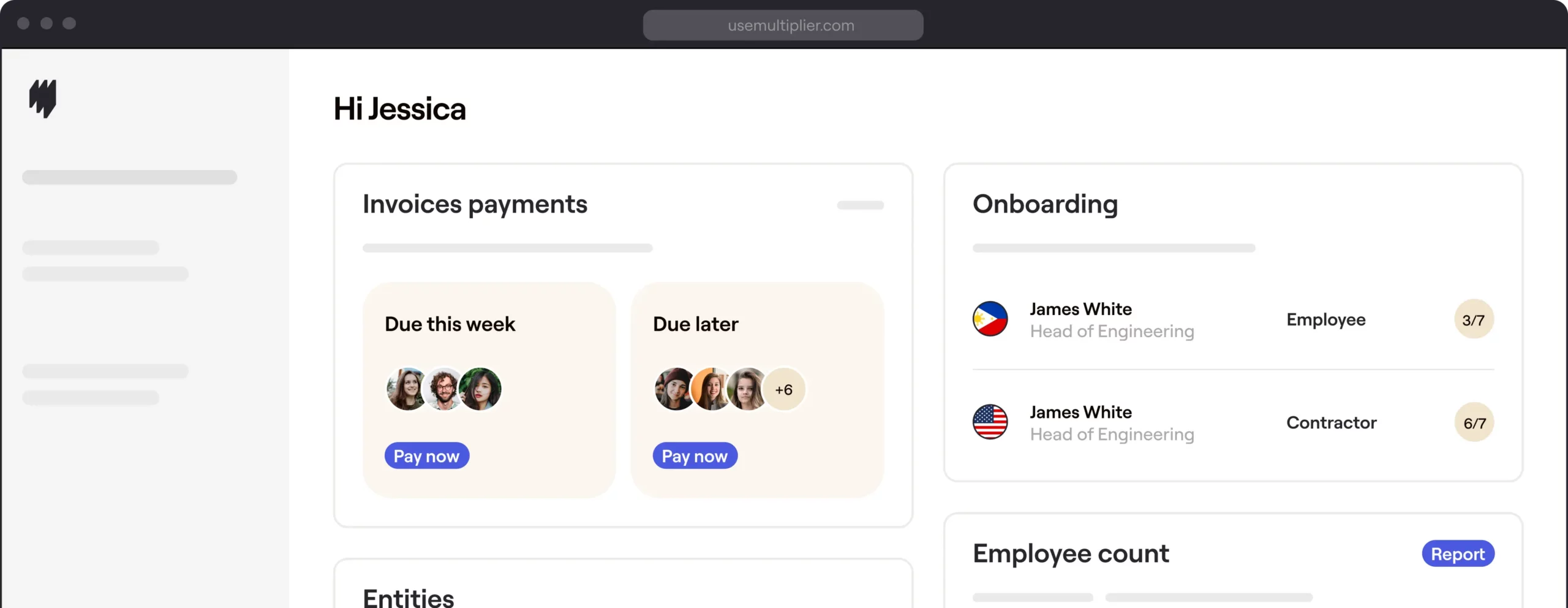
- Centralized payroll, payments, and documentation in one dashboard with clear, audit-ready records that support consistent reporting and financial transparency.
- Tools that reduce misclassification and support compliance by enforcing structured onboarding, classification guidance, and standardized workflows.
- A unified dashboard for contracts, onboarding, invoices, and payments, allowing finance and HR teams to manage the full contractor lifecycle from a single system.
What Capterra reviewers say about Multiplier
“It is a complete solution for our international hiring, onboarding & payroll needs. Moreover, the multi-lingual contracts coverage is a bonus.” — Chinmay C., Co-Founder, Accounting
Book a demo to see how Multiplier simplifies compliant contractor management in South Africa and helps your team scale confidently.
FAQs
Is it legal to hire independent contractors in South Africa?
Yes. Companies can hire contractors in South Africa as long as the agreement reflects independence and avoids employer-style control. Clear documentation reduces misclassification exposure.
How are contractors taxed in South Africa?
Contractors usually pay provisional tax and submit IRP6 returns. Employees fall under PAYE. In some cases, a contractor may be treated as a deemed employee, which requires employer withholding.
What is the difference between a contractor and an employee in South Africa?
Contractors manage their work independently and file their own taxes. Employees are supervised, receive statutory benefits, and require PAYE deductions. Correct classification helps prevent penalties.
Does Multiplier help with contractor compliance in South Africa?
Yes. Multiplier offers onboarding tools, compliant agreement templates, payment systems, and documentation workflows that support SARS compliance and reduce misclassification risk.
What documentation is required when hiring contractors in South Africa?
A tax identification number, service agreement, compliant invoices, bank details, and VAT documents when applicable. These records support tax reporting and audit readiness.
Do contractors receive employee benefits in South Africa?
No. Contractors do not receive benefits such as UIF or paid leave unless reclassified as employees. These benefits apply only under formal employment relationships.
Can foreign companies pay South African contractors directly?
Yes. Foreign businesses can pay contractors directly as long as compliant invoices are collected and any applicable withholding tax is remitted. Multiplier can simplify cross-border payment workflows.