The Liechtenstein Civil Code (ABGB) and the Employment Act, which provide the foundation for governing employer-employee interactions, are the main laws governing employee benefits and compensation in Liechtenstein. To provide a high level of worker protection, these regulations impose stringent criteria for social security, working hours, and leave rights.
The following entities are covered under these laws:
- Local employers: Companies that are based in the Principality and are registered there.
- Foreign companies: Foreign businesses with employees in Liechtenstein that often need to comply with certain cross-border tax agreements.
The significance of compliance:
- Protecting employees: Ensuring that employees enjoy the premium advantages that the EEA offers.
- Legal issues with the Office of Economic Affairs can be avoided by ensuring compliance and minimizing penalties and litigation.
- Legal HR management: Handling the intricate “three-pillar” pension plan and the most recent 2026 leave changes.
This guide also illustrates how hiring and managing staff may be made easier for international teams by utilizing Employer of Record (EOR) services.
What are employee benefits?
Employee benefits are additional perks or advantages offered on top of compensation. The company provides a variety of benefits to its workers, including health insurance, vacation time, and pension contributions.
These benefits help to build employee trust and retain talent. It also makes employees feel that their employers are investing in their stability and career advancement. This article explores Liechtenstein’s benefits and compensation framework in detail.
Compensation laws in Liechtenstein
Although strictly controlled, compensation is variable in Liechtenstein. The Labor Code and other industry-specific Collective Bargaining Agreements (CBAs) set payroll rules, even though there isn’t a single national minimum wage.
Employers are required by law to follow these guidelines:
- Fair remuneration: If the industry is covered by a general applicability agreement, wages must be in line with CBA standards.
- Minimum wages: There is no statutory national minimum wage in Liechtenstein. Pay rates must be agreed upon directly between the employer and employee.
- Overtime premiums: For office, technical, and industrial staff, the standard week is 45 hours. Overtime must be paid at 125% of the regular rate or compensated with equivalent time off.
- Swiss Franc (CHF) payments: Due to the nation’s currency union with Switzerland, salaries are typically denominated and paid in Swiss francs.
- 13th-month salary: Paying a 13th-month bonus is a common market practice that employees anticipate, even though it is not required by law.
- Record-keeping: Employers must maintain detailed records of hours worked, including overtime and rest periods, for at least five years to ensure compliance with the Office of Economic Affairs.
How to design an employee benefits program in Liechtenstein?
To meet employee needs and retain top talent, organizations must carefully consider how to design their benefits package. Additionally, an effective design lowers the expense of employee perks and pay.
Step 1: Establish a precise budget and target
Establishing your goals is the first step. Your objective may be to compete with Swiss or Austrian companies for specialized personnel in a high-income market like Liechtenstein. Common objectives include:
- Must help attract cross-border commuters (over 50% of the workforce)
- Must adhere to the mandatory “Three Pillar” pension contributions
- Must provide competitive “fringe benefits” to stand apart from Swiss competitors
- The “Total Cost of Employment,” which includes required contributions to the Family Compensation Fund (FAK) and the Old-Age and Survivors’ Insurance (AHV), employers should budget an additional 15–20% for statutory contributions.
Step 2: Do an internal and external analysis
Find out what your employees value by doing a needs assessment. Benefits like flexible “frontier worker” arrangements (for individuals traveling from nearby nations) are frequently given top priority in the local market. Benchmark your offerings against market standards in Vaduz’s banking and industrial sectors.
Step 3: Develop an adaptable and customized strategy for employee benefits
After determining the gaps, create a strategy that can be customized. You may provide commuter mobility allowances, additional occupational pension contributions, meal vouchers (Lunch-Checks), or professional development grants in addition to the required pillars. This flexibility ensures the package is relevant to a variety of groups, from young foreigners to elderly residents.
Step 4: Explain the benefits package to current and prospective workers
Effective communication is essential, particularly in light of the 2026 modifications to paid parental leave. Workers must be aware of their own health insurance obligations as well as how their payments are distributed among the three pension pillars. Transparency helps build long-term trust, which is essential for talent retention.
Step 5: Evaluate the benefits’ efficacy
Review the program on a regular basis. Failing to adapt may result in non-compliance since Liechtenstein regularly adopts EU-aligned legislation, such as the current Work-Life Balance Directive. As the EEA legislation changes, ongoing evaluation guarantees that your perks stay competitive and lawful.
Types of guaranteed benefits in Liechtenstein
Liechtenstein provides a structured framework of statutory benefits, including social security pensions, paid leave entitlements, parental and maternity support, and sickness and disability protection.
Social security (the three pillars)
- First pillar (AHV/IV): Mandatory state pension and disability insurance. Employer and employee each contribute approx. 4.9% and 4.7% respectively.
- Second pillar (BVG): Mandatory occupational pension for employees earning over a specific threshold. Employers must contribute at least 50% of the premium.
- Third pillar (Pillar 3a): Voluntary private savings with tax incentives. As of 2026, retroactive purchases are possible to close previous contribution gaps.
Annual leave and holidays
Age determines statutory yearly leave:
- Less than 50: At least four weeks (20 days)
- Over 50: At least five weeks (25 days)
In addition, the nation has about 13 to 15 official public holidays that are recognized as paid time off.
Paid parental and paternity leave (New for 2026)
Liechtenstein has greatly increased family benefits as of January 1, 2026:
- Paternity leave: Eligible fathers are entitled to 2 weeks (10 working days) of paid leave, compensated at 80% (capped), to be taken within 8 months of birth.
- Parental leave: Each parent is entitled to 4 months of leave. 2 of these months are now paid by the Family Compensation Fund (FAK), capped at CHF 4,900/month.
Maternity leave
20 weeks of maternity leave are granted to mothers. This is 80% paid for by the Family Compensation Fund or illness insurance, guaranteeing that the worker gets a substantial portion of their usual pay during this time.
Sickness and disability leave
When they are unwell, employees are legally protected, and employers are generally required to pay at least 80% of wages for a specific period (based on tenure), after which mandatory daily sickness allowance insurance takes over for up to 720 days.
Employee benefits for expatriates
All statutory benefits are available to expatriates in Liechtenstein, especially those from the EEA. To draw top talent from around the world to the Principality, businesses frequently:
- Relocation allowances: Providing Rhine Valley interim housing and covering relocation expenses.
- Cross-border support: Assisting residents of Switzerland or Austria in obtaining “frontier worker” permits.
- Supplemental pension: Increasing second-pillar contributions to enhance retirement benefits.
- Language instruction: German classes to assist foreigners in assimilating into the local business community.
How are employee benefits taxed in Liechtenstein?
The employer is responsible for withholding social contributions and taxes:
- Income tax withholding: For foreign workers without a permanent residency status, tax is withheld at the source (Quellensteuer).
- Social contributions: AHV (old age), IV (disability), and ALV (unemployment) deductions must be made by employers.
- FAK contributions: The new 2026 paternity and parental leave payments are now financed by a particular employer-only contribution to the Family Compensation Fund.
Restrictions for Liechtenstein benefits and compensation
To safeguard employee welfare, Liechtenstein’s labor and social security framework establishes several statutory protections and limitations.
- Working hour caps: For office and industrial workers, the maximum workweek is often set at 45 hours.
- Rest intervals: In order to adhere to the Employment Act, mandatory daily and weekly rest intervals must be rigorously respected.
- Non-compete clauses: Although they are lawful, non-compete agreements must pass stringent reasonableness criteria about their term and geographic reach.
- Termination protection: Depending on the duration of employment, notice periods are required.
Supplemental benefits for employees in Liechtenstein
To stay a “top employer,” businesses usually provide:
- 13th-month salary: A yearly bonus that is commonly anticipated.
- Non-occupational incidents are covered under private accident insurance.
- Meal allowances: Local restaurant coupons or lunch subsidies.
- Continuing education: Funding for university courses and professional certifications.
How can Multiplier help with benefits management in Liechtenstein?
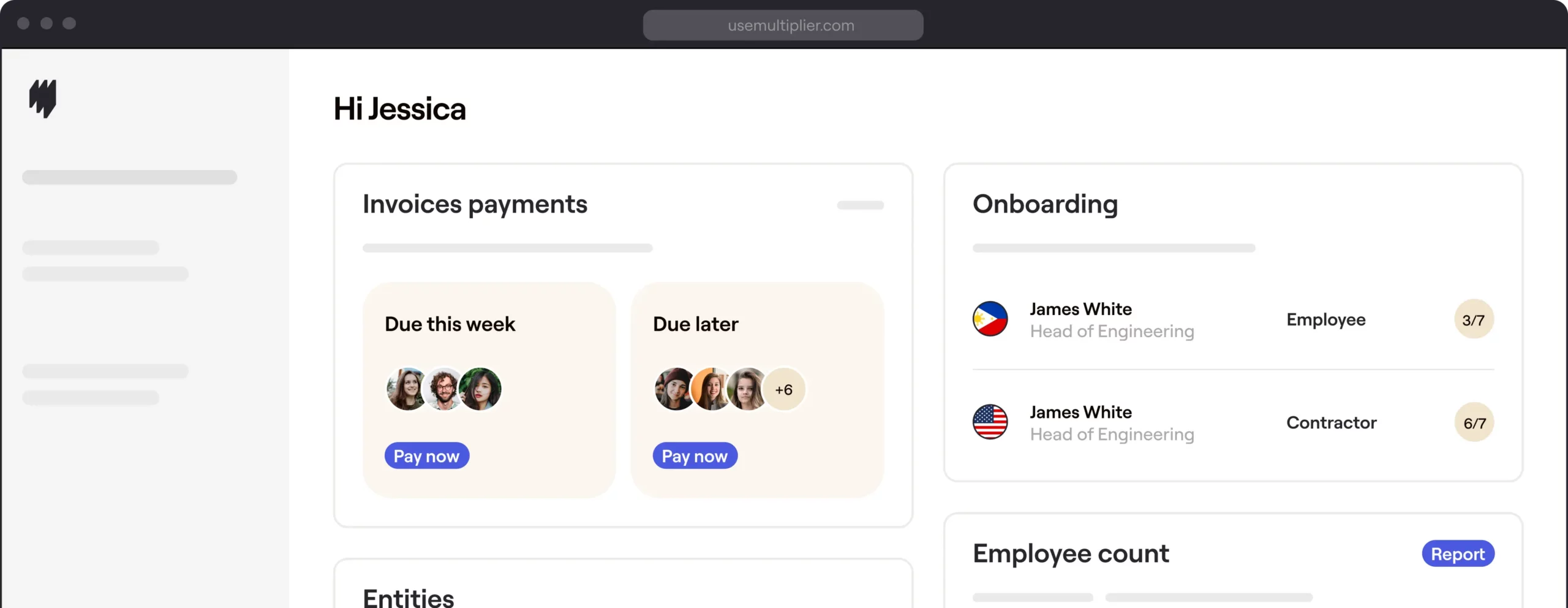
Managing employee benefits in Liechtenstein involves navigating strict statutory requirements, contribution systems, and 2026 compliance updates. Without local expertise, handling pension schemes, FAK filings, and payroll nuances can become complex and time-consuming.
Multiplier simplifies benefits management by offering:
- Administration of the three-pillar pension system (AHV/IV, BVG, Pillar 3a)
- Accurate FAK registrations and family benefit processing
- Automated 13th-month salary and statutory payments
- Compliance with cross-border taxation for frontier workers
- Locally compliant payroll and benefits structuring
- Reduced administrative workload through a centralized platform
With Multiplier, businesses can manage benefits efficiently while ensuring full compliance in Liechtenstein. Book a demo with Multiplier to streamline how you manage employee benefits compliantly and efficiently.
FAQs
Does Liechtenstein have a minimum wage?
There is no legally mandated national minimum wage. Pay scales are typically determined by industry-specific Collective Bargaining Agreements (CBAs).
How does Multiplier respond to the changes to parental leave in 2026?
Multiplier ensures that your employees get their new paid entitlements accurately by automating the registration of leave with the Family Compensation Fund (FAK).
Do workers need to have health insurance of their own?
Yes. In Liechtenstein, health insurance is a personal requirement for residents. However, employers must provide Occupational Accident Insurance, and Multiplier can assist you in that.
What is the pension system's "First Pillar"?
The required state old-age and survivors' insurance (AHV), which the employer needs to compute and pay each month, is referred to as the First Pillar.
In what ways can an employer assist "frontier workers" who travel to Liechtenstein?
For workers who reside in Switzerland or Austria but work in Liechtenstein, Multiplier handles the particular social security and tax withholding obligations.