Distributed, cross-border teams are no longer the exception. They’re the default.
Talent moves freely, growth is rarely confined to a single market, and work happens anywhere, with the majority of EU enterprises now regularly conducting remote meetings.
Regulation is now being forced to catch up with that reality. Ursula von der Leyen, President of the European Commission, used her recent speech at Davos to announce a “new truly European company structure […] with a single and simple set of rules that will apply seamlessly all over our Union.”
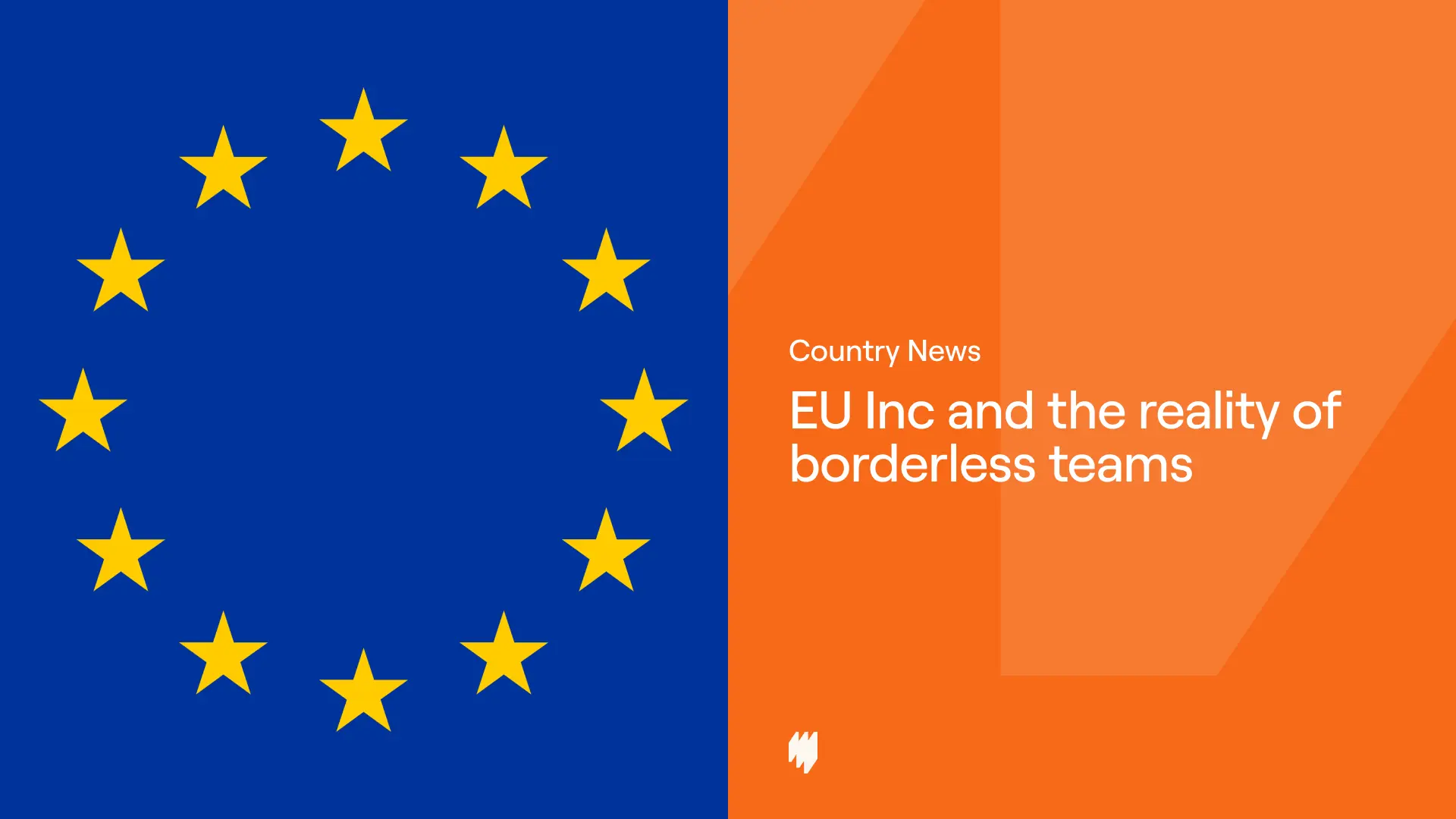
This EU Inc initiative is a clear signal that European policymakers recognise that companies already operate across borders. But while EU Inc meaningfully simplifies how companies are created, it stops short of simplifying how companies actually operate once people enter the picture.
What is EU Inc?
EU Inc proposes a single, digital-first company structure that works across all 27 EU member states. In practical terms, it promises faster online incorporation in as little as 48 hours, no mandatory notaries, and one legal entity recognised across the EU. Corporate rules around equity, insolvency, and cross-border operations would be standardised, reducing the friction that has historically made European expansion slow, expensive, and unpredictable.
“President von der Leyen’s announcement at Davos is a positive step for European business,” says Amanda Frayne, Multiplier’s Chief Legal and Compliance Officer. “Faster online company registration and a unified capital regime address real barriers to cross-border growth by moving toward a single EU framework instead of 27 national systems.”
This matters. For years, incorporating — and especially shutting down — entities in many EU countries has been disproportionately complex for businesses of all sizes. EU Inc is a response to that inefficiency.
But there’s a risk in assuming that a single entity automatically creates a single operating reality.
One entity, multiple employment experiences
EU Inc creates a unified corporate shell, but beneath it remain 27 distinct labor systems, each with its own rules, protections, and enforcement regimes. One entity does not mean one payroll or one set of employment obligations. And neither does it mean one employee experience.
Roughly 1.8 million EU workers live in one country and commute regularly to another, but there’s a patchwork of cross-border partnerships for reconciling differences in employment law between countries.
While EU Inc takes big strides, it does not fix this lingering issue. Local employment laws, worker protections, termination rules, benefits, leave entitlements, collective bargaining agreements, and social security systems will still apply. Nor does it standardise payroll calculations, tax withholding, or reporting obligations.
As Frayne notes: “Incorporation is only one part of the challenge.” The complexity of employing people across Europe will continue to contribute significant ongoing operational burdens. “Companies still face fragmented employment laws, payroll rules, tax withholding, social security, benefits, and reporting requirements in each country.”
No wonder that 60% of payroll leaders in Europe struggle to keep pace with changing labour laws, leading more than half to go to external providers. In its current incarnation, EU Inc likely won’t make a huge dent in that statistic. An entity is formed. Talent is hired. But the ongoing cost of compliance, payroll accuracy, and regulatory risk will continue to scale with each new country you hire in.
Where do EORs and Global Payroll fit in with EU Inc?
While EU Inc expands the menu of options for companies operating in Europe, it doesn’t eliminate the need for support in managing across borders.
Employer of Record (EOR) solutions, for instance, will remain a critical way to preserve agility, particularly for early-stage expansion, testing new markets, or hiring opportunistically rather than committing to permanence. They also serve as a hedge against long-term compliance exposure in jurisdictions where employment risk is high and regulatory enforcement is unforgiving.
For teams that span beyond the EU — or plan to — EU Inc solves only a portion of the operating puzzle. Global Payroll systems remain essential for paying worldwide employees through a single platform while still respecting local rules. For most companies, the only viable way to manage complexity accurately at scale is by resorting to a third party specialist rather than shelling out capital on a vast in-house team.
Even within Europe, how EU Inc is ultimately implemented will matter. “Whether the proposal becomes a directly applicable regulation or directive requiring 27 different national implementations will ultimately determine how much real simplification it delivers,” Frayne explains.
Borderless teams made simple
EU Inc is a welcome, meaningful and overdue reform. It validates what businesses have already been doing for years: Building teams that don’t stop at national borders.
But incorporation becoming borderless doesn’t make employment borderless. Payroll remains local. Compliance remains local. Risk remains local. Which is why local expertise will remain invaluable.
“While EU Inc may simplify company formation, businesses will still need substantial expertise and infrastructure to hire, pay, and manage employees compliantly across multiple markets,” says Frayne.