Liechtenstein is a compact yet affluent European microstate with a nominal GDP of about $9.42 billion and a GDP per capita of over $231,700. Its economy is highly diversified. Manufacturing, high-tech industries, financial services, and a strong SME base drive most output.
As of 31 December 2024, according to the Prague Process (drawing on the Office of Statistics Liechtenstein), Liechtenstein employed 24,943 cross-border commuters. That is 57.4% of total employment among roughly 43,411 workers.
Despite this stability and access to a skilled multilingual workforce, hiring here presents several hurdles. Setting up an entity requires detailed registration with the Office of Justice, meeting substance rules, and completing commercial registry procedures.
Employers must also manage AHV, IV, and FAK social insurance duties, arrange mandatory accident coverage, and comply with strict cross-border hiring regulations.
Employer of Record services simplify expansion by handling payroll, contracts, compliance, and worker registrations. Teams evaluating a Liechtenstein employer of record usually want speed without giving up control of the work itself.
Liechtenstein: Employment laws at a glance
Liechtenstein has no statutory minimum wage. Pay often follows collective bargaining agreements. The standard week is 45 hours. Employer social charges are about 4.9% of gross salary, with 13 public holidays each year. The snapshot below is simplified — CBAs and role type can change the detail.
Topic | Rule |
Currency | CHF (Swiss Franc) |
Minimum salary | No statutory minimum (CBA-dependent) |
Working hours | 45 hours per week |
Overtime | 25% above hourly rate; max 2 hours/day, 48 hours/week average |
Employer taxes | ~4.9% of gross salary |
Public holidays | 13 days per year |
Note: Employment regulations in Liechtenstein can be detailed, with variations based on collective agreements. The table above offers you a simplified overview.
Key considerations and challenges when hiring in Liechtenstein
Hiring in Liechtenstein is slowed by Employment Act (ArG) compliance. Entity capital, resident-director rules, and a hard residence-permit quota add friction. Those points raise cost and risk if you build local infrastructure yourself. Key considerations include:
Compliance challenges
- Provide statutory benefits: pensions, paid leave, 20-week maternity leave at 80% pay, and accident insurance
- Employer social-security contribution: 4.9%; employee contribution: 4.7% of salary
- Must comply with the Liechtenstein employment laws framework under the Employment Act (ArG) on hours, rest, and termination
- Misapplying CBAs or entitlements risks disputes and back-payments
Entity setup challenges
Capital, running costs, and governance rules add fixed overhead before your first hire is productive.
Item | Cost |
GmbH minimum capital | CHF 10,000 (about $10,600) |
AG minimum capital | CHF 50,000 (about $53,200) |
Annual running costs (licenses, accounting, tax) | CHF equivalent not published on source — about $15,900 USD average per year |
Registration fees | CHF 1,800-2,000 (about 1,900-2,100) per year |
- At least one resident director is required; corporate directors are not allowed
Legal risks
- Only 72 residence permits are issued annually; 56 are tied to employment
- Contractor misclassification can trigger fines and back-payments — see guidance on hiring contractors in Liechtenstein before you default to freelancers
- Maximum probation period is 3 months
- Payroll errors can lead to audits, disputes, and legal claims
These challenges can slow hiring and raise compliance risk. A Liechtenstein employer of record removes the need for your own entity while covering payroll, HR administration, and local compliance work on your behalf.
What is a Liechtenstein employer of record?
A Liechtenstein employer of record (EOR) acts as the legal employer. You can hire local talent without creating a subsidiary. You keep full control over daily work. The EOR manages payroll, tax filings, and AHV/IV registrations. It also covers Employment Act (ArG) rules and applicable collective bargaining agreements.
The EOR also handles compliant contracts, statutory benefits, and work permits for international hires. It fits when you need faster market entry, lower setup cost, and clear accountability for local employment rules.
Typical hiring timeline
- With an EOR: 3-7 days for onboarding
- With an entity: 8-15 weeks (business registration and admin)
Employee cost calculator
Compare employee hiring costs across 120+ countries, so you can forecast your budgets with confidence. Try it out with our Employee Cost Calculator!
Who does what when you hire through an EOR in Liechtenstein?
You direct the work and culture. The EOR employs the person on paper and runs statutory employment operations under local law. The split below shows how responsibilities usually land.
Responsibility | Your team | EOR |
Day-to-day work direction and performance | Owns role design, goals, and management | Does not manage job content |
Employment contract | Approves offer terms and start date | Issues a compliant local contract |
Payroll and AHV/IV filings | Funds compensation on schedule | Runs payroll and statutory filings |
Statutory benefits and leave admin | Sets any extra perks policy | Tracks leave and statutory benefits |
Work permits and immigration filings | Confirms role need and candidate fit | Sponsors and files where in scope |
Local legal entity ownership | No Liechtenstein entity required for EOR hires | Employs through its local infrastructure |
EOR vs entity: Cost savings and benefits
Setting up a company in Liechtenstein requires multiple registrations, fees, and ongoing compliance work. A Liechtenstein employer of record is usually faster and more predictable on cost. You skip incorporation while still employing under local rules. If you later need permanence at scale, compare this path with setting up a subsidiary in Liechtenstein.
Here’s how typical local entity costs compare with an EOR in Liechtenstein:
Expense category | Hiring via a local entity | Hiring via EOR |
Company registration fees | CHF 10,000-50,000 (about 10,600-53,200) minimum capital | No setup cost |
Notary and legal formalities | CHF 3,000-6,000 (about 3,200-6,400) | Included |
Annual government fees | CHF 1,800-2,000 (about 1,900-2,100) per year | Included |
Accounting/bookkeeping | CHF 3,000-10,000 (about 3,200-10,600) per year | Included |
Local director requirement | CHF 5,000+ (about $5,300+) per year | Included |
Payroll processing services | CHF 100-200 (about 110-210) per employee, per month | Included |
Beyond cost savings: An EOR keeps you aligned with Liechtenstein payroll, tax, and labor rules. Monthly employment cost is easier to forecast. Learn how much you could save with Multiplier’s transparent EOR pricing.
Step-by-step: How a Liechtenstein employer of record simplifies hiring
A Liechtenstein employer of record runs contracts, payroll, benefits, permits, and exits under ArG so you can hire without incorporating. Here’s how the process works step by step:
Step 1: Contracts and compliance
Your Liechtenstein employment contracts must comply with the General Civil Code and the Employment Act (ArG). They cover probation, working hours, salary, notice, termination grounds, and data protection. Update contracts when collective bargaining agreements and labor rules change.
Liechtenstein contract essentials (as per Employment Act, 2025)
Topic | Rule |
Probationary period | Up to 90 days (can extend to 190 days for management roles) |
Termination notice | 1 month (first year), 2 months (2-9 years), 3 months (9+ years) |
Severance pay | No statutory requirement (may be contractual) |
How EOR simplifies contract generation: An EOR drafts German-language contracts with the legal clauses your role needs. It updates terms when collective agreements change. Notice, probation, and rest rules follow hire date and seniority. Proper termination steps protect your legal position.
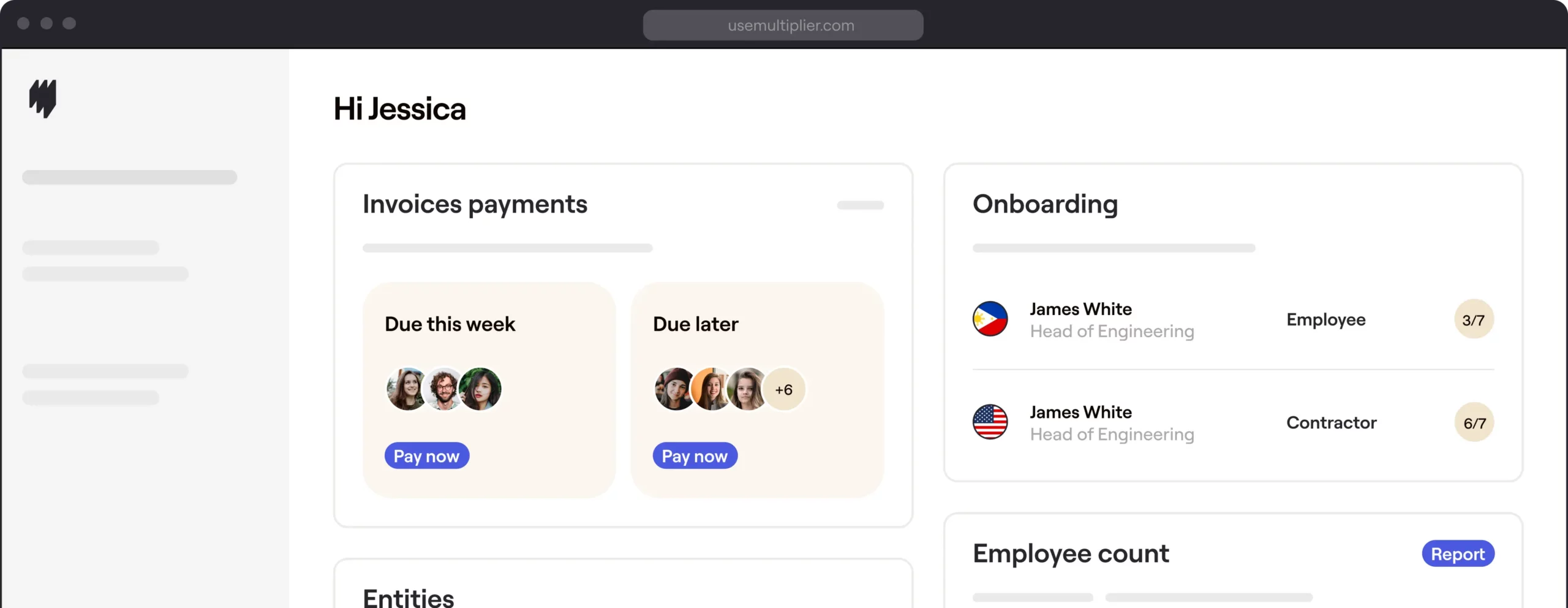
Watch how an EOR helps you onboard in minutes
Hiring in Liechtenstein can be simple for you. Learn how Multiplier makes compliant onboarding effortless.
Step 2: Payroll and compensation
Liechtenstein payroll is highly regulated, and you must account for taxes and social contributions. The table below outlines key payroll requirements:
Topic | Rule |
Payroll cycle | Monthly (mandatory) |
Employer social security | ~4.9% of gross salary |
Employee social security | ~4.7% of gross salary |
Tax year | Jan 1-Dec 31 |
13th salary | Common practice but not mandatory |
In addition to these payroll rules, you must also cover mandatory contributions and benefits.
What are employer costs and mandatory benefits in Liechtenstein?
Employer contributions add ~4.9% on top of gross salary. Breakdown:
Contribution | Rate / notes |
Old-age and survivors’ insurance (AHV) | ~4.15% of gross salary |
Disability insurance (IV) | ~0.75% of gross salary |
Family allowances (FAK) | Included in social security contributions |
Unemployment insurance (ALV) | 0.5% on the first CHF 126,000 (about $132,700) of compensation |
Accident insurance (UVG) | Mandatory occupational and non-occupational coverage |
Note: Liechtenstein’s social security system is designed to be efficient while maintaining relatively low employer social charges, giving you a competitive advantage.
How EOR simplifies payroll: An EOR manages payroll runs for you. It ensures accurate contributions and filings. It applies statutory updates so you stay compliant without extra admin load.
Step 3: Benefits, leave, and holidays
You must follow strict rules on statutory leave and employee benefits in Liechtenstein. The Employment Act (ArG) and social security system set the floor. These entitlements cover vacation, holidays, and paid leave types you need to administer correctly.
Leave type | Entitlement |
Annual leave | 20-25 days (4-5 weeks); 5 weeks for employees under the age of 20 |
Public holidays | 13 days per year |
Sick leave | Paid from day 2; at least 80% salary; max 720 days within 900-day period |
Maternity leave | 20 weeks (80% salary; 4 weeks pre-birth, 16 weeks post-birth) |
Paternity leave | No statutory paid leave (4 months of unpaid parental leave available) |
Parental leave | 4 months unpaid per parent until the child is 3 years old |
Note: Leave entitlements may vary under collective bargaining agreements, which can provide more favorable terms for your employees.
How EOR can simplify benefits: An EOR handles statutory leave tracking, submits AHV/IV claims, and ensures employees receive correct entitlements. It can also help you offer compliant extras, such as supplementary insurance or bonuses, in line with Liechtenstein law.
Step 4: Hiring foreign talent (Work visas)
Non-EEA/Swiss employees need employer-sponsored work and residence permits. Quota room is scarce. Only 72 residency permits are issued annually to EEA nationals, including 56 tied to employment. That scarcity helps explain why cross-border commuting is so common in Liechtenstein’s workforce.
Common permit types include:
- L Permit (Short-term): Up to 12 months for temporary or project roles
- B Permit (Annual): One-year, employer-specific, and renewable
- G Permit (Cross-border): For employees living in Switzerland, Austria, or Germany
- C Permit (Settlement): Long-term residency with very limited quotas
EEA nationals do not need a work permit. Non-EEA nationals require both a work visa and a residence permit. Swiss nationals need no permits but must reside in Switzerland.
How an EOR can simplify work visas: An EOR sponsors work permits and manages Office of Economic Affairs filings. It tracks quota constraints so you can plan foreign hires with fewer delays.
Step 5: Termination
In Liechtenstein, you cannot terminate employees at will. Dismissals need legally valid grounds such as just cause, redundancy, or mutual agreement. They must follow the Employment Act (ArG).
Service stage | Notice period |
Probation | 7 days |
First year | 1 month (end of month) |
2-9 years | 2 months (end of month) |
9+ years | 3 months (end of month) |
Protected period | Duration |
Pregnancy and after birth | Pregnancy and 16 weeks after birth |
Illness/injury (year 1) | 30 days |
Illness/injury (years 2-5) | 90 days |
Illness/injury (year 6+) | 180 days |
Liechtenstein has no statutory severance requirement unless specified in the contract.
There is no general legal requirement for employers to provide severance pay when terminating an employment contract, though contractual agreements may stipulate otherwise.
How EOR simplifies terminations: An EOR calculates notice periods, prepares German-language documents, finalizes benefits, and submits required filings so separations stay within the statutory process.
EOR vs building your own Liechtenstein entity
Choose an EOR when you need speed, a small initial headcount, or a reversible market test. You avoid capital, a resident director, and full local admin. Choose your own entity for a long-term, larger footprint and direct control of the legal employer relationship. Many teams start on EOR, then migrate selected roles after the market is proven. The cost tables above show why early incorporation is hard to justify for a handful of hires.
Key considerations when choosing an EOR in Liechtenstein
When you choose a Liechtenstein employer of record, pick local payroll depth and GAV update handling. You also want reachable human support and transparent pricing. Small compliance misses can turn into fines or disputes fast. Here are core concepts you’ll encounter:
Employment in Liechtenstein: Recap of key terms
- Employment Act (ArG): Defines rules on working hours, rest, termination, and employment conditions
- Gesamtarbeitsverträge (GAV): Collective agreements that set mandatory industry wages and working conditions
- AHV/IV/FAK: Required social insurance contributions for old-age, disability, and family allowances
- Office of Economic Affairs: Authority responsible for your work permits and business licensing
- General Civil Code (ABGB): Governs employment relationships and contract requirements
Partner with an EOR that offers strong local payroll expertise, compliance aligned with GAV updates, and on-the-ground HR support. With the right provider, your team can focus on growth while employment operations stay in expert hands.
Why choose Multiplier as your Liechtenstein employer of record?
Expanding into Liechtenstein offers strong opportunities. Labor laws, payroll, and benefits still take real operational capacity. With Multiplier as your Liechtenstein employer of record, you skip entity setup for EOR hires. You start employing on a days-not-weeks timeline.
What sets Multiplier apart:
- Speed: Onboard employees in as little as 24-72 hours
- Compliance ownership: Stay aligned with the Employment Act (ArG) and collective bargaining agreements
- Published pricing: EOR from $459/employee/month (Core, annual) and $519 Growth (annual) on Multiplier’s transparent EOR pricing
- Global scale: Hire across 160+ countries with 150+ owned entities behind the product
- Proven volume: 2,700+ companies and $2B+ in cross-border wages processed
- Recognition: Named an IEC Group Global EOR Leader 2026 for the third consecutive year, and GPA Employer of Record of the Year 2026
- Human support: 24/5 specialist coverage so compliance questions don’t wait on a ticket queue
What Multiplier customers say on Capterra
“Onboarding happens in just minutes. We enjoy how quickly we can employ someone in less than a day. This is a big plus for Multiplier.”
Focus on scaling your business while Multiplier manages compliance, payroll, and HR. Book a demo to see how hiring in Liechtenstein works on the platform.
FAQs
Does Liechtenstein have a statutory minimum wage?
No. Liechtenstein has no statutory minimum wage. Pay is set by industry collective bargaining agreements or the individual contract you negotiate, so you still need CBA awareness even without a national floor.
How does an EOR simplify hiring in Liechtenstein?
A Liechtenstein employer of record becomes the legal employer for payroll, CBA-aligned contracts, benefits, and filings. You keep day-to-day management and skip building a local entity before your first hire.
What employer contributions are mandatory in Liechtenstein?
Employers contribute about 4.9% of gross salary to social security. That covers pension, disability, family allowances, and unemployment insurance components tied to the local system.
How long does EOR hiring take in Liechtenstein?
EOR onboarding typically takes 3-7 days. Building your own entity often takes 8-15 weeks for registration and setup before you can employ the same way.
Can Multiplier handle Liechtenstein work permit quotas?
Yes. Multiplier sponsors eligible work permits and files with the Office of Economic Affairs. It plans around quota limits so non-EEA hiring is coordinated instead of ad hoc.
Why do collective bargaining agreements matter in Liechtenstein?
GAVs can set wage floors, hours, and benefits by industry that override a bare contract. Multiplier maps the right CBA terms into employment paperwork so you don't underpay or miss conditions.
How does Multiplier stay compliant with Liechtenstein rules?
Multiplier pairs local HR expertise with ongoing monitoring of ArG and CBA changes. Contracts, payroll, and benefits stay updated as rules move, with one team accountable for the employment stack.