Innovation, stability, and top talent: discover it all in Sweden!
A thriving economy, top-tier talent, and a culture that rewards innovation make Sweden a top choice for global businesses. With a strong free-market environment, a highly skilled workforce, and a culture of innovation, Sweden can be an exciting launchpad into Europe.
With promising industries like engineering and manufacturing, software, energy, industrials, life sciences, transportation, and green solutions—Sweden is a great place to do business. But getting set up here can take time. Partnering with an Employer of Record (EOR) can simplify things, letting you hire and operate without registering a legal entity.
Before diving into the setup process, let’s consider why Sweden is such a strategic choice for business expansion.
Why Sweden is a great place to expand your business
Sweden consistently ranks among the world’s best countries for business and boasts of the second-highest number of unicorns per capita globally (just behind Silicon Valley).
Here are some reasons why it’s so conducive to business:
Stable economy and business-friendly regulations: Sweden boasts a strong financial system and ranks high in transparency and business regulations.
Highly skilled workforce: Sweden’s multilingual, highly educated talent pool makes it a top choice for global companies.
Access to the EU market: As a member of the European Union, Sweden offers businesses access to a vast European customer base.
Digital infrastructure and innovation hub: Sweden is a global leader in digitalization, making it ideal for tech startups and businesses relying on innovation.
Competitive corporate tax rates: At 20.6%, Sweden’s corporate tax rate is competitive compared to many European countries.
Not every company needs a full legal entity in Sweden—sometimes, a simpler route makes more sense. That’s where an EOR comes in. Let’s explore how.
Traditional company registration vs. EOR
When expanding into Sweden, you have two options: setting up a company or taking a faster, leaner approach with an EOR.
Here’s how they compare:
Factor | Company registration in Sweden | Expanding via an EOR |
Ownership and control | Full control over operations | EOR manages HR, payroll, and compliance |
Time to set up | Several weeks to months | Can be done in days |
Compliance burden | Full legal responsibility for compliance | EOR ensures compliance on your behalf |
Costs | Registration, legal, tax, and operational costs | Single, predictable service fee |
Scalability | Requires entity setup and permits for expansion | Quick, flexible hiring and scaling |
How an EOR simplifies business expansion in Sweden
A EOR simplifies market entry by handling HR, payroll, and compliance. Most importantly, companies can begin hiring and growing their teams here without establishing a legal entity. This is especially beneficial for businesses testing the market before committing to full-scale operations.
Benefits of using an EOR in Sweden:
Faster market entry: Avoid lengthy registration processes and start hiring within days.
Payroll and compliance: From payroll and taxes to labor law compliance, an EOR ensures full legal and financial alignment with Sweden’s strict regulations.
Cost efficiency: Reduce overhead costs associated with legal registration, office space, and administrative fees.
Flexibility and scalability: Easily scale your workforce up or down without administrative complexity.
While an EOR accelerates and streamlines hiring, some businesses can afford to take time. If you need the operational control that comes with setting up a legal entity, here’s what the registration process looks like.
A step-by-step process for registering a company in Sweden
If you choose to establish your own company in Sweden, here’s the stepwise registration process.
Step 1: Choose your business structure
The most common types of business entities in Sweden include:
Limited company:
- Requires a minimum share capital of SEK 25,000.
- Ideal for businesses planning long-term operations.
- Shareholders, or partners, are typically not personally liable for the company’s debts. Their liability is limited to the capital they’ve invested in the company.
- At least one person (or enterprise).
Sole trader:
- Only one person is the owner.
- Suitable for individual entrepreneurs, but personal assets are not legally separate from business assets.
Limited partnership:
- Can start a limited partnership with one or more people.
- Some partners have limited liability, meaning they’re only responsible for what they’ve invested in the company. These partners are called limited partners and typically don’t get a say in how the company is run.
- Requires at least one general partner with unlimited liability who’s responsible for the company’s management.
Branch office:
- Foreign companies can establish a Swedish branch instead of a separate legal entity.
- You must appoint a managing director to run the office in Sweden.
Trading partnership:
- At least two people (or enterprises).
- Partners are jointly liable for all company debts.
Not yet sure about your entity structure? An EOR, like Multiplier, lets you hire in Sweden before making these critical decisions. An EOR can help you hire and grow teams within days, and you can scale up, downsize, or exit anytime with minimal risks and financial commitments.
If you are clear about your long-term plans and entity structure, the next step is to register your business name.
Step 2: Register your business name to protect it
In Sweden, you must register your business name to protect it. First, check whether you chosen name is available on the Verksamt website. Then head over to the Swedish Companies Registration Office (Bolagsverket) website, where you can complete the process for a small fee.
Step 3: Prepare necessary documents and deposit your share capital
You’ll need to create a document explaining why you want to set up your company. This is called a memorandum of association and should include a draft of the articles of association, which acts as the company’s rulebook.
Key requirements at this stage include:
- You appoint a board of directors and an auditor if you’re setting up a limited company.
- The board of directors set up a share register, which lists all the shares and shareholders.
- You open a business bank account and deposit a minimum of SEK 25,000 in share capital. This can be in the form of cash or assets that are useful for the business, like a car or property.
- The bank issues you an electronic bank certificate for the share capital you’ve paid.
Step 4: File your business registration
You can apply to register your company through the service on verksamt.se. Once your company is registered, the Swedish Companies Registration Office will send you a certificate of registration. As of March 2025, the registration fee starts at SEK 1,900, while registering a limited partnership starts at SEK 1,200.
Once registered, you’ll receive an Organization Number (corporate identity number), that you need for tax registration and banking. An organization number is a unique ID given to legal entities like companies and associations. However, sole traders may use their personal identification number instead.
Step 5: Complete tax registration formalities
Companies operating in Sweden must register with the Swedish Tax Agency (Skatteverket) for corporate tax, VAT (if applicable), and employer contributions.
F-tax approval: Once your company is registered, you’ll need to apply for F-tax approval with the Swedish Tax Agency. Some details, like your company’s financial year, will automatically transfer from your registration.
VAT registration: If your business sells goods or services, you might need to register for VAT. The e-service on the Swedish Tax Agency’s website will guide you through the rules and help calculate your tax base.
Employer registration: If you’re planning to hire employees or pay yourself a salary, your company must register you as an employer. If you only occasionally process payments, you can opt for seasonal registration.
Alternatively, you skip the trouble of establishing a legal entity in Sweden. Business needs can change rapidly— especially in today’s markets. Multiplier’s EOR services let you scale up, downsize, or exit Sweden with far less hassles and risks.
Step 6: Apply for business permits and licenses (if required)
Go to the Verksamt website to find out if your business needs a license or any special approvals from public authorities, municipalities, or other organizations. You may also find specific requirements for the business owner or the premises you plan to use.
Step 7: Register a beneficial owner (if required)
Once your company is registered, you must report the beneficial owner to the Swedish Companies Registration Office. This refers to the individual or individuals who ultimately own or control the business.
If you’d like to skip all of this and make global hiring easier, the right EOR like Multiplier helps boost employee satisfaction, improves retention, and creates a workplace culture that thrives on innovation and growth. You can focus on scaling your business while your EOR handles the logistics, helping you expand without limits.
Of course, every expansion strategy involves financial considerations. In the next section, we examine the costs of setting up a company in Sweden.
Understanding the costs of company registration in Sweden
Setting up a business in Sweden involves various costs, including registration fees, taxation, and operational expenses.
Company registration fees: Depending on company type, can range from SEK 1,200 to SEK 2,500 for the e-service option. If you’d like to know the detailed fee breakdown, go here.
Minimum share capital requirements:
Limited company): SEK 25,000
Branch office: No capital requirement
Other costs:
Corporate tax rate: 20.6%
VAT: 25% (standard rate)
Beneficial ownership: Costs SEK 250 and is usually done online through the Bolagsverket e-service. An authorized signatory can easily complete it with a few clicks.
When using an EOR like Multiplier, you bypass many of these costs and instead pay a fixed service fee that includes payroll, compliance, and administrative support.
Of course, costs can vary based on business needs, but here’s how traditional registration stacks up against an EOR.
Cost comparison: Registering a company vs. using an EOR in Sweden
Here’s a breakdown of the major cost factors to consider when choosing between full company registration and an EOR.
Expense category | Traditional company registration | EOR solution |
Setup fees | Included in EOR package | |
Share capital | Not required | |
Payroll, tax handling, and financial reporting | Typically range from SEK 800 to 1,200 per hour. However, many providers offer the option to negotiate a fixed price. | Managed by EOR |
Time to expand | Weeks or months | Immediate hiring possible |
Of course, the costs above are indicative and may vary based on your business needs. To get a clearer estimate tailored to your expansion plans, our experts are available to guide you.
They can help you understand why businesses trust Multiplier as a more dependable and cost-effective way to scale in Sweden.
Why businesses trust Multiplier for their Swedish market expansion
Sweden offers incredible business potential, but setup can be time-consuming. With an EOR like Multiplier, you can hire, pay, and grow—without the administrative hassle.
Grow your business in Sweden—without the headaches.
Here’s how we do it
Effortless hiring and onboarding: Quickly hire Swedish talent without establishing a local business entity. Multiplier ensures legally compliant employment contracts that align with Swedish labor laws. That means you can onboard employees in just a few days—far faster than the traditional company registration process.
Payroll and tax compliance made simple: We calculate, withhold, and process payroll taxes, including Sweden’s mandatory social security contributions. This way, you ensure accurate and timely salary payments in SEK with zero administrative hassle. We also ensure automatic compliance with the Swedish Tax Agency (Skatteverket) and labor laws—no legal surprises.
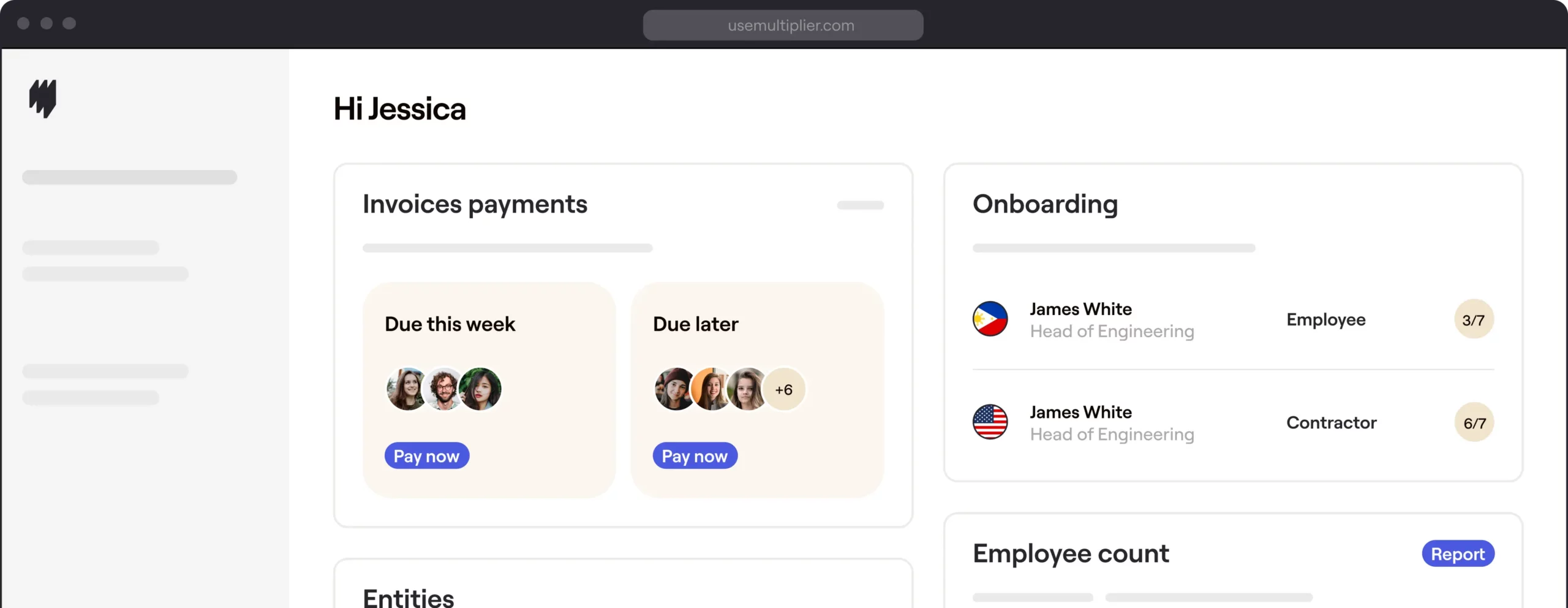
Scalable and cost-effective growth: Scale up or down effortlessly—hire employees in Sweden without committing to long-term operational costs. Multiplier lets you manage multiple hires across different countries, all from a single dashboard.
Comprehensive HR and benefits management: We offer locally competitive benefits, including healthcare, pensions, and paid leave, to attract top Swedish talent.
Risk-free, hassle-free expansion: We mitigate legal risks by fully complying with Sweden’s employment laws. You won’t need to worry about severance pay, wrongful termination claims, or regulatory fines—we handle it all.
Ready to effortlessly expand into Sweden? Book a demo to see Multiplier in action.