Today, building a remote distributed workforce has become a core business strategy, enabling companies to access broader talent pools with specialized skills, stronger local insights, and round-the-clock customer service.
But as global hiring accelerates, so do the compliance challenges that come with it. Every country has its own labour laws, tax rules, payroll standards, and social security requirements — and even small errors can lead to heavy penalties, retrospective taxes, misclassification issues, or permanent establishment exposure.
To navigate international payroll complexities, many companies use the Non-Resident Employer (NRE) model. NRE allows you to hire employees abroad without setting up a local entity, while ensuring compliance with local tax and labor laws.
Understanding NRE payroll is key to building a compliant, scalable global team — and this article explains how it helps simplify remote employee compliance.
Challenges of remote employee compliance
Remote employee compliance refers to meeting all country-specific employment, payroll, tax, immigration, and data-protection requirements for globally distributed workforce. Any gaps across these requirements can quickly expose companies to severe financial penalties and regulatory action — making it essential to understand the key compliance challenges that follow.
1. Accurate and timely payroll
Managing payroll for remote employees across multiple countries is inherently complex. Differences in local tax laws, social security rules, and residency definitions make accurate withholdings and payments challenging. Time zone differences, currency conversions, and varying statutory deadlines further complicate timely payroll.
These challenges mean that even small mistakes can have serious consequences. As Menaka Karthikeyarayan, Vice-President, Payroll Operations at Multiplier, notes, “An error in payroll can lead to tax penalties, legal and compliance risks, and mistakes in social security payments, ultimately causing employee dissatisfaction — often because an employee’s residency is misidentified, resulting in incorrect tax withholdings and contributions.”
Cross-border tax nuances remain a widespread challenge, with Multiplier’s Global hiring gap report showing that 53% of companies struggle most with international tax compliance in payroll.
2. Conflicting labour laws
Labor laws differ across countries, so remote employees are subject to local rules on working hours, overtime, statutory leave, paid holidays, termination protections, and workplace safety. Violating these local requirements can lead to fines, legal disputes, or mandatory compensation.
Companies must constantly monitor variations in definitions, obligations, and statutory deadlines across jurisdictions, which can change frequently. This complexity is not trivial: 82% of organizations implementing remote work cite tax and legal compliance as their biggest challenge, highlighting how easily cross-border labor regulations can become a major operational risk.
3. Permanent establishment risk
Permanent Establishment risk (PE) arises when an employee’s activities in a foreign country — especially revenue-generating or client-facing work — create a taxable business presence for the employer. 65% of companies identify PE as a top compliance concern when managing remote employees.
If triggered, PE can lead to back taxes, interest, audits, and forced entity registration. Even a small remote team in a new jurisdiction can expose the company to significant unplanned liabilities.
4. Data security & privacy risks
Remote work widens the company’s attack surface because employees often access sensitive systems from personal devices or unsecured networks.Compliance is further complicated by global privacy regulations. The average cost of a data breach is $4.88M, and 74% involve human error. Risk grows in remote environments due to less oversight and fragmented controls.
Companies must consider GDPR (EU), CCPA (California), LGPD (Brazil), PDPA (Singapore), DPDPA (India), and every region and country-specific data privacy law, each with distinct rules for data processing, storage, and transfer.
5. Worker misclassification & timekeeping
Misclassification occurs when remote contractors perform employee-like duties but are labeled otherwise. Authorities evaluate supervision, integration, and exclusivity to determine status. 10–30% of employers misclassify workers, exposing companies to back taxes, unpaid benefits, and penalties.
6. Immigration & mobility compliance
Remote employees working in another country can trigger visa and corporate obligations. Even short-term work abroad may create tax or immigration liabilities for both the employee and employer. Sudden policy changes, such as updates to H-1B visa rules in the U.S., highlight how quickly compliance requirements can shift.
Violations can result in fines, deportation, travel restrictions, and penalties for the company. Proper mobility compliance ensures remote work does not inadvertently break local laws.
How NRE solves remote employee compliance
The Non-Resident Employer (NRE) payroll model, also called non-resident payroll (NRP) or foreign payroll registration, enables a foreign company to hire employees in a host country without establishing a full local legal entity. When handled with a provider like Multiplier, compliance and administrative overload is taken off the shoulders of employers allowing them to focus on strategic business objectives.
1. Compliance through registration and direct employment
NRE providers allow foreign companies to operate legally in the host country while minimizing administrative overhead. The employer registers as a non-resident employer (or foreign employer) with local authorities, a process that is faster and more cost-effective than establishing a local entity.
Explaining the complexity of setting up a local entity, Sowmya Murthy, Product Director, Payroll at Multiplier, emphasizes that the “No ID, No Entry” barrier is exactly what NRE Payroll is built to remove. She says, “Instead of spending months and significant cost building a full entity just to hire one person, NRE payroll registers you with the foreign tax authority for a Tax ID — giving you a fast, compliant ‘guest pass’ to operate.”
Removing these barriers is critical for successful expansion. As per Multiplier’s Global hiring gap report, 46% of companies have failed to successfully onboard international talent specifically due to compliance issues.
The company remains the legal employer while meeting all local employment and tax requirements. Companies manage only employment obligations through foreign employment registration, avoiding the ongoing accounting, reporting, and corporate compliance of a local entity.
2. Tax and financial compliance management
NRE providers handle the complexities of cross-border payroll to ensure statutory adherence and financial accuracy. They seamlessly process gross-to-net payroll accurately in compliance with the employee’s country-specific mandates for income tax and social contributions. This includes issuing legally compliant, localized payslips and documentation that detail all statutory breakdowns for audit readiness.
Multiplier’s NRE payroll is specifically designed to manage tax residency clarity, recognizing that personal income tax is typically due where the employee is resident and working. Furthermore, the provider manages complex cross-border fund transfers and utilizes built-in FX management to ensure timely salary disbursements while reducing cost unpredictability.
3. Risk and expertise mitigation
The NRE provider assists clients in structuring remote roles to minimize the risk of the employee’s activities triggering Permanent Establishment (PE) risks, a corporate tax liability in the host country. This guidance helps demonstrate to tax authorities that the foreign company’s presence is limited to employment, reducing the risk of unexpected corporate tax nexus.
Simultaneously, the NRE service ensures compliance with tax treaties by accurately processing payroll based on the principle that income tax is due where the employee works. They handle the complex calculation, withholding, and remittance of the correct income tax and social contributions locally. This precise local withholding provides employees with the necessary documentation to claim tax relief, preventing the burden of double taxation — a situation where the same income is taxed both in the employee’s home country and in the country where they are working..
4. Worker classification and local expertise
NRE services reduce the significant risk of employee misclassification by ensuring the worker’s official status aligns accurately with stringent local labor law. The provider achieves this by partnering with local legal experts who validate the worker setup and provide guidance on the employment relationship, confirming the worker is correctly classified as an employee.
5. Automation and efficiency
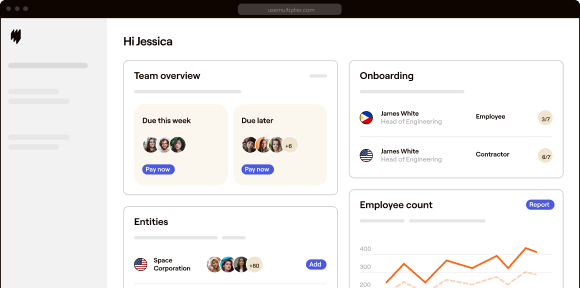
Multiplier NRE payroll leverages automation to ensure payroll aligns with each country’s statutory rates, legal deductions, and reporting schedules, minimizing errors and maintaining full compliance. This is paired with a centralized dashboard that tracks payroll status, costs by country and currency, and overall compliance health, with granular approvals and role-based access for complete visibility and control.
How EOR solves remote employee compliance
The Employer of Record (EOR) is a third-party service that legally hires staff on a company’s behalf, enabling global hiring without setting up local legal entities. The EOR assumes full administrative, legal, and HR compliance in the host country, transferring statutory liability so businesses can focus on managing employees’ work and strategy.
An EOR is typically chosen over NRE payroll when a business needs the provider to take on full statutory employment liability, manage all compliance obligations, and handle end-to-end benefits administration.
It plays a critical role in managing remote employee compliance in the following ways:
1. Compliance through liability transfer
The core value of an EOR is taking on the legal and administrative responsibilities of employment. By becoming the legal employer, the EOR handles payroll, benefits, and employment contracts, allowing the client company to hire globally without establishing a local legal entity.
This separation also mitigates risk, including permanent establishment (PE) exposure, because the EOR assumes statutory liability. The client can focus on day-to-day employee management while knowing all local compliance obligations are professionally handled.
2. Mandatory and statutory benefits compliance
EORs ensure employees receive all legally required protections and benefits, including health insurance, pensions, and long-term disability coverage. They also navigate country-specific statutory bonuses and entitlements, such as holiday or service bonuses codified into law.
Small companies benefit from the EOR’s scale, which allows access to required benefits that would otherwise be costly or difficult to procure. Deep local expertise ensures employees are compliant with both mandatory and customary benefits in each jurisdiction.
3. Ease and speed of global expansion
EOR services enable companies to hire talent abroad quickly and compliantly. From employee registration to payroll processing, the EOR handles all HR and administrative tasks, allowing businesses to scale without delays or the complexity of entity formation.
While establishing a legal entity offers maximum flexibility, EORs can provide robust non-statutory benefits such as wellness, life, or disability policies, even for small teams. This ensures employees are well-supported while compliance obligations are fully met.
Alternative compliance solutions
Companies can also establish a fully registered subsidiary or branch in the target country. This gives full legal control over employees, ensuring payroll, taxes, and labor law compliance are handled directly. It’s best suited for long-term operations but involves high setup costs and ongoing administrative responsibilities.
Choosing the right business structure — corporation, LLC, partnership, or sole proprietorship — is critical, as each has different implications for liability, taxation, ownership, and governance.
Once established, a local entity gives companies complete control over HR, payroll, benefits, and compliance. By directly hiring employees under local contracts and managing payroll internally, organizations can ensure strict adherence to labor, tax, and social security laws. This control also strengthens market credibility and brand presence.
However, setting up and maintaining a local entity carries significant costs and operational complexity. Beyond registration and licensing, companies must manage ongoing obligations such as audits, filings, and payroll compliance. For smaller teams or experimental markets, the overhead often outweighs the benefits, making entity formation most suitable for long-term, substantial investments where full control and local integration justify the effort.
Feature / Criteria | EOR (Employer of Record) | NRE payroll (Provider Managed) | Local entity |
Legal employer status | Becomes the legal employer. | Client is the legal employer. | Client is the legal employer. |
Liability | Assumes all statutory and HR liability. | Client retains full legal liability. | Client retains full legal liability. |
Entity requirement | Not required for the client. | Client registers as Non-Resident Employer (FE). | Client must establish a legal entity. |
PE risk | Highest mitigation; minimizes tax nexus. | Medium mitigation; provides guidance but client holds risk. | High PE risk (intentional presence). |
Labor law | Enforces all local labor laws (contracts, leave, safety). | Limited to statutory payroll obligations. | Full compliance managed internally. |
Benefits | Manages all statutory and optional benefits. | Focuses on statutory payroll deductions only. | Client manages all benefits directly. |
Speed | Rapid global hiring. | Quick setup for remote payroll execution. | Slowest solution; setup takes months. |
NRE Payroll is positioned as the ideal middle ground for businesses that want control without the operational overhead. Sowmya Murthy provides a clear, memorable analogy to distinguish the options, “Think of it like housing: EOR is a hotel (Fast but expensive). A legal subsidiary is building a house (Slow and heavy). NRE Payroll is renting an apartment — the ‘Goldilocks’ solution.”
Choosing the right compliance model
Hiring globally doesn’t have to be complicated — but choosing the right compliance model is critical. Multiplier’s NRE payroll lets you hire quickly without setting up a local entity, keeping payroll, taxes, and statutory obligations in check while minimizing administrative headaches. EOR goes a step further, taking on full legal and HR responsibility so your company can scale confidently across borders.
Ultimately, the best-fit model depends on how well you understand your needs across legal-employer status, liability exposure, payroll accuracy, benefits compliance, PE risk, operational complexity, and the speed at which you plan to expand.
Get in touch to discover which model fits your global growth strategy.
Sources
FAQs
How does NRE payroll fundamentally differ from EOR in terms of liability?
The core difference is who holds the legal employment liability. With an EOR, the provider becomes the legal employer, assuming all statutory and HR liability, which protects the client from direct legal exposure and regulatory penalties. With NRE payroll, the client remains the legal employer, retaining full legal and statutory liability, while the provider handles the administrative payroll and tax functions.
How does Multiplier's NRE payroll manage cross-border fund transfers?
Multiplier's NRE payroll manages complex cross-border fund transfers and utilizes built-in FX management. This ensures salary disbursements are timely while reducing cost unpredictability for the client company. The system accurately processes gross-to-net payroll in compliance with the employee's country-specific mandates.
Can a company use an HRIS platform instead of NRE or EOR for compliance?
An HRIS platform is not a compliance tool and cannot replace the function of an NRE or EOR. HRIS systems are valuable data tools that track rules, generate alerts, and manage employee data. They help maintain compliance visibility, but they do not take on the legal liability or execute the local statutory payroll and tax remittance that NRE or EOR providers handle.