As global hiring becomes the norm, organizations are often caught off guard by the maze of compliance challenges. In fact, TMF Group reports that only 24% of jurisdictions believe their clients are ready for growing compliance demands, while 31% say companies are generally unprepared.
As businesses expand globally or tap into remote talent pools, two primary options emerge for managing international employees:
- Partnering with a payroll company (also known as “payrolling”)
- Engaging an employer of record (EOR)
While both ensure employees are paid accurately and on time, their roles differ significantly. Payroll providers focus on transactions, whereas an EOR assumes full legal responsibility and compliance risk.
This article explains the critical differences between payroll and EOR services, highlighting when to use each. It equips HR leaders, finance executives, and founders to make compliance-first decisions that best support their global growth strategies.
What is a payroll company?
A payroll company is a third-party provider that streamlines payroll functions for businesses, including:
- Disbursing employee salaries accurately and on time
- Managing tax withholdings and ensuring compliance with local tax reporting requirements
- Handling social security and other statutory contributions, such as pension or unemployment insurance
- Generating payslips and maintaining payroll records for employees
However, payroll companies are not the legal employer of record. Their role is limited to processing payments, which means:
- A legal entity is required: Businesses must establish a local entity in the employee’s country, as payroll companies do not assume employer responsibilities
- Employer responsibilities remain: The hiring company is accountable for employment contracts, benefits administration, labor law compliance, work permits, and related liabilities
- Best for robust HR teams: Payroll providers suit organizations with strong in-house HR and legal expertise that need payroll execution, not full employment management
Example: A US-based company with a German subsidiary may partner with a local payroll provider to process salaries, tax deductions, and social contributions. The US company still handles contracts, benefits, and compliance with German labor laws.
How Multiplier helps
Multiplier streamlines payroll across 150+ countries. With one platform, you can process salaries, taxes, and contributions in local currencies while staying compliant with statutory requirements.
What is an employer of record (EOR)?
An Employer of Record (EOR) is a third-party provider that acts as the legal employer for your international workforce, going far beyond payroll. By assuming the role of the employer on paper, an EOR allows businesses to hire globally with ease and full compliance.
Key services provided by an EOR include:
- Drafting compliant employment contracts: Creating localized agreements that follow the employee’s country-specific labor laws.
- Streamlining onboarding and offboarding: Managing hiring paperwork, documentation, and compliant terminations.
- Managing payroll, taxes, and benefits: Processing salaries, withholding taxes, administering benefits, and contributing to social security.
- Ensuring regulatory compliance: Navigating complex labor, tax, and employment laws across jurisdictions.
- Assuming liabilities: Taking on legal risks such as disputes, penalties, or non-compliance.
Benefits of using an EOR include:
- No local entity required: Hire abroad without establishing a costly subsidiary.
- Reduced compliance risk: The EOR assumes responsibility for adhering to local laws.
- Rapid market entry: Onboard employees in new markets within days.
- Focus on core management: Businesses retain control of daily operations and performance.
Example: A Singapore-based SaaS company hires a graphic designer in Spain through an EOR. The EOR manages contracts, payroll, and compliance, while the company directs the designer’s work.
In the next section, we summarize the differences via a comparison table.
Payroll company vs employer of record: Comparison table
Discover the core differences between a payroll company and an EOR in this comparison table.
Feature/Responsibility | Payroll company | Employer of Record (EOR) |
Legal employer | Client | EOR |
Payroll and tax processing | Yes | Yes |
Drafting contracts | No | Yes |
Onboarding/Offboarding | No | Yes |
Benefits administration | No | Yes |
Compliance with labor laws | No | Yes |
Employment liability | Client retains | EOR assumes |
Requires a local entity | Yes | No |
Best suited for | Payroll admin for local staff | Hiring globally without entities |
In the next section, let’s discuss in further detail when a payroll company and/or an EOR should be leveraged.
Use cases: When to use a payroll company vs. an EOR
Choosing between payrolling and an EOR depends on your expansion model, compliance needs, and risk appetite.
When to use a payroll company
- You already have a legal entity in the target country
- You only need salary disbursement and tax processing support
- Your HR/legal teams can manage contracts, benefits, and compliance
- You’re hiring where you have operational control and local expertise
- You have resources to handle compliance monitoring and liabilities
Why choose Multiplier for payroll
Even when you have local entities, Multiplier’s payroll services offer superior advantages over traditional payroll companies — unified reporting across all countries, consistent compliance standards, and the flexibility to switch to EOR services in the same platform when expanding to new markets.
When to use an EOR
- You want to hire in countries without a legal entity
- You need quick, compliant onboarding without lengthy setup
- You prefer shifting compliance risks to an expert partner
- You’re testing new markets before permanent expansion
- Your team lacks expertise in international labor laws
Why choose Multiplier as your EOR
Multiplier doesn’t just provide EOR services — it offers the most comprehensive global employment platform available. Whether you need EOR services today and payroll services tomorrow, or want to manage both contractor and employee relationships, Multiplier scales with your business without forcing you to switch providers
Many companies also adopt a hybrid approach — using payroll providers in countries where they already have entities, while relying on EOR services for quick entry into new markets. This combination allows businesses to balance cost-efficiency with compliance flexibility.
Cost comparison: Is payrolling cheaper than EOR?
While payroll companies may appear less expensive on paper, total cost considerations extend beyond monthly service fees.
Payroll company costs
Lower recurring fees, but factor in:
- Entity setup and ongoing maintenance in each country
- HR/legal team overhead for compliance management
- Risk of fines for compliance errors or violations
- Administrative delays slow hiring and productivity
- Hidden costs of managing complex employment regulations
EOR costs
Higher monthly fee per employee (percentage of salary), but includes:
- Contract drafting, onboarding, benefits, payroll, and compliance
- No entity setup or maintenance fees
- Reduced legal exposure and compliance risk
- Faster hiring and time-to-productivity
- Expert navigation of local labor laws
The Multiplier advantage: Rather than choosing between cost and comprehensive service, Multiplier offers transparent, competitive pricing for both payroll and EOR services. More importantly, you avoid the hidden costs of vendor switching — when you’re ready to expand from payroll-only to EOR services (or vice versa), you’re already on the right platform.
For many global companies, blending both services is the most cost-effective strategy — running payroll where entities exist while relying on EOR for new markets. This hybrid model minimizes overhead while ensuring compliance everywhere
How Multiplier combines the best of EOR and a payroll company
Multiplier bridges the gap between payroll providers and full EOR solutions by offering:
- Legal employer status in 150+ countries for full compliance
- Localized contract management aligned with country-specific labor laws
- Seamless payroll, benefits, and statutory contributions across jurisdictions
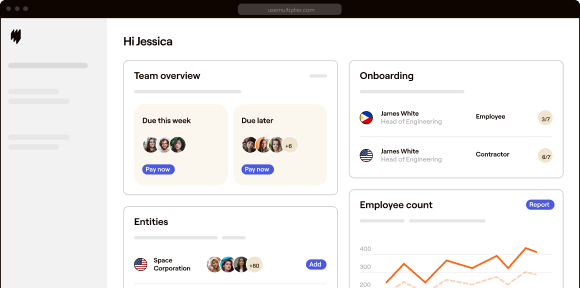
- A unified platform with a centralized dashboard for onboarding, payslips, and payroll
- Scalable support, from a single hire to thousands globally
- Cross-border benefits administration, ensuring employees receive compliant health, insurance, and retirement packages anywhere
Multiplier combines the compliance protection of an EOR with the efficiency of payroll services — without the complexity of multiple vendors.
Finding the right partner for global growth
While both models support international hiring, they differ greatly in responsibility, risk, and scope.
A payroll company suits businesses with existing legal entities needing payroll execution support, while an EOR is ideal for entering new markets, scaling remote teams, or reducing compliance risks.
The best approach is a platform offering both. Your choice impacts more than payroll—it shapes hiring speed, compliance, risk, and long-term costs. By aligning your chosen model with predicted Global Hiring Trends 2026, you ensure your expansion strategy is resilient enough to handle the next wave of workforce evolution. With Multiplier, you avoid tough trade-offs or vendor changes as your needs evolve.
Ready to hire globally with confidence?
Book a demo today and see how Multiplier helps businesses streamline payroll and expand compliantly worldwide.
FAQs
What’s the difference between payrolling and employer of record?
Payrolling handles salary and tax processing, but requires you to have a legal entity. An EOR acts as the legal employer, covering contracts, compliance, and liability.
Can I use a payroll company to hire employees internationally?
Only if you already have a registered entity in that country. Without one, you’ll need an EOR.
What is payrolling in global employment?
It’s outsourcing salary processing, taxes, and payslips to a third party, but not transferring legal employer responsibilities.
Is payrolling cheaper than using an EOR?
The monthly fee may be lower, but EORs can save money by removing entity setup costs, compliance risk, and delays.
Can I use both services together?
Yes. Many companies use a mix of payroll companies where they already have entities, and an EOR where they don’t.