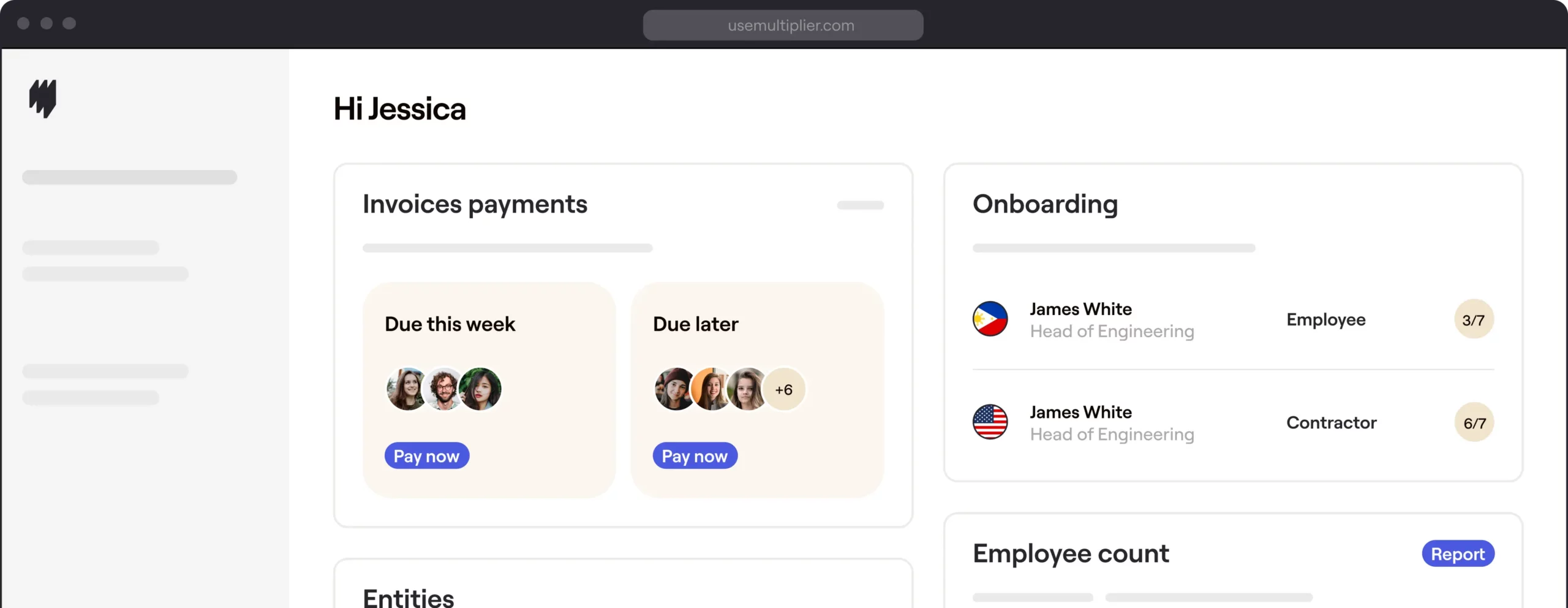
Employing staff in Dubai requires careful adherence to UAE labor regulations, which define employer obligations and employee protections for both local and international businesses. Companies entering the Dubai market must understand statutory requirements to avoid penalties, disputes, or operational disruptions.
This guide explains the key employment rules organizations should follow and outlines how Employer of Record (EOR) services can support compliant hiring, streamline administration, and reduce legal and operational risk when building a workforce in Dubai.
Overview of employment and labor law in Dubai
Dubai’s employment framework is built on Federal Decree-Law No. 33 of 2021 on the Regulation of Labour Relations. It replaced the older 1980 law and took effect in February 2022. Later amendments in 2023 and 2024 clarified dispute timelines, procedures, and penalties.
The law covers:
- employment contracts
- working hours and overtime
- wages and benefits
- leave entitlements
- termination rules
- workplace safety
Cabinet Resolution No. 1 of 2022 provides the executive regulations supporting the law.
The framework applies to all private-sector employees in the UAE, regardless of nationality. However, it does not apply to government employees, armed forces, police, or domestic workers.
Some free zones follow separate employment rules, including:
Disputes usually go through mediation before reaching the labor courts. That makes early compliance especially important.
Managing ongoing compliance under Dubai employment law
Dubai employment rules change frequently through court decisions and regulatory updates. Many global companies rely on an EOR in Dubai to manage contracts, payroll, and statutory obligations while avoiding the administrative and legal burden of direct compliance.
Hiring and recruitment under the Dubai labor law
When you hire in Dubai, you must follow specific legal conditions to establish a valid employment relationship. The law clearly distinguishes between employees and independent contractors. Misclassifying someone as a contractor when they should be classified as an employee can expose you to significant penalties and back-pay obligations.
Classification matters
You must correctly classify workers as employees or independent contractors. Misclassification can trigger fines and back-pay obligations.
Recruitment restrictions
Certain interview questions about personal characteristics are not allowed. Medical or criminal checks require employee consent.
Hiring foreign nationals
If you hire foreign workers, you must:
- Ensure valid work permits
- Handle visa sponsorship properly
- Register employees with the authorities on time
Contract types and work models
All private-sector contracts are now fixed-term. Unlimited contracts no longer exist.
Key rules:
- Maximum contract length: three years
- Renewable by agreement
- Extensions allowed
Recognized work models include:
- Full-time
- Part-time
- Temporary
- Flexible
- Remote
- Job-sharing
These affect how leave and working hours are calculated.
Probation rules
Probation cannot exceed six months.
Updated rules require:
- Employers to give 14 days’ notice to terminate during probation
- Employees leaving the country to give one month’s notice
Employment contracts under the Dubai labor law
Written employment contracts are mandatory in Dubai. All employment relationships must be governed by written contracts, issued in two copies, one for the employer and one for the employee. The law recognizes fixed-term contracts with a maximum term of 3 years, renewable for the same or shorter period.
Every contract must include mandatory terms:
- Job description and responsibilities
- Working hours and schedule
- Salary and benefits structure
- Leave provisions and entitlements
- Termination conditions and notice periods.
The contract language should be clear, and you should maintain a copy for both yourself and the employee. If both parties continue working after a contract expires, it automatically renews.
You can include non-compete clauses, but they must:
- Protect legitimate business interests
- Last no longer than two years
Changes to contracts require written employee consent. Unilateral changes usually won’t hold up legally.
Generate a contract in less than 5 minutes with Employer of Record
Create compliant Dubai contracts in under five minutes with Multiplier’s EOR. Auto-generate localized terms, reduce legal risk, and speed onboarding. Watch the demo video to see how it works instantly.
Working hours, overtime, and rest periods
The standard working limit is:
- Eight hours per day
- 48 hours per week
During Ramadan, daily hours are reduced by two hours for all employees.
Overtime rules
Overtime generally cannot exceed two hours per day. Total working hours, including overtime, must not exceed 144 hours over any three weeks. Typical overtime pay:
- +25% of the hourly wage for regular overtime
- +50% for night overtime (10 pm to 4 am)
Employees working on public holidays must receive:
- A replacement day off, or
- Normal pay plus 50% overtime
Rest and breaks
Workers must receive:
- At least one hour of breaks if working five consecutive hours
- Weekly rest days
Summer outdoor work ban
From June 15 to September 15, outdoor work under the sun is banned between 12:30 pm and 3 pm.
Violations can lead to:
- $1,361 (AED 5,000) fine per worker
- up to $13,613 (AED 50,000) per company
These protections are compulsory and ensure safe working conditions.
Key employment law obligations in Dubai
Employers operating in Dubai must comply with a broad range of statutory obligations covering wages, working conditions, employee protections, and termination procedures. The key legal requirements are outlined below.
Wages, minimum pay, and statutory deductions
The Labour Law does not set a statutory minimum wage in the UAE, but requires that wages be sufficient to meet employees’ basic needs in line with the job category and market practices. However, the Ministry of Human Resources and Emiratisation raised the private-sector minimum wage for UAE nationals to AED 6,000 per month, effective 1 January 2026, increased from the previous AED 5,000.
Salaries can be paid in UAE dirhams or another currency if both parties agree, and the chosen currency is clearly recorded in the employment contract. The UAE enforces electronic wage transfers through a Wage Protection System (WPS). Employers must pay salaries through approved banks and payroll channels. This system helps labour authorities check that basic wages and other dues are paid on time.
You must maintain accurate wage records for all employees and ensure equal pay for equal work. This principle applies across all job categories and is strictly enforced. If you fail to meet minimum wage requirements for UAE nationals, you face fines and potential liability for back wages.
Statutory leave and time-off entitlements
You’re required to provide annual paid leave that accrues based on length of service.
Private‑sector employees who have completed:
- A year of service is entitled to at least 30 days of paid annual leave for each year of service.
- More than six months but less than one year, they are entitled to two days of paid leave for each month of service.
Other leave rights include:
- Up to 90 days of sick leave with medical proof
- Maternity leave of 60 days (45 fully paid, 15 half paid)
- Paid public holidays
Occupational health and safety obligations
Dubai health and safety laws place strict duties on employers to assess risks, train employees, and implement preventive measures. You must identify hazards, establish emergency procedures, and monitor workplace safety continuously. Employees may refuse dangerous work without penalty. Accidents must be investigated, and serious incidents reported, with violations carrying administrative and potential criminal liability.
Anti-discrimination and equal treatment
Dubai labor law strictly prohibits discrimination based on race, color, sex, religion, national or social origin, and disability across all employment stages. Employment decisions cannot rely on these factors, directly or indirectly. The UAE has several laws that aim to prohibit discrimination and hatred based on caste, race, religion, and ethnic origin.
In 2018, the UAE Cabinet approved a law on equal wages and salaries for women and men. Article 4 of the UAE Labour Law provides that the female worker shall be granted a wage equal to that of a man if she were performing the same work. There are laws to protect the rights of people of determination (those with special needs), and laws for women’s rights to equal pay as men.
Workplace harassment and bullying prevention
Article 14 of the new law states that sexual harassment, bullying, or any verbal, physical, or psychological violence committed against the worker by the employer, his superiors at work, colleagues, or the persons who work with him is prohibited. The law criminalizes sexual harassment, bullying, and verbal or physical abuse, empowering employees to lodge complaints directly with MoHRE.
Violators of these laws can be fined up to $2,723 (AED 10,000) and face imprisonment for up to one year. For repeated offenses, the penalties increase, potentially including longer imprisonment terms and higher fines.
Emiratisation requirements
Companies with 50+ employees must increase Emirati hiring by two percent annually in skilled roles, targeting 10% by 2026.
Some sectors also require companies with 20–49 skilled employees to participate.
Non-compliant companies must pay:
- $1,634 (AED 6,000) per month per missing Emirati hire
- penalties increase yearly until 2026
Termination under Dubai law
You can terminate employment in Dubai by giving notice, by just cause, or by mutual agreement. The minimum notice period is 30 days, unless otherwise specified in the employment contract. Some contracts may allow up to 90 days, depending on the agreement between the employer and employee.
Gratuity rules
End-of-service gratuity equals:
- 21 days’ basic wages for each of the first five years of service
- 30 days’ basic wages for each year beyond five years
If a worker has served for more than 1 year but less than 5 years, they are entitled to full gratuity pay based on 21 days’ salary for each year of work. Total gratuity cannot exceed two years’ wages.
Employers must settle all outstanding wages, other entitlements, and gratuity within 14 days of termination.
Employment disputes and legal remedies
Disputes usually begin with mediation. Many claims under $13,613 (AED 50,000) can be resolved through administrative decisions rather than full court cases.
Employees now have up to two years after termination to file claims.
Common disputes include:
- Unpaid wages
- Overtime disagreements
- Unfair dismissal
- Gratuity calculations
Penalties for labour violations have increased sharply. Fines can range from $27,226 (AED 100,000) to $272,257 (AED 1 million), depending on severity.
How Multiplier simplifies compliance with Dubai employment laws
Managing Dubai employment regulations is complex, and the stakes are high. You face challenges managing intricate termination rules, ensuring contract compliance, registering workers with authorities, and protecting statutory worker rights. Non-compliance can result in lawsuits, regulatory fines, and operational disruption.
Multiplier is a global employment and compliance partner that simplifies this process. We provide locally compliant employment contracts drafted by Dubai legal experts. Our hiring and onboarding process ensures you follow all statutory obligations from day one. We handle the Wage Protection System requirements and statutory obligations that often confuse foreign employers.
Most importantly, Multiplier lets you hire employees in Dubai without establishing your own legal entity. We become the registered employer while you manage the day-to-day relationship. This approach reduces legal and financial risk while giving you flexibility to build your Dubai team efficiently.
Ready to hire in Dubai compliantly and confidently? Book a demo with Multiplier to see how we simplify Dubai employment compliance for global teams.
FAQs
Do Dubai employment contracts need to be registered with the government?
Yes. Private-sector employment contracts in Dubai must be registered with the Ministry of Human Resources and Emiratisation (MoHRE). Registration ensures the contract is legally recognized and protects both employer and employee rights.
What is the Wage Protection System (WPS) in Dubai?
The Wage Protection System (WPS) is a government-monitored payroll system that requires employers to pay salaries through approved banks or financial institutions. It helps authorities verify timely and accurate wage payments.
Can companies hire remote employees in Dubai without opening a local entity?
Yes. Companies can hire workers in Dubai without setting up a local entity by using an Employer of Record like Multiplier, which manages contracts, payroll, and statutory compliance on the employer’s behalf.
Are non-compete clauses enforceable under Dubai labor law?
Yes, non-compete clauses are enforceable if they protect legitimate business interests and remain reasonable in duration, location, and scope. Most restrictions cannot exceed two years after employment ends.
How does probation work under Dubai employment law?
Probation in Dubai can last up to six months. Employers must provide 14 days’ notice for termination during probation, while employees leaving the UAE must give at least one month’s notice.
How does Multiplier help companies stay compliant with Dubai labor laws?
Multiplier helps companies stay compliant by managing employment contracts, payroll through WPS, statutory benefits, and onboarding requirements while reducing legal risk and administrative complexity.
Can Multiplier help foreign companies sponsor employees in Dubai?
Yes. Through its Employer of Record model, Multiplier can sponsor employees, manage work permits, and handle local employment compliance without requiring foreign companies to establish a UAE entity.