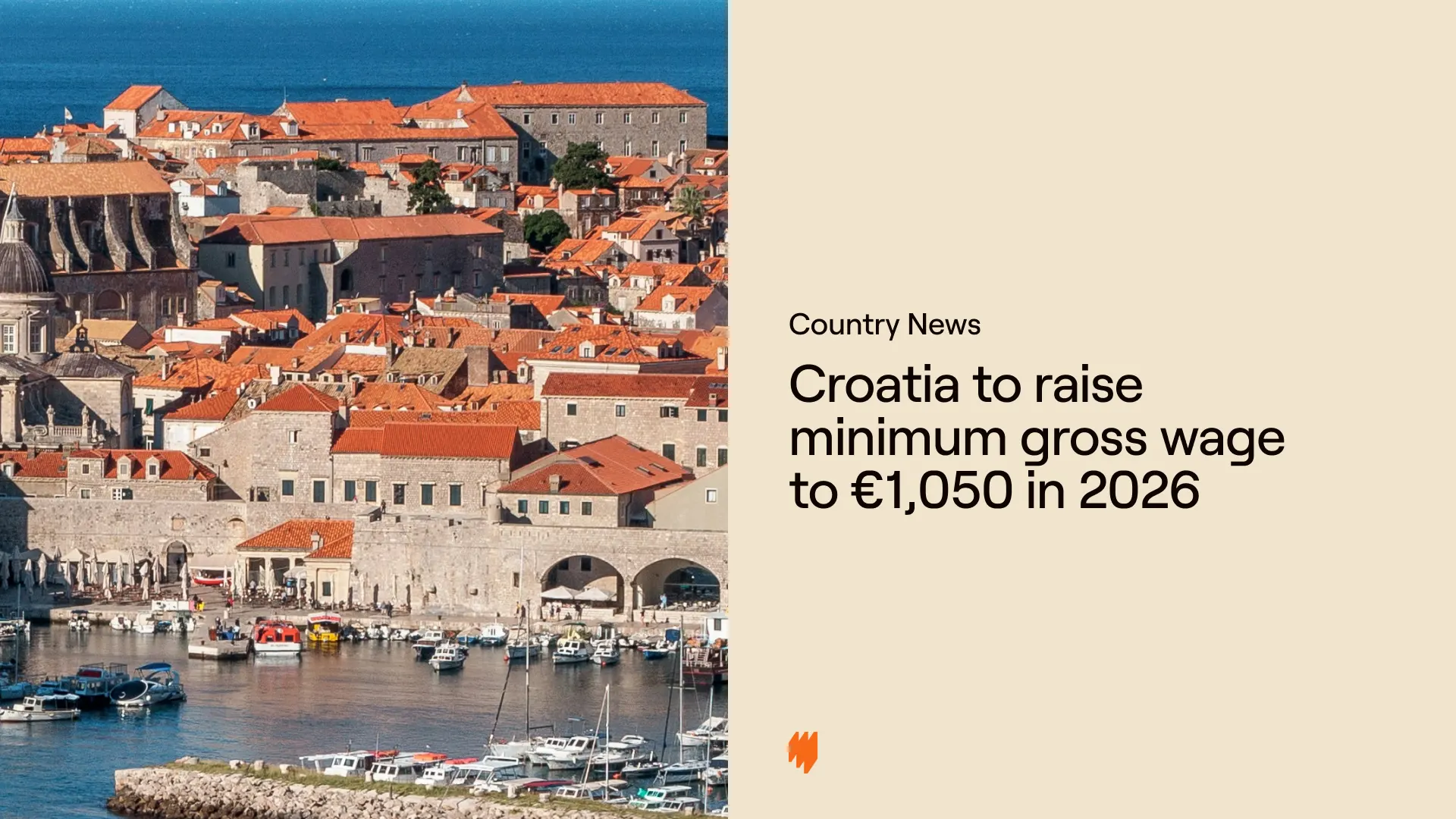
The Croatian Government has adopted a new regulation to increase the national minimum wage to €1,050 gross per month starting January 1, 2026. This decision marks an €80 increase over the 2025 minimum wage of €970. Prime Minister Andrej Plenković emphasized that this adjustment is rooted in “realistic parameters,” citing the country’s strong economic growth, record-high employment levels, and a steady upward trend in average wages.
This reform is part of a broader strategic effort to improve living standards and ensure that Croatia remains a competitive and attractive destination for talent within the European Union.
Details of the new wage regulation
The jump to €1,050 is the latest in a series of aggressive wage hikes. Since 2016, when the minimum gross wage was just €414, the rate has surged by 153%. Over the last three years alone, the wage has grown by 50%, rising from €700 to the newly announced €1,050.
Recent data from the Croatian Bureau of Statistics (DZS) highlights that this isn’t just happening at the bottom of the pay scale; the average net monthly salary in Croatia reached €1,446 in August 2025, a real-term increase of 4.9% compared to the previous year. By raising the minimum wage, the government aims to move Croatia beyond its current standing at 75% of the EU average for minimum wages, further closing the gap with its European peers.
To mitigate the financial strain on employers, particularly in labor-intensive sectors, the government will continue to provide compensation schemes through the Croatian Employment Service to help businesses absorb the higher costs without cutting jobs.
What this means for skilled workers
For employees and contractors in Croatia, the 2026 wage hike provides a significant boost to purchasing power and financial security.
- Improved living standards: The €80 monthly increase helps workers keep pace with the cost of living in a growing economy.
- Wage parity: As the minimum wage rises, it often exerts upward pressure on salaries for mid-level and skilled roles, ensuring more competitive compensation across the board.
- Enhanced protections: The government’s focus on “appropriate” wages ensures that even those at the entry-level receive a salary that reflects Croatia’s position as a thriving EU member state.
What it means for employers
For businesses operating in or looking to expand into Croatia, the new regulation requires immediate planning to ensure compliance with local labor laws.
- Budget adjustments: Employers must update their 2026 financial forecasts to reflect the increased gross salary, as well as the associated statutory contributions and taxes.
- Compliance risks: Failing to meet the new minimum wage threshold by January 1, 2026, could lead to significant fines and reputational damage.
- Need for agile payroll: Managing these changes manually — especially for companies with distributed teams — can lead to errors in gross-to-net calculations and tax filings.
How Multiplier can help: Expanding into or managing a team in Croatia doesn’t have to be a bureaucratic hurdle. For companies without a local legal entity, Multiplier’s Employer of Record (EOR) platform enables you to hire and manage employees in Croatia with ease. We handle the complex task of updating salary bands, calculating local taxes, and ensuring every payslip is 100% compliant with the latest Croatian regulations. If you work with independent contractors, our Contractor of Record (COR) service ensures they are correctly classified and paid on time in Euros, avoiding the risk of “false self-employment”.
Conclusion
Croatia’s move to a €1,050 minimum wage is a clear signal of its economic maturation and commitment to worker welfare. While this is excellent news for the workforce, it introduces new administrative and financial complexities for businesses. By partnering with Multiplier, you can navigate these changes with confidence. Whether you need an EOR to hire full-time talent, a COR to manage your contingent workforce, or Global Payroll to centralize your operations, we provide the tools to scale your business in Croatia effectively and compliantly.
FAQ
What is the new minimum wage in Croatia for 2026?
The Croatian government has set the minimum gross wage for 2026 at €1,050 per month, effective from January 1, 2026. This is an increase from the 2025 rate of €970.
How much has the Croatian minimum wage increased since 2016?
Since 2016, the minimum gross wage in Croatia has increased by 153%, rising from €414 to the €1,050 rate set for 2026.
What support is available for Croatian employers affected by the wage increase?
To help businesses manage the higher wage costs, the government is providing compensation and support schemes through the Croatian Employment Service to help preserve jobs in affected sectors.
How does the 2026 minimum wage increase affect worker classification in Croatia?
With rising minimum standards, it is more important than ever for employers to ensure workers are classified correctly. Using a Contractor of Record (COR) can help businesses avoid misclassifying workers who should be entitled to the full protections and wages of a full-time employee under the new law.
How can an Employer of Record (EOR) help with the new Croatian wage laws?
An EOR like Multiplier acts as the legal employer in Croatia, automatically updating payroll systems to reflect the new €1,050 minimum wage. This ensures that your business remains compliant with local labor laws and tax requirements without needing to establish a local legal entity.