The UK is home to a thriving gig economy, with over 4.2 million self-employed workers accounting for nearly 13% of the workforce. For businesses worldwide, this represents an incredible opportunity to tap into top-tier talent in fields like IT, finance, creative design, and consulting.
But hiring contractors in the UK isn’t as simple as signing a contract and sending payments. The country has some of the world’s strictest labor and tax compliance rules, including IR35 legislation, which determines whether a contractor should legally be treated as an employee. Get it wrong, and you risk significant financial penalties, back taxes, and reputational damage.
This is where Contractor Management Services (CMS) comes in. These solutions make it easy to onboard, classify, pay, and manage contractors compliantly without building an in-house compliance team or UK entity.
In this guide, we’ll cover what contractor management means in the UK, why businesses need it, key legal and tax considerations (including IR35), features to look for in a contractor management solution, and how Multiplier simplifies UK contractor compliance.
What is contractor management?
Before diving into the why, let’s first understand the what, if you’re new to the concept, contractor management is about sending payments to freelancers using a structured process that ensures compliance and efficiency.
Contractor management refers to the process of onboarding, paying, and managing independent contractors in compliance with local labor and tax laws.
Unlike employees, contractors:
- Operate under a contract for services rather than a contract of employment.
- Manage their own taxes and National Insurance contributions (NICs).
- Typically use their own tools and enjoy autonomy over how work is performed.
In the UK, contractor management often involves:
- Reviewing IR35 status (to confirm genuine contractor status).
- Drafting UK-compliant contracts.
- Collecting right-to-work documentation.
- Setting up secure GBP or multi-currency payments.
- Maintaining audit-ready compliance records.
This process sounds straightforward, but in reality, it’s layered with legal, tax, and operational nuances, especially in a regulatory-heavy market like the UK. That brings us to the next big question on why use contractor management services in the UK.
Why use contractor management services in the UK?
Now that we’ve defined what contractor management is, let’s explore why it’s critical for businesses hiring in the UK.
The market presents unique challenges for businesses engaging contractors:
- Strict compliance standards: Misclassification under IR35 can trigger significant liabilities.
- Complex tax obligations: Contractors handle their own taxes, but businesses often have reporting duties.
- Right-to-work checks: Employers must verify eligibility under UK immigration laws.
- GBP and multi-currency complexities: Delays or currency losses can frustrate contractors and harm relationships.
Trying to manage all of this manually can lead to compliance gaps and administrative headaches. That’s where contractor management services come in. They simplify the process while ensuring every step meets UK legal requirements.
There are also amazing benefits of using contractor management services, such as:
- Saving time: Automate onboarding, contract drafting, and payments.
- Minimizing legal risk: Stay IR35-compliant without hiring expensive legal counsel.
- Scaling faster: Engage talent in days instead of weeks without setting up a local entity.
Now, let’s look at the legal and tax considerations you must address when hiring in the UK.
Legal and tax considerations when hiring UK contractors
Compliance in the UK isn’t just about paying invoices; it involves navigating complex tax rules and employment tests.
Here are the essentials:
IR35: The game-changer
- Introduced to prevent disguised employment.
- Applies when contractors work under conditions similar to employees but bill through intermediaries (e.g., personal service companies).
- If inside IR35, the hiring company is responsible for deducting income tax and NICs.
Worker classification
- Contractors = independent, self-employed, working under contract for services.
- Employees = integrated into the business, working under a contract of employment with benefits and PAYE obligations.
Right-to-work requirements
Employers must check that contractors have the legal right to work in the UK, even if they’re not employees.
Tax obligations
- Contractors usually file their own taxes and VAT returns.
- Businesses hiring directly must confirm invoicing compliance and maintain accurate payment records.
Understanding these rules is key to avoiding misclassification risks. Now, let’s explore what a robust contractor management service includes.
What do contractor management services typically include?
Once you grasp the legal requirements, the next step is to see how contractor management platforms simplify compliance. Comprehensive platforms like Multiplier typically offer:
- Classification and IR35 checks: Verify contractor status before onboarding.
- Localized contract templates: Draft contracts that align with UK labor laws.
- Digital onboarding workflows: Collect right-to-work documents and tax info.
- Automated invoicing: Validate contractor invoices and ensure VAT compliance.
- GBP and multi-currency payments: Pay contractors in GBP or their preferred currency with real-time conversion.
- Compliance storage: Keep contracts, invoices, and payment proofs audit-ready.
Now that you know what’s included, let’s compare contractor management with another popular model, i.e., Employer of Record (EOR).
Contractor management vs Employer of Record (EOR) in the UK
Choosing the right engagement model depends on your hiring goals. Here’s the difference:
- Contractor Management: For engaging independent freelancers — flexible, short-term work arrangements.
- Employer of Record (EOR): For hiring full-time employees without a UK entity. The Employer of Record (EOR) becomes the legal employer and handles payroll, benefits, and taxes.
When to use which?
Contractor Management = Flexible, short-term, specialized roles.
EOR = Long-term positions requiring full employment compliance.
The good news?
Multiplier offers both solutions, so you can scale with confidence using the model that suits your business.
Next, how do you pick the right partner to manage all this?
How to choose a contractor management partner in the UK
Not all platforms are built equally. When evaluating providers, look for a platform that offers:
- IR35 compliance support
- Localized UK contracts
- GBP and multi-currency payment options
- Automated invoicing and tax reporting
- Fast onboarding and audit-ready workflows
- Global coverage for future expansion
Watch how Multiplier simplifies contractor compliance:
Trusted choice: Multiplier combines UK compliance expertise with the ability to manage contractors in 150+ countries, making it a truly scalable solution.
Benefits of using contractor management services
Managing contractors manually is time-intensive and risky. A structured service helps you:
- Hire top talent quickly without entity setup.
- Avoid costly misclassification penalties under IR35.
- Simplify global payments with automated compliance checks.
- Save internal HR and legal bandwidth.
- Improve contractor experience through timely payments and professional onboarding.
Still, businesses often make costly mistakes when handling contractors. Let’s look at what to avoid.
Common mistakes to avoid when hiring UK contractors
Following are some of the most common mistakes you should look out for and avoid:
- Misclassifying a worker as a contractor when IR35 rules indicate employment.
- Using generic or non-UK contracts lacking IP or compliance clauses.
- Skipping right-to-work verification.
- Delaying payments or sending them through informal channels.
- Failing to reassess contractor status when project scope changes.
Avoiding these pitfalls ensures smoother engagements and fewer compliance headaches. You can also take this worker misclassification test to identify your shortcomings. Finally, let’s see how Multiplier helps you do this seamlessly.
How Multiplier helps with contractor management in the UK
Multiplier’s Contractor of Record (COR) platform makes UK contractor hiring simple, fast, and compliant:
- IR35 compliance: Built-in checks and expert guidance.
- Localized contracts: Tailored for UK legal requirements.
- Payments in GBP or 120+ currencies: Transparent rates and fast transfers.
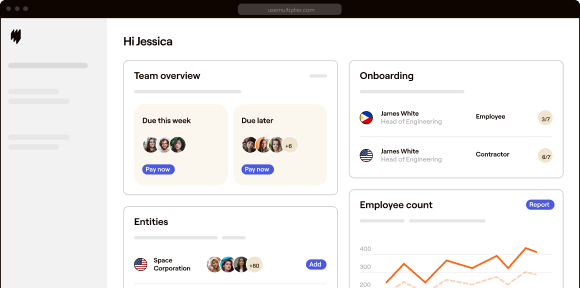
- Unified dashboard: Manage contracts, invoices, and onboarding in one place.
- Global scalability: Expand from the UK to 150+ markets effortlessly.
Final thoughts
The UK’s vibrant contractor market offers tremendous opportunity, but only if you stay compliant. With IR35 and strict tax obligations, DIY management is risky and time-consuming.
Using a contractor management service like Multiplier eliminates those risks and helps you scale globally with confidence.
Book a demo today to start hiring UK contractors compliantly and confidently with Multiplier.
FAQs
What is IR35 and how does it impact hiring contractors in the UK?
IR35 determines whether a contractor is genuinely self-employed or should be treated as an employee for tax purposes. If inside IR35, you’re responsible for PAYE and NIC deductions.
Do I need a legal entity to hire contractors in the UK?
No. You can engage contractors through a Contractor of Record platform like Multiplier without setting up an entity.
Can I pay UK contractors in currencies other than GBP?
Yes, with solutions like Multiplier, you can pay in GBP or 120+ currencies with built-in compliance.
How do I classify a worker correctly under UK law?
Use IR35 status checks and legal tests for supervision, control, and independence. Platforms like Multiplier handle this for you.
What’s the difference between contractor management and an EOR service?
Contractor management is for freelancers; EOR is for employees. Multiplier offers both for maximum flexibility.