Norway: your gateway to the Nordics for business growth
Norway stands as the ideal entry point into Scandinavia, offering a unique blend of innovation and stability. With transparent business policies and a streamlined registration process supported by the Brønnøysund Register Centre, Norway is perfectly positioned for companies looking to scale with confidence.
Its strong emphasis on innovation, sustainability, and digital transformation provides a fertile environment for growth.
By establishing your presence in Norway, you can unlock opportunities in the broader Nordic market while aligning with a forward-thinking ecosystem that prioritizes long-term success.
The business benefits of registering your company in Norway
For global organizations planning on expansions in 2025, Norway’s transparent regulations and streamlined processes make managing compliance and operations remarkably straightforward.
Here’s why Norway is an excellent choice for your business expansion:
- Benefit from competitive corporate tax rates and government incentives for sustainability and innovation.
- Register your company easily through the Brønnøysund Register Centre’s efficient system.
- Establish a base in Norway to access the broader Nordic and European markets.
- Flexible capital requirements cater to both startups and established enterprises.
- Clear regulations reduce administrative burdens, allowing you to focus on scaling your business.
- Access a highly skilled, tech-savvy workforce in a country renowned for its education and training initiatives.
Norway offers a business-friendly environment designed to support growth and innovation, making it an ideal destination for companies seeking to expand globally.
Next, we’ll explore the different pathways — standard company registration and Employer of Record (EOR) to help you determine the best approach for your business.
What is the difference between standard company registration and EOR in Norway?
Norway provides two primary options for establishing and expanding a business, each tailored to meet different operational needs:
Aspect | Standard registration | Employer of Record (EOR) |
Purpose | Creates a legal entity, granting full operational control. | Allows hiring in Norway without entity setup; EOR handles compliance and employment. |
Control | Full autonomy over operations and finances. | Operational control of employees while EOR manages legal and administrative tasks. |
Compliance | Requires adherence to Norwegian corporate, tax, and labor laws. | EOR ensures full compliance with local regulations on your behalf. |
Setup time | Lengthy, requiring documentation and approval processes. | Fast, enabling immediate workforce deployment. |
Cost | Involves setup fees, share capital requirements, and ongoing administrative expenses.. | Predictable service fees, often more cost-effective than entity setup. |
Scalability | Best for businesses planning a long-term, significant local presence. | Highly flexible, ideal for testing new markets or scaling operations quickly. |
While standard company registration is suited for businesses aiming for a long-term physical presence, an Employer of Record (EOR) offers a faster and more flexible way to expand into Norway. With an EOR, businesses can hire local talent, ensure compliance, and start operations without the complexities of entity formation.
Next, let’s dive into how an EOR simplifies onboarding and compliance for businesses entering Norway.
How an EOR simplifies company registration in Norway
An Employer of Record (EOR) offers an efficient approach to setting up operations, hiring local talent, and ensuring compliance, all without the need for a legal entity.
Here’s how an EOR supports businesses expanding into Norway:
- Skip the lengthy setup process as the EOR acts as your legal employer, allowing you to focus on growth from day one.
- Offload payroll, tax filings, and other administrative tasks to the EOR, freeing up time and resources.
- Ensure compliance with Norway’s labor laws and tax regulations through the EOR’s local expertise, reducing risks and providing peace of mind.
- Avoid establishing a legal entity, redirecting funds toward scaling your business, and cut costs.
- Expand your team with flexibility, adapting quickly to market demands without long-term commitments.
- Tap into Norway’s skilled and tech-savvy workforce without the hurdles of navigating local hiring practices.
- Offer competitive, locally compliant benefits to attract top talent, with the EOR handling the administrative responsibilities.
- Minimize legal and compliance risks while expanding confidently with the EOR’s end-to-end support.
An EOR not only simplifies your entry into Norway but also ensures your operations run smoothly from day one. By handling compliance, payroll, and onboarding complexities, it lets you focus on scaling your business with confidence.
Next, let’s walk through the traditional approach with a step-by-step guide to registering a company in Norway.
A step-by-step guide to registering a company in Norway
Setting up a business in Norway involves a clear and structured process. Here’s how you can get started, ensuring compliance at every stage:
Step 1: Register with the Brønnøysund Register Centre
The Brønnøysund Register Centre is your first stop for registering a company in Norway. It acts as the national registry, managing business and corporate information.
How to register?
Submit an application through the Brønnøysund Register Centre’s online portal.
Provide key details such as your chosen business name, type of business activity, and registered address.
Step 2: Choose your business structure
Establishing a business entity in Norway can be challenging and time-intensive. With an Employer of Record (EOR) like Multiplier, you can skip the hassle. From hiring and onboarding to payroll, taxes, and compliance, we handle it all while you focus on scaling your business.
Common business entities
Here’s a breakdown of Norway’s most common entity types:
- Aksjeselskap (AS) – Private limited company
- Liability: Limited to shareholders’ capital. Personal assets are protected.
- Capital requirement: Minimum NOK 30,000
- Governance: Requires a board (size depending on assets/turnover) and possibly an auditor
- Ideal for: Most foreign investors and startups. Offers credibility and protective structure as recommended by Tetra Consultants
- Allmennaksjeselskap (ASA) – Public limited company
- Liability: Limited to capital.
- Capital requirement: Minimum NOK 1 million
- Governance: Board and auditor compulsory; must maintain a gender-balanced board
- Ideal for: Large enterprises planning to obtain a stock listing or raise capital publicly
- Ansvarlig selskap (ANS) – General partnership
- Liability: Unlimited and joint among partners
- Capital requirement: None
- Ideal for: Small teams or SMEs comfortable with shared liability; no minimum capital makes it easy to start
- Kommandittselskap (KS) – Limited partnership
- Structure: At least one partner with unlimited liability (“komplementar”) and other silent investors (“komandittister”) with limited liability
- Equity: Kommandittists must invest at least NOK 20,000 (min. 20% upfront); complementary must fund at least 10% of total capital
- Tax & Audit: Single level of taxation; audited accounts mandatory
- Ideal for: Real estate, joint ventures, or investment vehicles
- Enkeltpersonforetak (ENK) – Sole proprietorship
- Liability: Unlimited. Owner’s personal assets at risk
- Capital & Setup: No minimum capital required, no registration fee, and uncomplicated setup
- Ideal for: Freelancers, sole traders, small-service businesses
Step 3: Prepare and submit the required documents
Once you have chosen your business structure and deposited the mandatory capital, the critical “paperwork phase” begins. These documents are submitted to the Brønnøysund Register Centre (the central registry for Norwegian entities).
Here’s what you’ll need and how to manage the process efficiently:
1. Foundational company documents
- Memorandum of Association and Articles of Association: These documents define your company’s purpose, structure, and internal rules. They must align with Norwegian legal standards.
- Completed registration forms: These include official application forms required by the Brønnøysund Register Centre, tailored to your company type (such as AS or ASA).
2. Proof of capital deposit
For private limited companies (AS), you must deposit the required minimum share capital (currently NOK 30,000) into a Norwegian business bank account. A certificate from the bank confirming this deposit is a mandatory part of your application.
3. Identity and address proofs
For each director and shareholder, provide:
- A valid, notarized copy of a passport or national identity document
- Proof of residential address (such as a utility bill or bank statement dated within the last 3 months)
If a corporate entity is involved as a shareholder or director, you must also submit:
- Certificate of incorporation
- Company’s constitutional documents
- Certificate of good standing or similar documentation from its home jurisdiction
4. Ultimate beneficial owner (UBO) information
You must declare and document who ultimately owns or controls the company. This includes:
- Identity and address proof for each UBO
- Ownership structure showing shareholding percentages
- Supporting documents (like share certificates or legal agreements) to establish UBO control
5. Additional documents
- Proof of registered address in Norway: A lease agreement or office registration showing the official business address.
- Power of attorney: If you’re using a third-party service provider or local representative to register on your behalf.
- Apostilled or notarized foreign documents: If any documentation is issued outside Norway, it may need to be notarized and/or apostilled, depending on the country of origin.
Step 4: Open a business bank account
A corporate bank account is essential for managing your company’s transactions, from paying taxes to receiving revenue.
Options include:
- Traditional banks: Norwegian banks such as DNB and Nordea provide comprehensive business banking services.
- Digital banks: Fintech platforms like Revolut may offer flexible online options for non-residents.
Documents needed:
- Business registration certificate
- Proof of identity for account signatories
- Company’s Articles of Association
Opening a bank account in Norway can be challenging, but Multiplier makes it easy to manage payroll without one.
With Multiplier, you can:
- Run payroll in multiple currencies.
- Stay compliant with Norwegian tax laws.
- Simplify global payroll management.
Focus on growing your business while we handle payroll and compliance seamlessly.
Step 5: Register for tax and compliance purposes
Compliance with Norwegian tax regulations is a critical step.
Key registrations:
- VAT Registration: Mandatory for businesses with annual revenue exceeding NOK 50,000.
- Payroll Taxes: If you employ staff, register for payroll tax and social security contributions.
To understand all tax and compliance requirements for businesses in Norway, you can refer to the official Norwegian tax administration guide.
Compliance requirements include:
- Maintaining accurate accounting records
- Submitting annual financial statements to the relevant tax authorities
- Adhering to Norwegian labor laws and employee benefits regulations
By following these steps, you’ll set up your company efficiently while ensuring full compliance with Norwegian laws.
Next, let’s break down the costs involved in registering and maintaining a business in Norway.
The real cost of registering a business in Norway
For businesses planning to establish a presence in Norway, understanding the associated costs is essential for effective budgeting. Here’s a detailed breakdown:
1. Registration costs
- Brønnøysund Register Centre fee: Registering a private limited company (AS) typically costs NOK 5,570 when done online or NOK 6,797 for paper applications.
- Share capital requirement: A minimum share capital of NOK 30,000 is required for AS registration, which must be deposited into a business bank account.
- Registered address: If you’re a non-resident, renting a legal address in Norway typically costs NOK 2,000–5,000 annually.
- Notary fees: Fees for notarizing documents can range from NOK 1,000 to NOK 3,000, depending on complexity.
2. Annual maintenance costs
- Accounting services: Basic bookkeeping services start at NOK 500 per month and increase with business complexity.
- Annual reporting: Filing annual financial statements typically costs NOK 5,000–15,000, depending on the service provider.
- Taxes: Norway requires businesses to pay corporate tax (currently 22% of profits) and VAT registration is mandatory if annual revenue exceeds NOK 50,000.
- Legal address renewal: Non-residents may need to pay an annual fee to maintain a registered address, costing approximately NOK 2,000–5,000.
3. Additional considerations
- Banking fees: Opening and maintaining a business bank account often involves setup fees of NOK 1,000–3,000 and monthly charges of NOK 100–300.
- Compliance and legal services: Hiring professionals for ongoing compliance can cost NOK 10,000–30,000 annually, depending on your business size.
An Employer of Record (EOR) significantly helps reduce these costs by handling payroll, compliance, and employee management without requiring entity setup. With an EOR, you pay a predictable monthly service fee, avoiding the upfront expenses and administrative burden of traditional registration.
Next, let’s compare the costs and benefits of standard company registration versus an EOR to determine the best approach for your business in Norway.
Cost comparison: standard registration vs. EOR
Here’s a breakdown of the costs involved in setting up a business in Norway through traditional registration compared to partnering with an Employer of Record (EOR):
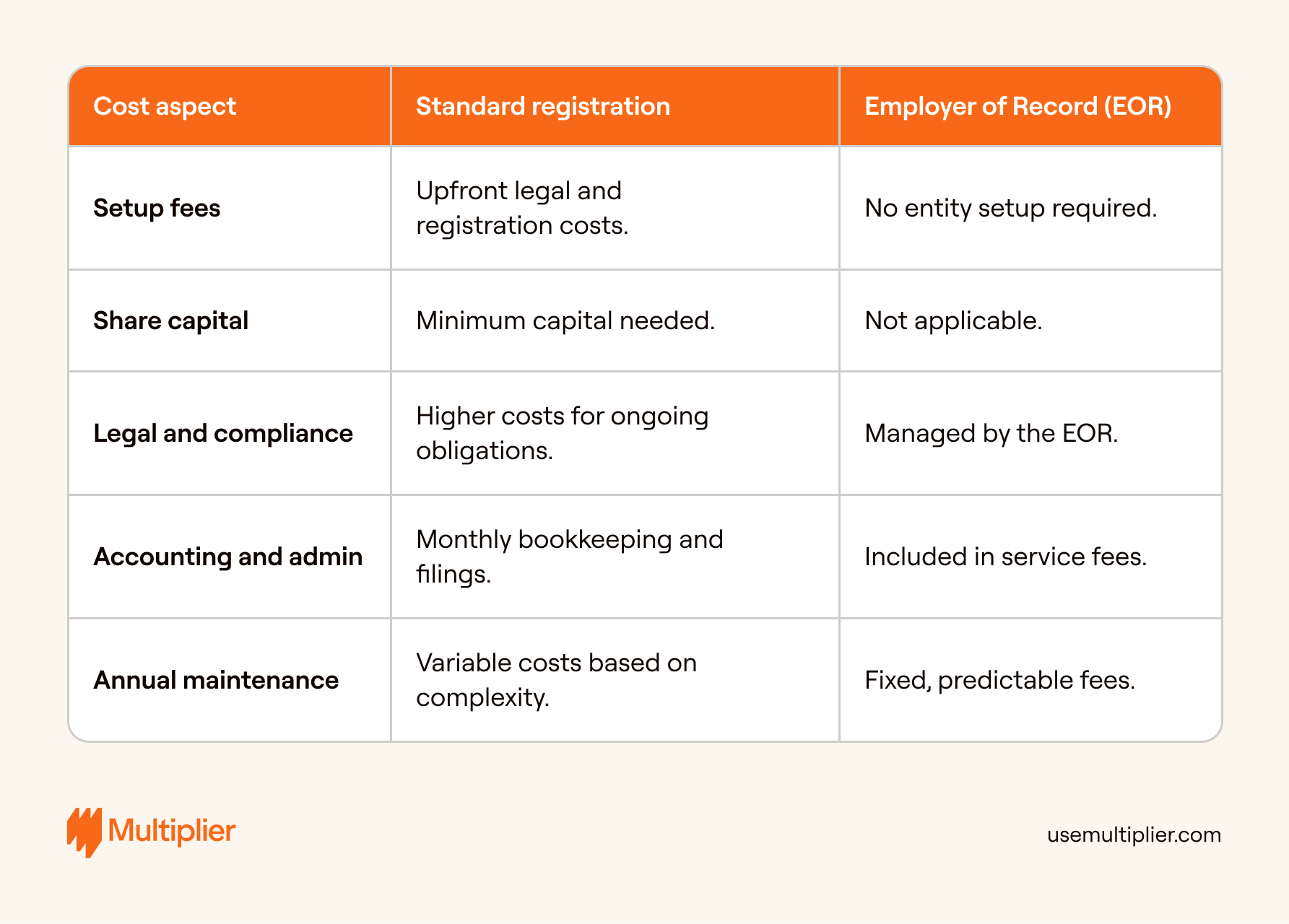
While traditional registration may suit businesses planning a long-term, substantial presence in Norway, it comes with higher initial costs and ongoing administrative responsibilities. In contrast, an EOR streamlines the process by managing payroll, compliance, and employee administration, offering predictable costs and a faster path to market.
Next, let’s explore how an EOR partnership, like Multiplier, simplifies and accelerates your expansion into Norway.
Simplify your Norwegian expansion with Multiplier
Establishing your presence in Norway has never been easier. With Multiplier’s Employer of Record (EOR) solution, you gain a partner dedicated to simplifying the process, allowing you to concentrate on building your team and achieving your business objectives in a dynamic market.
Why Multiplier, you can:
Hire locally, grow globally
Easily access Norway’s skilled talent pool to seamlessly hire both full-time employees and contractors in Norway. With Multiplier, our local HR specialists manage compliant employment contracts, contractor agreements, and efficient onboarding, making team growth stress-free.
Precision payroll management
Simplify payroll with real-time accuracy. Multiplier ensures taxes, social contributions, and payouts fully comply with Norwegian payroll regulations, leaving no room for error.
Streamlined HR workflows
Handle HR operations in Norway effortlessly with our all-in-one platform. From onboarding to expense management and leave approvals, you’ll have full control over your Norwegian operations.
Compliance handled for you
Stay ahead of Norwegian labor laws and tax obligations with Multiplier. From VAT compliance to safeguarding employee rights, we ensure your business remains fully compliant.
Competitive, localized benefits
Stand out in Norway’s competitive market with customized benefit packages. Let us handle the administrative details, so you can focus on building a thriving, motivated team.
Dedicated support and security
Rely on 24/7 expert support and GDPR-compliant processes. With SOC 2-certified security, your business data is in safe hands at all times.
At Multiplier, we go beyond offering solutions — we create opportunities for your success. Whether it’s streamlining payroll, enabling rapid team expansion, or navigating Norway’s unique regulations, we provide the tools, expertise, and support to help your business thrive. With us by your side, growth isn’t just a goal, it’s a guarantee.
Book a demo today and discover how Multiplier’s EOR services can make your Norwegian expansion smooth and hassle-free.
FAQs
Q. Can a foreigner register a company in Norway?
Yes, foreigners can register a company in Norway. Both individuals and foreign companies are allowed to establish a business, provided they meet legal requirements such as having a Norwegian business address, a D number, and required documentation.
Q. How do I set up an LLC in Norway?
In Norway, an LLC is known as an Aksjeselskap (AS). To set one up, you must:
- Choose a business name and structure
- Deposit a minimum share capital of NOK 30,000
- Register through the Brønnøysund Register Centre
- Submit the required documents, such as Articles of Association, proof of address, and shareholder IDs
Q. Is it easy to start a business in Norway?
Yes, Norway offers a streamlined and transparent process for starting a business. With clear regulations, online registration, and government support, setting up a company, especially via the Brønnøysund Register Centre, is efficient and business-friendly.
Q. How much is VAT in Norway?
The standard VAT (Value Added Tax) rate in Norway is 25%. Businesses must register for VAT if annual revenue exceeds NOK 50,000. Lower VAT rates apply to specific goods and services, such as 15% for food and beverages.
Q. What business can I start in Norway?
You can start a wide range of businesses in Norway, including tech startups, consultancy services, retail, manufacturing, and green energy ventures. Norway encourages sustainable and innovative businesses, providing support through grants and incentives. For faster entry without entity setup, use an EOR like Multiplier to hire locally and operate compliantly from day one.