A Hong Kong hackathon could offer a useful blueprint for talent leaders looking to diversify their recruitment methods…
The hackathon is hot right now.
This fast-paced format is perfect for bringing big groups of employees together to identify core business problems, working as one unit to quickly spin up solutions.
Run properly, they free talented-but-busy individuals from their day-to-day siloes and jam-packed schedules to deliver solutions that have a real-world impact, without any of the usual friction or distractions.
Why Canva & Meta love hackathons
No wonder they’ve proven popular, particularly for SaaS or tech-oriented businesses, and workplaces looking to crowdsource AI innovations.
Meta, for example, has said that hackathons are a part of its DNA: “A number of features found on Meta products, including some of our most popular that are used by billions of users, were created as a result of our hackathons.”
Jennie Rogerson, Canva’s Global Head of People, meanwhile, recently hailed the format. She reflected on a two-day, company-wide hackathon – part of the company’s second week-long shutdown for staff AI discovery – which generated some 467 ideas, up from 330 in 2025.
“The hackathon that closes out AI Discovery Week has always been my favourite part,’ Rogerson confessed. “Hackathons have always been part of how we think and build at Canva, and what AI Discovery Week has added to that tradition is the conviction that the best ideas can come from anywhere in the company, when the conditions are right.”
Heed this Hong Kong hackathon
Hackathons need not only be a tool for internal creativity and innovation, however.
The format lends itself perfectly to employers looking to widen their talent pools and identify potential candidates – what we’re calling the cross-border hackathon – especially for global organizations unsure where to begin in their search for skilled talent in new markets.
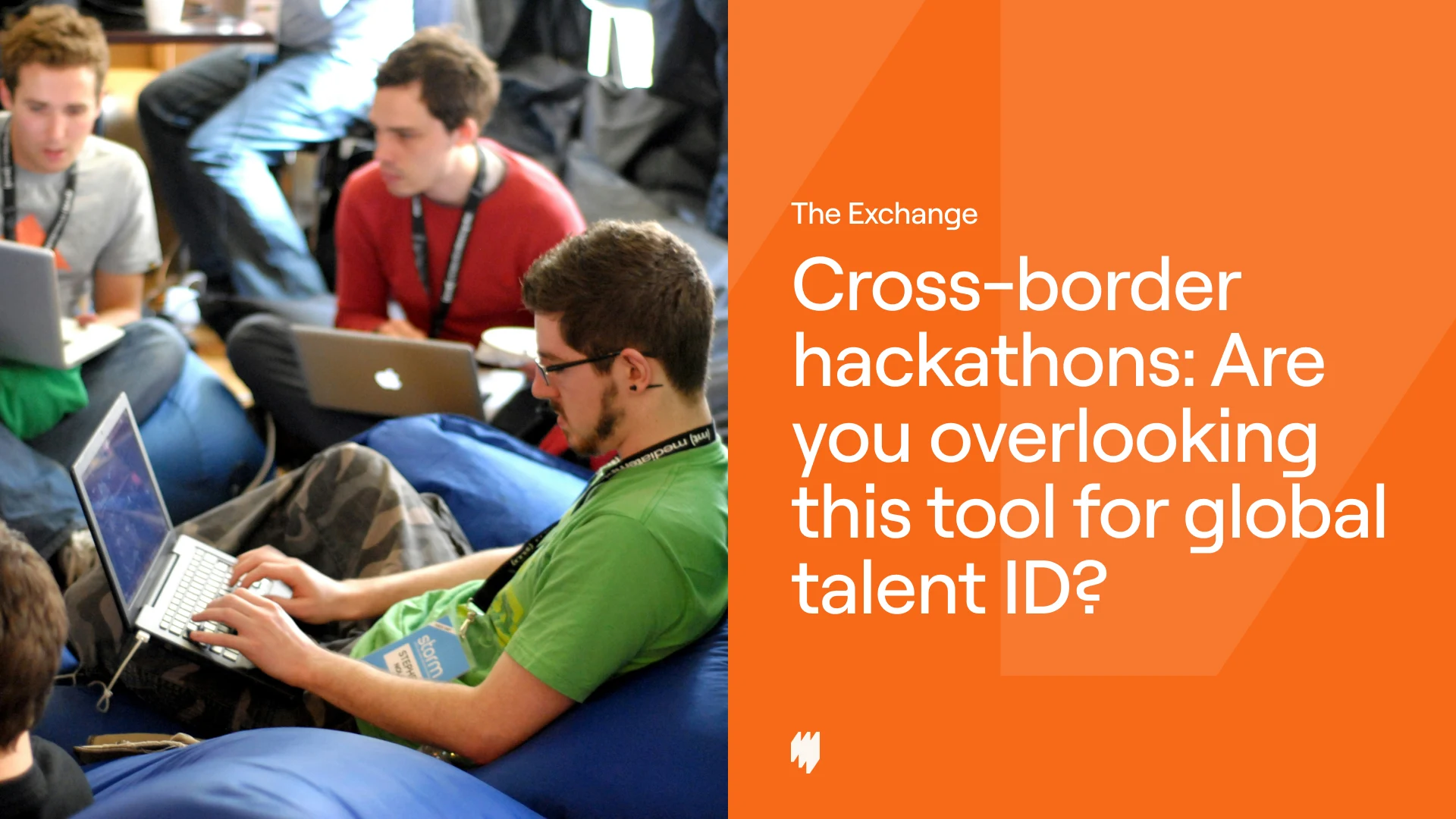
A recent cross-border hackathon organised by Hong Kong Talent Engage (HKTE) and the EuroTech Federation offers a useful blueprint.
As reported by SWNS and syndicated across national UK news outlets, the IT-focused hackathon was run throughout Europe, attracting 1,200 applicants from over 25 countries.
250 individuals advanced to the final round, with the winning 20 invited to visit Hong Kong, Shenzhen, and Guangzhou to “meet investors, incubators, research institutes, and industry leaders.”
A reported 90% of finalists expressed stronger interest in Hong Kong and Guangdong-Hong Kong-Macao Greater Bay Area (GBA) cities after taking part.
As Chris Sun, the Secretary for Labour and Welfare of the HKSAR Government stated, the hackathon – now in its fourth year – “connects global talent with I&T opportunities in GBA.”
The case study indicates how successful the cross-border hackathon format can be fuelling the global hiring and flow of talent.
Build global talent communities
Back to Canva and Meta. Both companies, alongside their internal programmes, run external hackathons for students. As well as the ideas they create, these initiatives also help the companies to attract and screen for prospective early career talent.
For the winners, there is presumably the prospect of a job (or internship) offer.
For the employer, there is the chance to build out a thriving talent community with a fresh pipeline of eager-to-please candidates consistently coming through the door, showing exactly how they think, work, collaborate, and deliver.
As far as candidate screening goes, it ticks an awful lot of boxes that traditional interview processes have long-struggled to deliver.
Moreover, as the HKTE’s hackathon demonstrates, this format has global potential.
Running remote, cross-border hackathons gives employers the chance to put candidates from across the world through their paces, locating hidden gems and creating networks in regions that may otherwise be challenging to enter.
So, next time you’re plotting a global hire and have no clue where to begin: consider the cross-border hackathon.