Managing payroll across multiple countries adds layers of operational and compliance complexity that are often underestimated in the early stages of expansion. As organizations expand into new regions, payroll operations often evolve organically. Different local vendors are onboarded across countries. Processes vary by region. Payroll data lives in multiple systems. Reporting requires manual consolidation. Compliance ownership becomes unclear.
Over time, payroll shifts from a predictable monthly process into a recurring operational burden that affects financial accuracy, regulatory exposure, and employee trust.
Global payroll services are often introduced to restore consistency and control in fragmented, multi-vendor payroll environments. Centralized platforms promise standardized processes, improved visibility, and stronger compliance coverage across countries. However, payroll providers vary significantly in execution maturity, accountability, and local expertise.
This is why organizations that treat payroll as a core operational function rely on a structured evaluation process before making a decision.
What is a Global Payroll RFP?
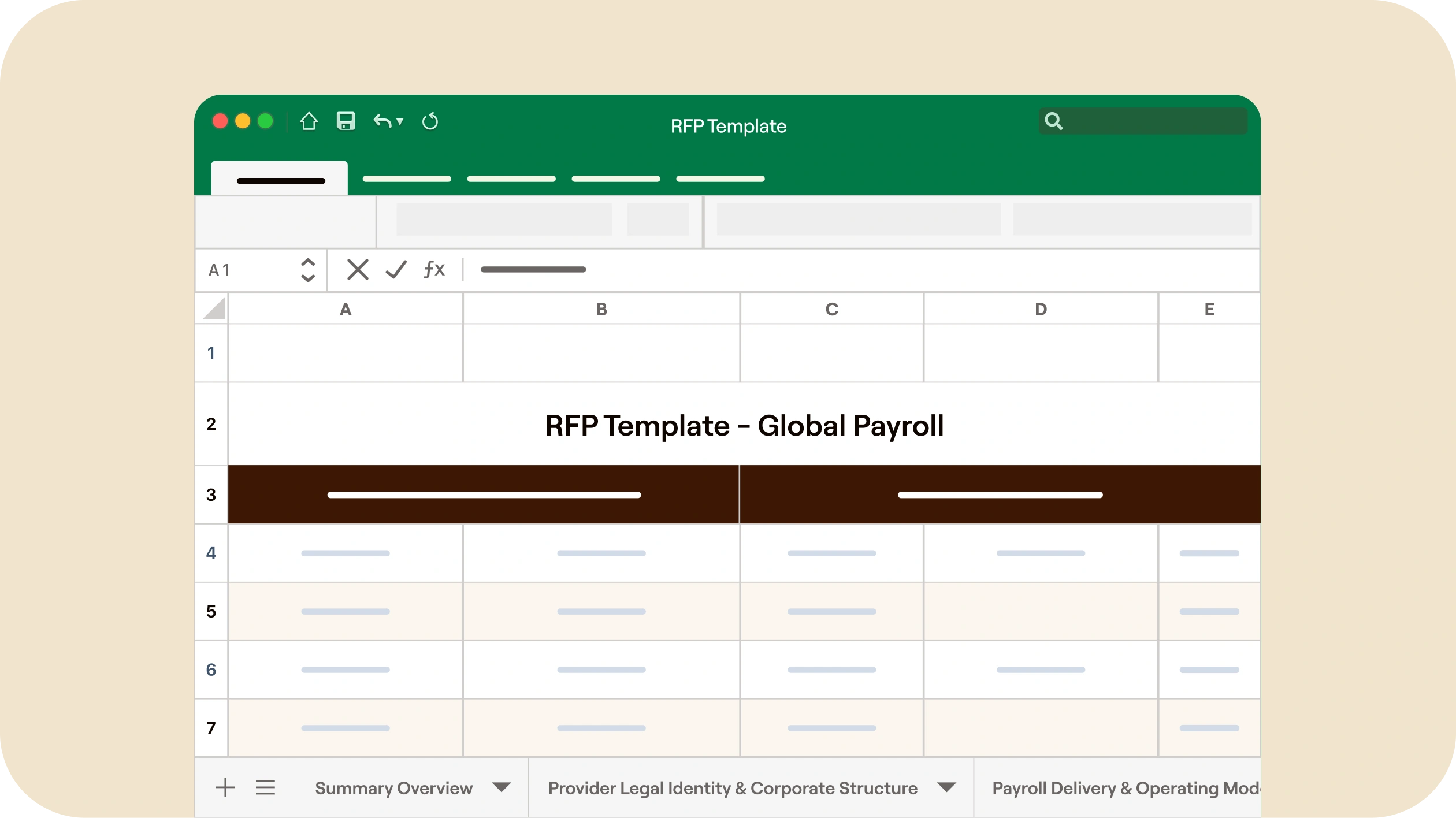
A Global Payroll Request for Proposal (RFP) is a structured document used to evaluate payroll providers that manage payroll across multiple countries. It defines payroll scope, compliance expectations, accuracy standards, service levels, and commercial terms so vendors can be assessed objectively. Unlike demo-led evaluations, a payroll RFP creates a consistent framework for Finance, Payroll, HR, and Procurement teams to compare providers and select a partner that can support payroll operations reliably at scale.
Why is a structured Global Payroll RFP essential?
Global payroll vendor selection affects multiple stakeholders simultaneously, each with different priorities and risk tolerances.
- Payroll teams are accountable for execution accuracy and timely processing
- Finance teams focus on cost predictability, controls, and reporting integrity
- Compliance teams evaluate statutory exposure and audit readiness
- HR teams rely on payroll continuity to maintain employee trust and engagement
Without a structured RFP, vendor selection often becomes influenced by product demos, marketing claims, or incomplete assumptions. Critical operational details surface only after payroll has gone live, when correcting mistakes becomes costly and disruptive.
A Global Payroll RFP introduces discipline by translating internal requirements into documented expectations that every vendor must address in the same way.
A well-designed payroll RFP helps organizations:
- Define payroll complexity clearly before engaging vendors
- Align Finance, Payroll, HR, Compliance, and IT stakeholders
- Compare providers on accuracy standards and service ownership
- Surface compliance and payment risks early in the process
- Create a documented, defensible selection record for procurement
Align teams on global payroll prioritiesAlign payroll, finance, and compliance expectations early to evaluate global payroll providers consistently and protect employee trust through reliable payroll execution. |
What does the Global Payroll RFP template help you achieve?
This template is designed to surface risks that typically appear only after implementation.
It helps organizations answer critical questions such as:
- Can this provider run payroll accurately across every country we operate in?
- Who owns statutory filings, regulatory updates, and error remediation?
- What controls exist to prevent payroll errors and detect issues early?
- How transparent and predictable are payroll costs as headcount scales?
- How much operational effort remains with internal teams after outsourcing?
Each section of the template forces vendors to respond with execution-level, country-specific detail rather than generic assurances.
How the Global Payroll RFP template is structured
Unlike hiring-focused RFPs, this Global Payroll RFP template mirrors the real lifecycle of global payroll operations, from defining scope and execution standards to governance, payments, and long-term cost control.
1. Organizational context and payroll landscape
This section establishes the payroll environment vendors are responding to.
Your document must include:
- Company size, industry, and headquarters
- Countries where payroll is currently processed
- Employee counts per country and expected growth
- Existing payroll setup, including vendors and tools
- Key challenges driving the RFP
Providing clear context ensures vendors understand your complexity and tailor proposals accordingly.
2. Countries, employee populations, and payroll cadence
Here, you define the operational scope of payroll services.
Include details such as:
- Countries currently in scope and planned expansions
- Payroll frequency by country
- Employee population types, including salaried and hourly workers
- Local currency requirements
- Payroll cutoff timelines and approval expectations
Clear scope definition prevents under-scoping during pricing and avoids renegotiations after onboarding.
3. Payroll processing mechanics and statutory obligations
This section focuses on how payroll is executed.
Vendors should explain:
- Gross-to-net calculation methodologies
- Income tax and social security contribution handling
- Filing processes with local authorities
- Payslip formatting and statutory disclosure requirements
- Record retention and audit support
Rather than asking if vendors are compliant, this section evaluates how compliance is operationalized in practice.
4. Regulatory change management and compliance ownership
Payroll regulations change regularly across jurisdictions.
This section assesses:
- How vendors monitor regulatory updates
- How changes are implemented without disrupting payroll cycles
- How clients are notified of updates
- Who bears responsibility for errors caused by regulatory changes
Clear ownership in this area reduces long-term compliance exposure. Establishing this clear ownership is a vital safeguard because, as per Multiplier’s Global hiring gap report, only 8% of companies report being fully compliant with international tax and labor laws on their own, leaving a staggering 92% exposed to regulatory risk.
5. Accuracy standards, validations, and payroll controls
Payroll accuracy is foundational to employee trust and financial reporting.
Define expectations for:
- Accuracy thresholds and acceptable error rates
- Validation checks before payroll finalization
- Approval workflows and segregation of duties
- Audit trails for payroll changes
- Error resolution timelines and escalation paths
Strong responses here indicate mature payroll governance.
6. Technology platform and payroll data visibility
Global payroll technology should simplify operations, not increase reconciliation effort.
Evaluate:
- HRIS and ERP integration capabilities
- Consolidated multi-country reporting
- Payroll approvals and access controls
- Data security standards and certifications
- Reporting availability for Finance and leadership teams
Visibility into payroll data is critical for forecasting, audits, and compliance oversight. Achieving this level of visibility is incredibly difficult when relying on fragmented systems. According to Multiplier’s Global hiring gap report, 51% of companies cite managing multiple vendors as a major source of friction in their global payroll operations.
| Modern global payroll platforms represent the future of global payroll, shifting from systems of record to integrated platforms delivering automation, compliance visibility, real-time data, and scalable global payroll operations. |
7. Payroll payments and cross-border cash flow considerations
Payroll does not end with calculations. Payments are a critical risk area.
This section evaluates:
- Salary payments in local currencies
- Cross-border payment timing and reliability
- FX handling and transparency
- Statutory remittances to local authorities
- Payment reconciliation and confirmation processes
Many payroll issues originate from weak payment infrastructure, making this section essential.
8. Service delivery model and ongoing support
Global payroll is an ongoing service, not just a software implementation.
Assess:
- Dedicated versus pooled payroll support models
- Time-zone coverage and response times
- Escalation paths during payroll-critical periods
- Communication cadence and governance reviews
- Support during audits and compliance inquiries
Service quality often becomes apparent only after go-live, so clarity upfront is critical.
9. Commercial model and cost transparency
Payroll pricing often appears simple but hides complexity.
Request clarity on:
- Pricing by country and employee volume
- One-time implementation and setup costs
- Fees for off-cycle payrolls and adjustments
- FX and payment-related charges
- Cost behavior as headcount grows
This enables Finance teams to model total payroll operating costs accurately.
10. Implementation approach and transition risk management
Changing payroll providers introduces operational risk.
Evaluate vendor plans for:
- Implementation methodology and timelines
- Parallel payroll runs and validation steps
- Data migration and historical payroll handling
- Country rollout sequencing
- Roles and responsibilities during transition
Strong implementation plans signal operational maturity.
$1M+ annual savings and 300 hours saved per month on payroll and compliance Axero Solutions partnered with Multiplier’s EOR to simplify global compliance and payroll across locations, including India, Spain, Montenegro, and the Philippines, reducing administrative burden and supporting international hiring. Key outcomes:
|
11. Proposal format, scoring, and evaluation process
To ensure fair comparison, the template standardizes how proposals are submitted.
It includes:
- Required response structure
- Documentation expectations
- Submission timelines
- Shortlisting and demo process
- Evaluation criteria and weightings
This supports procurement rigor and audit defensibility.
Together, these sections define what a complete Global Payroll RFP should contain. The next step is validating whether your RFP is asking the right questions. This checklist helps pressure-test vendor responses and ensures critical payroll, compliance, and cost considerations are not overlooked during evaluation.
Global Payroll RFP checklist: 5 must-ask questions during the Global Payroll RFP processBy this stage, your Global Payroll RFP should contain enough detail for vendors to respond meaningfully. Use this checklist to keep the evaluation structured and ensure no critical payroll requirement is missed. Global payroll vendor selection timelineA structured timeline ensures vendors provide thoughtful, country-specific responses and gives internal stakeholders adequate time to assess compliance, accuracy, cost, and delivery risk. Q1: What’s the ideal timeline for running a Global Payroll RFP? Global payroll evaluations typically take longer than single-country vendor selection due to regulatory, payment, and operational complexity.
Q2: How do we assess a vendor’s global payroll compliance capability? Focus on execution depth, not coverage claims. Ask for:
Q3: What matters most when evaluating global payroll pricing proposals? Look beyond headline fees and assess:
Q4: How do we evaluate payroll accuracy, controls, and data security? Payroll accuracy and data protection are critical. Ask vendors to outline:
Q5: What common risks should we watch for during a Global Payroll RFP? Be cautious of:
|
Common global payroll RFP mistakes to avoid
Even well-run organizations make avoidable mistakes during payroll RFPs. Understanding these pitfalls helps prevent long-term operational and compliance issues.
1. Assuming global coverage equals local expertise
Many providers claim global reach but rely on partners or thin local support in certain countries. Without probing execution depth and ownership, organizations discover gaps only after payroll errors occur.
2. Ignoring payroll payments and FX handling
Payroll accuracy depends on timely salary payments and statutory remittances. RFPs that focus only on calculations often overlook payment execution, FX transparency, and reconciliation processes, which are frequent failure points.
3. Evaluating cost without service accountability
Low per-employee pricing can mask weak support models or heavy reliance on manual processes. Cost must be evaluated alongside accuracy commitments, escalation paths, and compliance ownership.
4. Overlooking regulatory change management
Payroll regulations change regularly. RFPs that do not ask how vendors track and implement changes expose organizations to delayed updates and compliance penalties.
5. Rushing the RFP timeline
Short response windows lead to generic proposals and missed red flags. Vendors that cannot respond thoughtfully under realistic timelines often struggle during implementation and ongoing delivery.
Avoiding these mistakes significantly improves the likelihood of selecting a reliable long-term payroll partner.
5 Best practices for running a global payroll RFP
Organizations that run successful global payroll RFPs approach the process with discipline and realism.
1. Treat payroll as a risk-managed function
Payroll impacts compliance, financial reporting, and employee trust. Evaluate providers with the same rigor applied to financial systems or compliance partners, not as a transactional service.
2. Involve finance and compliance from the start
Bringing these teams in only at the approval stage leads to rework and delays. Early involvement ensures cost, reporting, and regulatory concerns are addressed upfront.
3. Demand country-specific responses
Generic global answers hide execution gaps. Require vendors to explain how payroll is run in your key countries, including filings, payments, and support structure.
4. Evaluate service ownership, not just technology
Strong platforms still fail without accountable service delivery. Assess who owns payroll outcomes, how issues are escalated, and how performance is measured.
5. Allow enough time for quality proposals
Two to three weeks for vendor responses typically produces more thoughtful proposals. Adequate evaluation time prevents rushed decisions that lead to operational pain later.
Following these best practices helps organizations move from vendor selection to stable, predictable global payroll operations.
Download Multiplier’s Global Payroll RFP Template
Selecting a global payroll provider is a long-term operational decision. This template helps teams evaluate providers with the rigor global payroll demands.
It enables:
- Payroll teams to standardize evaluation
- Finance teams to assess cost and compliance exposure
- HR teams to ensure payroll continuity
- Procurement teams to document fair selection
Download Multiplier’s RFP Global Payroll template
Why businesses evaluate global payroll with Multiplier
Teams evaluating global payroll providers during an RFP process often shortlist Multiplier for the following reasons:
In-country compliance expertise across 150+ countries
Multiplier supports payroll with local knowledge of tax rules, social security contributions, and statutory filings, helping teams manage compliance consistently as regulations change.
Strong payroll accuracy controls and validations
Built-in checks, approvals, and audit trails help reduce calculation errors and support reliable payroll execution across regions and pay cycles.
Clear ownership and accountability
Defined responsibility across payroll processing, compliance support, and issue resolution prevents ambiguity and reduces operational risk during ongoing payroll delivery.
Transparent and predictable pricing models
Clear, predictable pricing with full visibility into payroll fees, country-level costs, and payment-related charges allows Finance teams to forecast total payroll spend accurately as headcount scales.
Dedicated payroll support and governance
Access to knowledgeable payroll specialists ensures timely support during payroll runs, regulatory updates, audits, and complex country-specific scenarios.
Industry recognition: Multiplier was named a Top Next-Generation Multi-Country Payroll Vendor for 2024, reaffirming its expertise in compliant and scalable global payroll operations. |
Book a demo to see how Multiplier supports accurate, compliant, and scalable global payroll operations across multiple countries, currencies, and regulatory environments.
Frequently asked questions about Global Payroll RFPs
What is the difference between a Global Payroll RFP and an RFI?
An RFI is exploratory and gathers high-level information. A Global Payroll RFP is decision-focused, helping teams compare providers like Multiplier against defined requirements, service levels, compliance capabilities, technology, and pricing.
When should a company issue a Global Payroll RFP?
Typically, when running payroll across multiple countries, consolidating vendors, facing accuracy or compliance issues, or planning expansion into new regions that increase payroll complexity and risk.
Who should be involved in a Global Payroll RFP?
Payroll, Finance, HR, Compliance, and Procurement teams should be involved to define requirements, assess risk, evaluate costs, and ensure operational, legal, and commercial alignment.
What should be included in a Global Payroll RFP?
Company context, payroll scope, country coverage, statutory obligations, accuracy standards, service levels, technology expectations, payment and FX handling, pricing structure, and implementation and transition approach.
How long does a Global Payroll RFP process take?
Most Global Payroll RFP processes take six to eight weeks, covering preparation, vendor responses, evaluation, stakeholder reviews, and final selection.
Does a Global Payroll RFP cover payroll payments and FX?
Yes. Payroll payment execution, FX handling, statutory remittances, and payment controls are critical to payroll accuracy and compliance, and are core evaluation areas for providers such as Multiplier.
Can a payroll RFP be used to benchmark an existing provider?
Yes. Many organizations use Global Payroll RFPs to benchmark existing providers, validate pricing and service levels, or support renegotiation and vendor consolidation decisions.