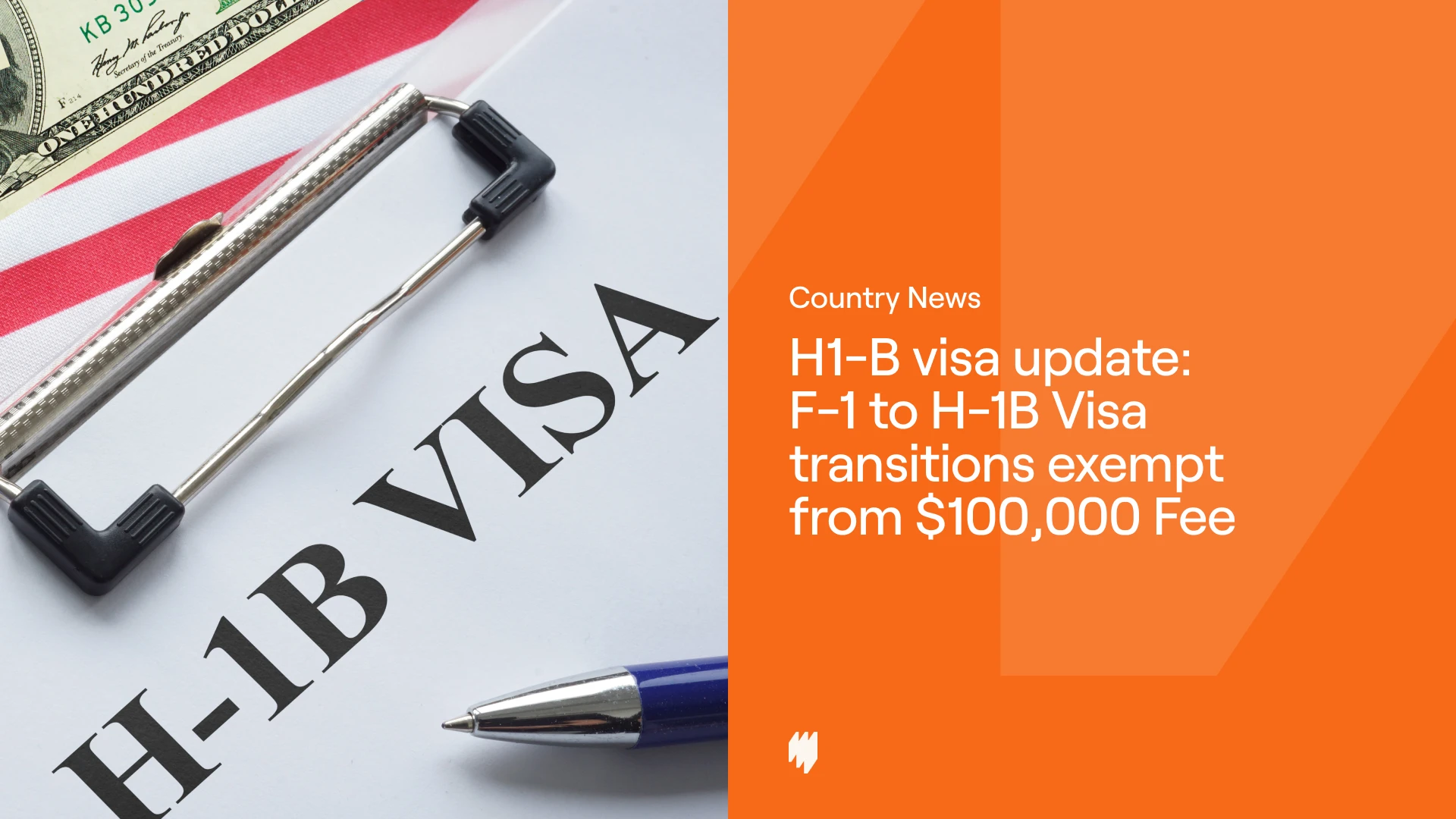
The controversial new $100,000 H-1B visa fee implemented by the US government will not apply to international students and other visa holders changing status within the country, according to new guidance from the US Customs and Immigration Services (USCIS). This clarification, issued on October 20, provides a significant measure of relief for US-based employers and thousands of international students on F-1 visas who seek to transition to H-1B skilled worker status. The move comes after a September 19 proclamation that hiked the H-1B fee, causing alarm and confusion among prospective workers and global businesses.
Details of the new H-1B visa fee exemptions
The USCIS guidance confirmed that the $100,000 fee is specifically for new H-1B petitions filed on or after September 21, 2025, for workers outside the United States who do not already hold a valid H-1B visa.
The following categories of petitions for workers inside the United States are exempt from the new fee, provided the amendment, change of status, or extension is granted by USCIS:
- Change of status: This includes F-1 students (including those on Optional Practical Training or STEM OPT extensions) transitioning to H-1B status. It also covers changes from L-1 (intra-company transfer) or J-1 (exchange visitor) to H-1B.
- Extension of stay: Petitions to extend the duration of an existing H-1B status.
- Amendment: Petitions for changes to the employment terms (e.g., job title or work location).
- Change of employer: Petitions filed when an H-1B holder moves to a new employer.
Additionally, individuals already in the US with approved H-1B applications will not become subject to the fee if they travel abroad. However, the fee will apply if the worker is found to be ineligible for the change of status (e.g., due to an earlier status violation) or if the employer requests consular notification instead of a change of status.
The clarification arrives as two separate lawsuits, including one from the US Chamber of Commerce, are challenging the legality of the new fee in federal court.
What this means for skilled workers
This new guidance is a major win for international students and professionals currently residing in the US.
- F-1 students: Graduates on F-1 visas, particularly those utilizing the Optional Practical Training (OPT) program, can now seek H-1B sponsorship from US companies without the employer incurring the steep $100,000 fee. This exemption removes a massive financial barrier that could have otherwise deterred US employers from hiring US-trained international talent.
- Current H-1B holders: Existing H-1B employees can breathe a sigh of relief as the fee does not apply to their extensions, amendments, or travel plans. This provides stability for their career path and family life in the US.
- J-1 and L-1 holders: Professionals on other work visas, such as L-1 intra-company transfers or J-1 exchange visitors, can also pursue a change of status to H-1B without the new charge, which is crucial for long-term career planning in the US.
What this means for employers
For US employers, particularly in the tech, research, and healthcare sectors, the clarification mitigates a significant new cost and simplifies the pipeline for hiring US-trained international graduates.
- Talent pipeline protection: The exemption allows companies to continue hiring top international talent who have integrated into the US education and employment system, reducing the risk of a severe skilled labor shortage. Many US companies rely on foreign graduates to fill high-skilled roles.
- Focus on local graduates: The fee’s application primarily to new applicants abroad creates a strong financial incentive for US businesses to focus their H-1B hiring efforts on F-1 students already in the country.
- Ongoing cost for offshore hiring: Companies, particularly Indian IT firms, that frequently transfer employees from overseas offices to the US on new H-1B visas will still face the $100,000 fee, which will add to their costs and administrative complexity.
This new policy underscores the unpredictable nature of immigration and labor laws. For US companies seeking to hire global talent outside the United States, managing compliance remains a complex, high-risk endeavor.
To hire talent seamlessly across borders without navigating the $100,000 fee for new overseas hires or the complexities of setting up local entities, employers can partner with a global Employer of Record (EOR) platform like Multiplier. Multiplier takes on the legal responsibility for global payroll, benefits, and compliance for international employees in 150+ countries, enabling businesses to expand their team compliantly and efficiently, even as visa policies shift.
Conclusion
The USCIS guidance on the H-1B visa fee offers a much-needed reprieve to US employers and international students, safeguarding a vital talent pipeline by exempting in-country status changes from the steep $100,000 charge. However, the fee for new overseas H-1B hires still represents a significant barrier for companies trying to access global talent.
For businesses looking for a simplified, compliant, and cost-effective way to hire employees in other countries, an Employer of Record (EOR) like Multiplier offers the ideal solution. Multiplier provides a single platform for global payroll, benefits administration, and compliance in over 150 countries, allowing you to hire the best person for the job, regardless of their location, without the burden of complex visa fees or legal setup.
Book a demo to expand your team globally.
FAQs
What is the new $100,000 H-1B visa fee, and who must pay it?
The $100,000 H-1B visa fee was introduced by a presidential proclamation in September 2025 as a new charge for the H-1B skilled worker visa. This fee applies only to new H-1B petitions filed on or after September 21, 2025, for individuals who are outside the United States and who do not already possess a valid H-1B visa. The fee must be paid by the sponsoring employer.
Are F-1 international students exempt from the new $100,000 H-1B visa fee?
Yes, F-1 international students are exempt from the $100,000 H-1B visa fee when they file a petition for a change of status to H-1B while remaining inside the United States. This exemption includes students on Optional Practical Training (OPT) or STEM OPT extensions. As long as the change of status is granted by USCIS, the fee does not apply, even if the individual later travels abroad for visa stamping.
Does the $100,000 fee apply to H-1B visa extensions, amendments, or change of employer?
No, the new $100,000 H-1B visa fee does not apply to petitions filed for an extension of stay, an amendment to the current employment, or a change of employer for an alien who is already inside the United States. The fee is explicitly aimed at new H-1B applicants who are outside the country.
What is a "change of status," and why is it significant for the H-1B fee exemption in the US?
A change of status is an application made by a foreign national who is already legally present in the United States on one type of visa (e.g., an F-1 student visa) to switch to a different non-immigrant status (e.g., an H-1B skilled worker visa) without leaving the country. It is significant because the USCIS guidance explicitly exempts H-1B petitions requesting a change of status, amendment, or extension of stay for an alien inside the United States from the new $100,000 fee.
How can US employers hire international talent without incurring the $100,000 H-1B fee for new overseas hires?
US employers can hire international talent outside the United States compliantly and without the burden of the $100,000 fee by utilizing an Employer of Record (EOR) platform like Multiplier. The EOR acts as the legal employer, handling all global payroll, benefits, and local legal/tax compliance in over 150+ countries. This allows the client company to access global talent seamlessly and cost-effectively without setting up local entities or navigating complex foreign visa processes like the H-1B for new overseas employees.