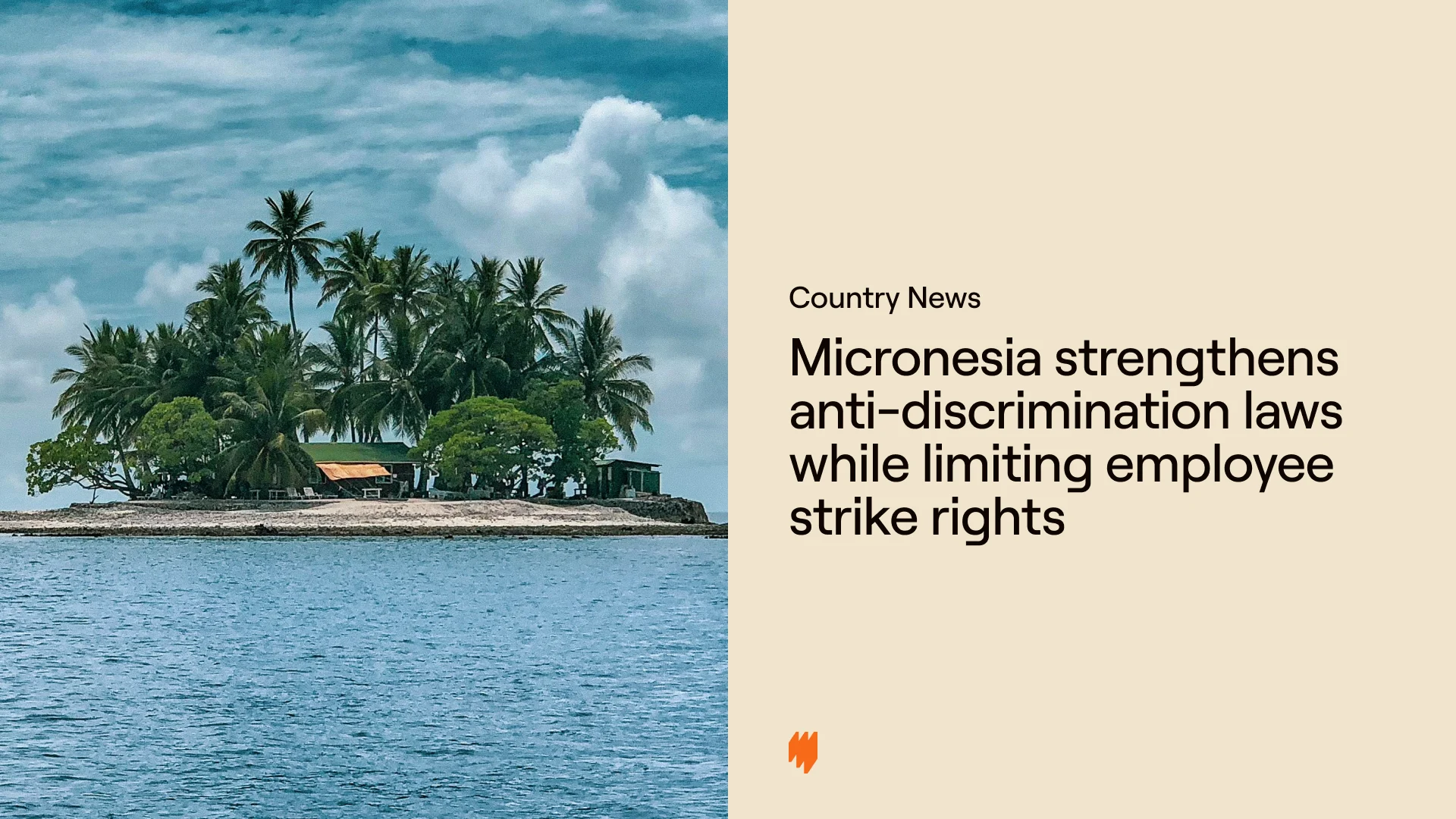
The Federated States of Micronesia (FSM) has enacted recent legislative updates that both expand employee protections and clarify limitations on labor action. These changes reflect the country’s unique legal landscape, which balances broad constitutional rights with specific regulations governing workplace conduct and collective bargaining.
Details of the new regulations
The FSM’s Constitution prohibits discrimination based on sex, race, ancestry, religious beliefs, national origin, language, physical disability, or social status. This protection has been explicitly expanded to include sexual orientation through a recent amendment to the FSM Code. This means that individuals are legally protected from discrimination in all aspects of employment based on these factors.
While citizens have the right to form associations to express their views to the government, employees are prohibited from striking or stopping work for collective bargaining. This prohibition applies to all employees, regardless of their status within the public service system. The law states that representatives of these associations must be given a “reasonable opportunity” to present their opinions to the government.
For whistleblowers, the FSM lacks formal legal protections against retaliation, particularly for those who report misconduct or corruption outside the public service system. There is no specialized national legal mechanism for reporting or remedies for retaliated whistleblowers.
What this means for skilled workers
For skilled workers and contractors in the Federated States of Micronesia, these regulations provide a mix of expanded protections and clear limitations. The new anti-discrimination laws offer a stronger sense of security and a clearer legal basis to challenge unfair treatment based on sexual orientation.
However, workers should be aware of the strict prohibition against strikes and work stoppages for collective bargaining purposes. Additionally, those who wish to report misconduct outside the public service system should be cautious, as there are no formal legal protections against retaliation.
What it means for employers
Employers in the FSM must update their policies to ensure they do not discriminate against employees based on any of the protected characteristics, including sexual orientation. This applies to all aspects of employment, from hiring and promotions to termination.
Businesses must also be aware of the prohibition on strikes and the lack of whistleblower protection, and they must ensure they provide a “reasonable opportunity” for employee associations to express their views.
Conclusion
Given the combination of national and state-specific laws, navigating the legal complexities of the FSM can be challenging for international companies. Multiplier’s Employer of Record (EOR) services offer a practical solution by handling all aspects of local employment, including legally compliant contracts, payroll, and benefits administration.
By partnering with an EOR, businesses can ensure full compliance with the FSM’s evolving labor laws without the administrative burden of establishing a local entity.
Book a demo today.
FAQs
What new protection has been added to the FSM's anti-discrimination laws?
The FSM Code has been amended to explicitly prohibit discrimination based on sexual orientation, expanding the protections already guaranteed under the FSM Constitution.
Are employees in the Federated States of Micronesia allowed to strike?
No, employees in the FSM are prohibited from striking or stopping work for the purpose of collective bargaining or to present their views to the government.
Does the FSM have a whistleblower protection law?
No, the FSM lacks a formal legal framework to protect whistleblowers from retaliation. There is no specialized mechanism for reporting or legal remedies for retaliated whistleblowers in the national law.
How can an international company ensure compliance with FSM labor laws?
An international company can ensure compliance by partnering with an Employer of Record (EOR) like Multiplier. The EOR manages all local legal and administrative requirements, including drafting compliant contracts, processing payroll, and ensuring all employment practices adhere to the FSM's laws.