Venezuela is an emerging destination for companies sourcing global remote talent, particularly in tech, design, and customer support. However, navigating employment classifications here can be complex. While hiring workers is easier than ever, misclassifying contractors as employees may lead to costly disputes and legal penalties.
Under Venezuelan labor law, the distinction between a dependent employee and an independent contractor impacts taxes, statutory entitlements, severance pay, and employer obligations.
This guide breaks down the legal difference between contractors and employees in Venezuela, walks you through classification criteria, benefits, and tax rules, and shows you how Multiplier’s Contractor of Record (COR), also known as Agent of Record (AOR), keeps you compliant at every step.
Worker classification in Venezuela
Before onboarding a new hire, companies must understand the legal definitions that determine their obligations.
Employee definition under Venezuelan labor law
- Governed by the Organic Labor Law for Workers (LOTTT)
- Works under a relationship of subordination, meaning the employer dictates how and when tasks are completed
- Entitled to:
- Social security
- Vacation and holiday pay
- Profit sharing
- Severance (prestaciones sociales)
- Considered to be in a contract of employment
Independent contractor definition in Venezuela
- Governed by the Venezuelan Civil Code
- Works with autonomy and is not subject to daily supervision
- Not entitled to social benefits under labor law
- Can work for multiple clients, issues invoices, and pays their own taxes
- Considered in a commercial or civil contract for services
Key legal distinction between contractors and employees in Venezuela
Here’s a clear comparison between a contractor and an employee in Venezuela:
Legal aspect | Employee | Contractor |
Governing law | Organic Labor Law for Workers (LOTTT) | Venezuelan Civil Code |
Control and supervision | High (employer controls how/when) | Low (worker operates independently) |
Tax deduction | Employer withholds social contributions | Contractor handles personal taxes |
Entitlements | Vacation, severance, benefits | None mandated |
Termination protection | Yes, requires a valid cause | Governed by contract only |
Contract type | Employment contract | Civil or commercial agreement |
Worker classification test in Venezuela
Venezuela does not have a single classification test like the IRS 20-factor model. Instead, courts assess employment relationships based on substance over form, considering factors such as:
Subordination test
Question: Does the company control how, when, and where the work is performed?
Interpretation:
- More control → Likely an employee
- More autonomy → Likely a contractor
Permanence test
Question: Is the working relationship long-term or indefinite?
Interpretation:
- Ongoing or indefinite arrangement → Likely an employee
- Short-term or project-based engagement → Likely a contractor
Economic dependence test
Question: Does the worker rely on one client for most of their income?
Interpretation:
- High financial dependency → Likely an employee
- Multiple clients or diversified income → Likely a contractor
Legal insight: Even if someone signs a “contractor” agreement, Venezuelan courts can reclassify them as an employee if the nature of the work implies subordination.
Worker classification checklist for Venezuela
Use this quick checklist to help determine whether your new hire should be classified as an employee or a contractor in Venezuela.
Question | If “Yes” → Likely an employee |
Do you set working hours or daily schedules? | Yes |
Is the work performed on your premises or through your systems? | Yes |
Is the worker part of your team or structure? | Yes |
Is the worker paid regularly (weekly/monthly)? | Yes |
Do you prevent the worker from accepting other clients? | Yes |
Do you evaluate or supervise their day-to-day tasks? | Yes |
If you answered “yes” to most of the above, you’re likely dealing with an employee, not a contractor.
Next, let’s understand the difference better by looking at the payment comparison between employees and contractors.
Employee vs contractor pay in Venezuela
The cost implications of each hiring model vary. Here’s a sample cost comparison for $1,000 monthly payout to help you understand it better.
Component | Employee | Contractor |
Gross salary | $850 | $1,000 |
Employer social benefits | $120 (approx.) | — |
Severance reserve | $30 | — |
TDS / withholding | — | $100 (approx.) |
Net payout | $850 | $900 |
Total employer cost | $1,000 | $1,000 |
Note: Actual figures vary based on inflation and regulatory updates. Always consult local experts.
How Multiplier can help
Use our free employee cost calculator to estimate the total cost of hiring in Venezuela, including salary, PF, ESI, and tax deductions.
Now, let’s see what benefits and protections you ought to provide to the employee and the contractor.
Employees vs contractors in Venezuela: Benefits and protections
Below are the key differences in taxation and statutory benefits/protections for contractors and employees in Venezuela.
Employee taxation
An employer must:
- Register the employee with the Venezuelan Social Security Institute (IVSS) and make monthly contributions.
- Contribute to the National Housing and Habitat Fund (FAOV) and the National Institute for Socialist Training and Education (INCES).
- Accrue and pay severance benefits as per the Organic Labor Law for Workers (LOTTT).
- Pay annual profit sharing (utilidades) — typically 15 to 120 days’ wages, depending on company profits.
- Deduct employee contributions for social security and other applicable payroll taxes.
Contractor taxation
A company must:
- Deduct withholding tax on payments to contractors (rate depends on residency, service type, and source of income — can be as high as 34% for certain non-resident services).
- No social security or FAOV/INCES contributions are required.
- Contractors are responsible for their own income tax filings.
- If registered, contractors must issue VAT-compliant invoices (VAT rate generally 16%).
Employees enjoy statutory protections, while contractors do not.
Benefit/protection | Employee | Contractor |
Paid vacation and public holidays | ✅ | ❌ |
Social security contributions | ✅ | ❌ |
Profit sharing (utilidades) | ✅ | ❌ |
Severance benefits | ✅ | ❌ |
Notice period & dismissal protection | ✅ | ❌ |
When to hire a contractor vs an employee in Venezuela
The following are some key factors to help you decide whether hiring a contractor is a good idea.
Hire a contractor when:
- The work is short-term or tied to a specific project.
- The role needs specialized skills (like a consultant, designer, or developer).
- You want flexibility without a long-term commitment.
Hire an employee when:
- The role is full-time and ongoing.
- You need more control over the person’s schedule and output.
- The work is essential to your core business.
Situation | Recommended hire |
6-month fixed design project | Contractor |
Ongoing tech support role | Employee |
Short-term marketing campaign | Contractor |
Full-time customer success representative | Employee |
Consultant with multiple clients | Contractor |
Risks of misclassification in Venezuela
Misclassifying an employee as a contractor can lead to:
- Back payment of social security (IVSS), housing fund (FAOV), INCES contributions, and profit sharing (utilidades).
- Heavy fines and penalties from the Ministry of Labor and the Tax Administration Service (SENIAT).
- Lawsuits from workers claiming statutory benefits under the Organic Labor Law for Workers (LOTTT).
How Multiplier helps you hire compliantly in Venezuela
Navigating Venezuela’s strict labor and social security laws can be challenging. Multiplier streamlines the process. We ensure your contractors meet LOTTT requirements, avoiding misclassification risks.
- Pre-onboarding classification checks to reduce risk
- Locally compliant contracts based on Venezuelan labor law
- Multi-currency payment processing and compliant payroll
- Legal document management for audits and labor inspections
- Expert guidance from local legal advisors
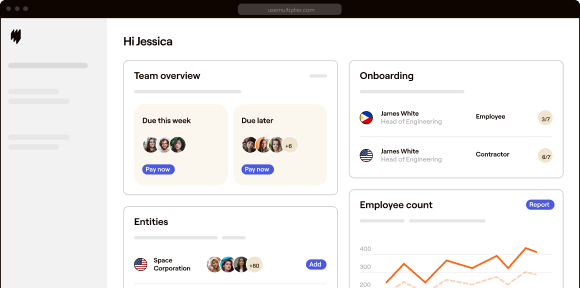
- Payroll, leave tracking, invoicing, and reporting in one dashboard
Scale your workforce in Venezuela compliantly
Venezuela offers cost-effective access to skilled contractors, but the line between employee and contractor is tightly regulated. Missteps can result in serious consequences. Always evaluate classification carefully and draft airtight contracts.
Multiplier simplifies classification, compliance, and payroll when hiring contractors or employees in Venezuela.
Book a demo today and learn how we can help you scale your global workforce without legal risk.
FAQs
Can I pay a contractor monthly in Venezuela?
Yes, but it’s better to structure it around milestones or deliverables to avoid reclassification.
Do Venezuelan contractors need to register for taxes?
Yes, they must register with SENIAT and may need to issue RIF invoices.
Can a contractor be reclassified as an employee?
Yes, especially if the relationship shows subordination and permanence.
Can I convert a contractor to an employee later?
Yes, through a new employment contract with updated obligations.
Does Multiplier support hiring in Venezuela?
Yes, Multiplier’s COR covers compliant hiring, contracts, and payroll in Venezuela.