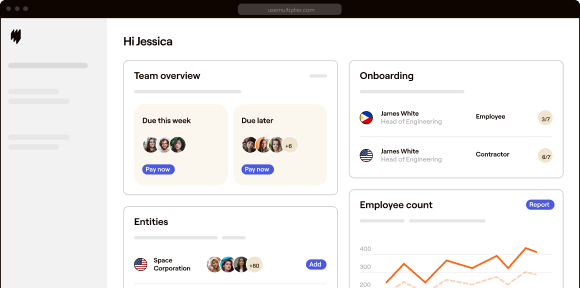
Rippling is an all-in-one workforce platform that unifies HR, payroll, IT, and finance into a single operating system. While Rippling’s EOR services operate in 32 countries directly, its broader contractor capabilities extend to 185+ countries, making global hiring accessible without establishing local legal entities.
This comprehensive review examines Rippling’s EOR capabilities, onboarding workflows, compliance infrastructure, payroll operations, integrations, and practical considerations for mid-market and enterprise organizations scaling internationally.
What is Rippling?
Rippling is a unified workforce platform founded on the principle of consolidating people, operations, and systems into one management hub. Unlike traditional HR-only solutions, Rippling integrates employee information systems with payroll processing, benefits administration, IT device management, and corporate expense tracking into a single data model. This integrated ecosystem allows information entered once to flow automatically across connected workflows, reducing manual data entry and compliance risk.
An Employer of Record (EOR) service is a third-party provider that becomes the legal employer of your international hires in specific countries, handling local compliance obligations, payroll, benefits, and statutory filings. With an EOR arrangement, your company maintains control over hiring decisions, compensation, and strategic direction while the EOR provider assumes employment liability and regulatory responsibility.
Rippling’s EOR operates through owned entities and local partnerships in 32 countries, eliminating the need to establish subsidiary companies while ensuring full compliance with local labor laws, tax requirements, and benefits obligations.
How does Rippling’s EOR work?
The steps below explain how Rippling operationalizes Employer of Record hiring, from pre-hire validation through payroll execution and ongoing employee changes, highlighting where compliance, automation, and approvals intersect.
Step 1: Country feasibility check (before you hire)
Before hiring internationally, companies should evaluate the appropriate employment structure, expected onboarding timeline, and potential compliance risks in the target country. This preparation helps ensure the role is set up correctly and avoids classification errors, regulatory issues, or intellectual property gaps later in the hiring process. Platforms like Rippling help guide these decisions early.
Key factors to review before international hiring
- Employment classification
Determine whether the role should be structured as a full-time employee, contractor, or hired through an Employer of Record (EOR) based on local labor regulations. - Realistic hiring timelines
Confirm expected onboarding timelines in the target country to align hiring plans with compliance requirements and administrative steps. - Role-specific compliance risks
Identify classification risks, local labor law obligations, or regulatory considerations that may affect how the role should be structured. - Intellectual property protections
Review whether the role involves IP-sensitive work that requires specific contractual protections or confidentiality clauses. - Benefits and employment obligations
Understand statutory benefits, employer contributions, and country-specific employment expectations before finalizing the offer.
Rippling’s platform typically provides recommended employment structures—such as EOR, contractor engagement, or direct employment through a local entity—along with estimated onboarding timelines, often within 24–48 hours, helping teams make informed global hiring decisions.
Step 2: Offer and localized contract
Once a hiring decision is finalized, the next step is preparing a compliant employment contract aligned with the labor laws of the employee’s country. Proper contract generation ensures that employment terms meet statutory requirements and internal company policies before the offer is issued. Platforms like Rippling automate this process to support consistent, compliant global hiring.
Key elements included in localized employment contracts
- Country-specific legal structure
Contracts are automatically tailored to the employee’s jurisdiction, incorporating mandatory clauses required under local labor law. - Probation and notice periods
Employment agreements include statutory probation timelines, termination notice provisions, and other legally required employment terms. - Intellectual property protections
Contracts contain appropriate IP assignment and confidentiality clauses for roles involving proprietary work or sensitive company information. - Internal approval workflows
Many organizations require contract approvals from Legal, HR, and Finance teams before issuing the final employment offer. - Compliance with local employment rules
Localized contracts address country-specific requirements such as severance calculations, benefits eligibility, non-compete restrictions, and termination procedures.
Rippling maintains an in-house contract template library that is regularly updated to reflect evolving labor regulations, helping companies remain compliant as employment laws change.
Step 3: Onboarding and document collection
Once the employment contract is signed, the onboarding process begins with collecting the necessary employee documentation and verifying identity details. Proper onboarding ensures the employee is compliant with local employment and tax regulations before payroll begins. Platforms like Rippling streamline this process through automated workflows and centralized data management.
Key onboarding requirements typically include
- Identity verification
Employees provide official identification such as a passport, national ID, or equivalent document to confirm their legal identity. - Tax documentation
Local tax forms or tax identification numbers are submitted to ensure accurate payroll reporting and statutory tax filings. - Banking details for payroll
Employees provide bank account information so salary payments can be processed correctly and on schedule. - Residential address confirmation
Proof of address may be required to meet local regulatory or tax reporting requirements. - Policy acknowledgments
Employees review and acknowledge company policies, employment terms, and compliance requirements during onboarding.
Rippling automates document collection and reminders, helping reduce administrative delays. Because the platform uses unified data entry, information captured during onboarding flows directly into payroll systems, tax filings, and IT provisioning, minimizing duplicate data entry and reducing errors.
Step 4: Payroll run, payments, and statutory filings
Once employees are onboarded, payroll runs follow a structured monthly cycle to ensure salaries, taxes, and statutory obligations are handled accurately. Each stage—from compensation approval to regulatory reporting—is coordinated through the platform, helping companies manage multi-country payroll efficiently while maintaining compliance with local labor and tax requirements.
Key steps in the monthly payroll process
- Timesheet and compensation approval
Your team reviews and approves employee timesheets, bonuses, and variable compensation before the payroll cutoff date. - Tax and statutory calculations
The platform calculates income taxes, social contributions, and other required statutory deductions in the employee’s local currency. - Payroll funding
The company funds the payroll run so salaries and employer obligations can be processed on schedule. - Employee salary payments
Payments are distributed to employees’ local bank accounts through the platform’s global payment infrastructure. - Statutory reporting and filings
Payroll reports, tax submissions, and labor filings are automatically sent to the appropriate local authorities. - Currency handling and payslips
Multi-currency payroll supports more than 50 currencies with automated exchange rate processing, and payslips are generated and delivered to employees automatically.
Rippling also operates in-house payroll engines in certain countries, allowing faster payroll cycles—often around five days—and supporting unlimited off-cycle payroll processing when corrections or urgent payments are required.
Step 5: Ongoing changes (salary updates, leave, terminations)
As employees progress through their roles, changes to compensation, benefits, or employment status must be reflected in payroll and compliance records. These updates often require payroll recalculations and, in some cases, contract amendments to ensure alignment with local labor laws. Platforms like Rippling help manage these changes through unified employee data and automated workflows.
Common lifecycle changes that trigger updates
- Compensation adjustments
Salary increases, bonuses, or other pay changes automatically update payroll calculations and reporting. - Leave and benefits updates
Changes in leave accrual, benefits eligibility, or employer contributions are reflected across payroll and benefits systems. - Promotions or role changes
Promotions may require contract amendments to update compensation, responsibilities, or employment terms. - Unified employee data synchronization
Because Rippling uses a unified data model, updates made in one place automatically sync across payroll, tax filings, and benefits administration. - Termination compliance requirements
Offboarding must account for local notice periods, severance calculations, and statutory obligations.
Rippling provides structured termination workflows that guide companies through notice delivery, final payroll settlements, benefits exit procedures, and documentation requirements, helping reduce compliance risks during employee offboarding.
What you actually get with Rippling EOR (feature deep dive)
This deep dive breaks down Rippling’s EOR offering beyond high-level promises, showing how coverage, compliance, ownership, payroll, integrations, and security work in real operating environments.
Country coverage and hiring speed
Rippling enables companies to hire employees through its Employer of Record services in multiple countries while also supporting contractor payments across a much broader global footprint. However, hiring timelines vary depending on local regulations, role complexity, and compliance requirements. In practice, onboarding speed depends heavily on the country and regulatory environment.
Key factors that influence international hiring timelines
- EOR country coverage
Rippling operates Employer of Record services directly in around 32 countries while supporting contractor payments across 185+ countries. - Global contractor and payment support
The platform supports contractor engagements in more than 50 currencies, enabling companies to pay distributed teams globally. - Faster onboarding in developed markets
In countries such as the UK, Canada, and much of Western Europe, employee onboarding is often completed within roughly 48 hours to one week once documentation is finalized. - Longer timelines in regulated jurisdictions
Countries requiring immigration approvals, work permits, or heightened compliance checks may require two to four weeks for full onboarding. - Realistic hiring expectations
Rather than promising universal “minutes-to-hire” timelines, Rippling’s onboarding speeds reflect the compliance requirements, regulatory complexity, and risk levels of each jurisdiction.
Compliance, ownership, and risk controls
Employer of Record (EOR) services allow companies to hire internationally without establishing a legal entity in each country. Under this model, Rippling becomes the legal employer in the country of hire while your company manages the employee’s daily work and strategic decisions. This structure helps ensure compliance with local labor regulations while reducing administrative and legal risk.
How the EOR structure operates
- Legal employer of record
Rippling acts as the official legal employer in the employee’s country and maintains the formal employment relationship under local law. - Employment contract management
Rippling signs the employment contract using your company’s agreed terms, ensuring it aligns with local statutory requirements. - Local employment liability
Responsibility for employment compliance and labor obligations within the jurisdiction is carried by Rippling. - Tax and statutory filings
Payroll taxes, social contributions, and other statutory filings are submitted to the relevant authorities by Rippling. - Benefits administration
Rippling manages required statutory benefits and employer contributions in accordance with local labor regulations.
This framework helps reduce exposure to worker misclassification risks, labor disputes, and potential tax penalties while enabling compliant international hiring.
Payroll and benefits administration
Employee benefits for international teams include both statutory benefits required by local law and optional supplemental benefits provided by the employer. Because benefits systems vary widely between countries, managing them accurately is essential for compliance and payroll accuracy. Platforms like Rippling coordinate benefits administration and integrate it directly into payroll processes.
How global benefits administration works
- Statutory benefits management
Rippling administers legally required benefits such as employer social contributions, unemployment insurance, pension programs, and mandatory health coverage. - Optional supplemental benefits
Companies can offer additional benefits such as expanded health coverage, retirement plans, or other employer-sponsored programs beyond statutory requirements. - Country-specific enrollment rules
Some countries automatically enroll employees into benefits programs, while others require employees to actively select benefits during onboarding. - Localized benefits alignment
Perfect benefits parity across countries is rarely possible, but Rippling helps identify equivalent local programs wherever feasible. - Payroll synchronization
Benefits data is integrated directly with payroll calculations to ensure accurate deductions, employer contributions, and statutory reporting.
Integrations and APIs
Rippling integrates with a wide range of HR, payroll, accounting, and IT systems, helping companies manage workforce data across their technology stack without duplicating processes. These integrations allow employee information, payroll data, and financial records to move automatically between systems, improving accuracy and reducing manual administrative work.
How integrations support workforce operations
- Extensive integration ecosystem
Rippling supports more than 600 integrations across HRIS platforms, accounting software, payroll tools, and IT systems. - Unified data synchronization
The platform’s unified data model ensures employee records, payroll information, and financial data remain consistent across connected systems. - Automated data flow
Information such as employee updates, payroll journals, and organizational changes can sync automatically between systems. - Reduced administrative overhead
Automated integrations minimize manual data entry and reduce the risk of data inconsistencies across HR and finance platforms. - Custom API capabilities
Rippling also provides APIs that allow technical teams to build custom integrations when pre-built connectors are not available.
Security and compliance claims (SOC 2, GDPR, etc.)
Managing employee data across multiple countries requires strong security and privacy controls. Platforms like Rippling report compliance with widely recognized security frameworks and include built-in protections to safeguard sensitive workforce information. However, organizations should always verify these claims through formal documentation during vendor evaluation.
Key security and compliance considerations
- Security certifications
Rippling reports SOC 2 Type II certification and alignment with ISO 27001 standards, reflecting established practices for protecting sensitive data. - Data privacy compliance
The platform supports GDPR compliance to ensure employee data from European jurisdictions is processed according to strict privacy regulations. - Access and data protection controls
Security features include role-based access permissions, data encryption, and detailed audit logs to track system activity. - Verification through documentation
Companies should request SOC reports, Data Processing Agreements (DPAs), and related documentation to confirm how security controls are implemented. - Subprocessor transparency
Reviewing the list of subprocessors helps organizations understand which third parties may process or store workforce data.
Rather than relying solely on certification claims, reputable providers share these artifacts upon request so organizations can independently evaluate their security posture.
Rippling pricing: What it publishes vs what buyers should confirm
Rather than fixed bundles, Rippling lets you assemble your own stack. You can start with HRIS, then add modules like Payroll, Scheduling, Benefits Administration, Global Payroll, or IT management as needed.
This approach prevents overpaying for unused features, but it also means pricing can vary widely. For a 100-employee company using HRIS, payroll, benefits, and time and attendance, typical costs range from $15–$25 per employee per month. More advanced setups, including global payroll, IT, and spend management, often reach $30–$50+ per employee per month. Certain premium features, such as badge access or biometric authentication, can increase costs up to $190 per employee per month.
Pricing questions to ask sales:
- What’s included in the base EOR fee per employee? (contracts, payroll processing, statutory filings, benefits administration, platform access, support)
- Are implementation or onboarding fees charged separately, or included?
- What foreign exchange markups apply, and how is funding handled?
- Are off-cycle payroll runs charged as add-ons or unlimited?
- Are termination support fees, immigration assistance, or legal consultations billed separately?
- How does pricing scale as you add IT management, corporate cards, or expense tracking?
Pros, cons, and who it’s best for
To assess Rippling fairly, you need to consider its advantages, trade-offs, and the kinds of teams it serves best in real-world use.
Rippling pros
- Unified platform consolidating HR, payroll, IT, and finance into one system reduces complexity and manual work
- Fast payroll processing with 5-day lead times in premium countries and unlimited free off-cycle runs
- Flexible employment model transitions between contractor, EOR, and direct employment without switching platforms
- Strong IT management integration allowing device provisioning, app access, and security controls alongside payroll
- 600+ integrations provide flexibility to connect Rippling with your existing tech stack without custom API work
- Comprehensive support for 50+ currencies and multi-country payroll scenarios with in-house compliance expertise
Rippling cons
- Modular pricing structure makes costs unpredictable as you scale or add features; no transparent all-in pricing
- High barrier to entry compared to single-purpose payroll tools; you pay for modules you may not use
- Steep learning curve due to the platform’s breadth—configuration and customization require dedicated resources
- Limited to 32 countries for direct EOR services; contractor-only support in additional markets creates operational complexity
- Support quality varies by region; some users report slow response times for non-critical issues
- Integration complexity with acquired payroll systems limits automation depth across some workflows
Best for
- Mid-market to enterprise organizations with 200+ employees across multiple countries needing unified operations
- Companies prioritizing IT management and security alongside payroll and hiring (startups, tech-heavy organizations)
- Organizations seeking to consolidate 5+ disparate tools (HR, payroll, IT, expenses) into a single system
- Teams with sufficient bandwidth to configure and customize the platform for their specific workflows
Not ideal for
- Early-stage startups with 5–10 international hires (cost overrun vs. simple contractor models)
- Organizations needing EOR-only services in 50+ countries (limited direct country coverage vs. specialists)
- Teams wanting transparent, simple pricing without module-based complexity
- Companies uncomfortable with platform breadth, preferring best-of-breed single-purpose tools
Rippling vs alternatives
The comparison below shows how Rippling compares with leading alternatives on pricing clarity, country coverage, and compliance depth to help guide informed decisions.
Dimension | Rippling | Multiplier | Deel | Papaya Global | Remote |
EOR countries | 32 countries direct; 185+ contractors | 150+ countries | 180+ countries | 160+ countries | 180+ countries |
Pricing (per employee per month) | Modular add-ons | $400 | $599 | Tiered module pricing | $699 |
G2 ratings | 4.8/5 | 4.7/5 | 4.7/5 | 4.5/5 | 4.5/5 |
Platform scope | HR + Payroll + IT + Finance unified | HR + Payroll + Compliance | HR + Payroll + Finance | Payroll-first + EOR | Payroll + Contractor management |
Payroll automation | In-house engines; 5-day timelines | Compliance-first workflows | Integrated; variable by region | High-volume optimized | Developer-friendly |
Integration breadth | 600+ apps; deep enterprise connectors | 150+ apps; compliance-focused | 50+ apps; self-serve HRIS | 100+ apps; payroll-centric | API-first; custom builds |
Onboarding speed | Minutes to days depending on country | Guided playbooks; faster average | Variable; often slower for complex hires | Slower; compliance-heavy | Quick for contractors |
Support model | Account managers; ticketed support | Dedicated support; operational clarity | Ticketed; Deel AI assistant | Account-based; payroll focus | Developer support; API-first |
Best for | All-in-one ops consolidation | Compliance certainty + scale | Global contractor + employee mix | High-volume payroll ops | Dev-friendly global hiring |
Buyer’s decision framework
Use this framework to align your operational goals, governance requirements, and growth plans with the EOR or payroll model that best fits your needs:
- If you need all-in-one HR, payroll, IT, and finance in a single platform, consider Rippling or Workday for enterprise use.
- If you need cost predictability and operational clarity, Multiplier offers transparent EOR pricing, while Papaya is better suited for payroll-first needs.
- If you’re hiring 100+ contractors globally, Deel supports contractor-first workflows, and Remote suits API-driven systems.
- If you need direct EOR coverage in 50+ countries, Pebl, Deel, or Papaya are strong options, while Rippling’s EOR coverage is limited to 32 countries.
- If you’re a developer-first organization, Remote provides deep API capabilities, and Rippling offers flexible integrations.
RFP-ready checklist for evaluating any EOR:
- Entity model: Is the provider the legal employer in your target countries?
- Local termination process: Can you terminate without cause? What severance applies by jurisdiction?
- Statutory filing ownership: Who submits taxes, benefits, labor filings, and to which authorities?
- Payroll cutoffs: What’s the latest you can approve timesheets before payment? Are off-cycle runs free?
- Audit trails: Can you export historical payroll data, compliance records, and tax filings for audits?
- Data privacy and security: Are SOC 2, GDPR, and DPA documentation available and current?
- Support SLAs: What’s the guaranteed response time for critical payroll issues affecting employees?
- Contract flexibility: Can you scale employees up or down, change benefits, or modify coverage by country?
- Immigration and work permit support: Is visa assistance, work permit guidance, and employment authorization included?
- Technology roadmap: What AI, automation, or platform improvements are planned for the next 12 months?
- Integration requirements: How many custom integrations will you need? What’s the cost and timeline?
- Termination support: Does the provider assist with severance calculations, final payments, and offboarding?
Choosing a compliance-first EOR? How Multiplier supports global hiring at scale
Companies evaluating alternatives to Rippling often look for stronger operational control, clearer pricing, and a platform purpose-built for global employment. Multiplier is designed specifically for hiring, managing, and paying international teams, supported by a global infrastructure that spans more than 150 countries and dedicated in-house teams across legal, payroll, HR, and benefits.
Built as a unified global employment platform
While some platforms have expanded by adding multiple acquired tools, Multiplier was designed from the beginning as a single global employment system. Contracts, payroll processing, compliance management, and employee lifecycle events are governed by one unified data model. This structure reduces operational complexity, improves visibility across countries, and helps ensure consistent execution as teams grow internationally.
Direct global employment infrastructure
Multiplier operates through a network of 150+ global entities supported by in-house specialists. This approach reduces reliance on external intermediaries and enables clearer operational accountability for payroll execution, employment compliance, and benefits administration across jurisdictions.
Transparent pricing for predictable global hiring costs
Cost predictability is critical when building distributed teams. Multiplier provides clear, transparent pricing that separates statutory employment costs from platform fees. This structure helps finance teams forecast hiring budgets more accurately and avoid unexpected charges as teams expand across multiple countries.
Dedicated support designed for global operations
Managing international payroll and compliance requires responsive support. Multiplier provides a dedicated Client Success Manager and regional payroll specialists who work directly with your team. This ensures operational questions, payroll issues, or regulatory changes can be addressed quickly, reducing risk and minimizing disruption to global workforce operations.
Companies comparing Rippling and Multiplier often find that Multiplier offers stronger pricing clarity, streamlined workflows, and a global employment platform designed specifically for cross-border hiring.
Book a demo to see how Multiplier can simplify compliant global hiring and payroll as your team scales.
FAQs
How is direct accountability ensured for my global team?
Multiplier operates 100+ wholly-owned legal entities with in-house legal, payroll, and HR teams, ensuring direct accountability for employment outcomes. This avoids the third-party handoffs and "coordination tax" often found in partner-led models.
Can EOR services be used without replacing an existing HRIS?
Yes. Multiplier is built to plug into your existing stack, like Workday or HiBob, rather than forcing you to rebuy your entire HR foundation. This avoids the "Rippling HRIS prerequisite" that can create friction for established teams.
How are "bundle taxes" and hidden fees eliminated?
Multiplier discloses all management, benefit, and IT costs upfront without forcing you into prerequisite modules like a $15 PEPM benefits admin fee. This typically results in a 30–35% better total cost of ownership compared to expanding stacks.
What flexibility exists for mid-month payroll changes?
Because the executor is internal, Multiplier can handle mid-month exceptions, promotions, and corrections without automatically pushing them to the next cycle. This contrasts with models where deadlines are anchored to partner readiness.
Does every customer receive a dedicated point of contact?
Yes. Multiplier provides a named Success and Implementation Manager from day one, regardless of headcount. Support is treated as an operational risk-control layer with 2–3 minute human chat responses.
How are compliance issues prevented before documents are signed?
Multiplier controls the legal workflow end-to-end, meaning reviews happen internally before any document goes out. This "compliance by design" approach reduces late-stage surprises and the need to revisit agreements after signature.
What happens if global headcount fluctuates?
Multiplier structures pricing to align with workforce reality, ensuring customers don't pay for "empty seats". This avoids order-form minimums and utilization true-ups that can penalize team shrinkage.
How is legal risk assumed for international contractors?
Multiplier offers Contractor-of-Record (COR) and Agent-of-Record (AOR) services specifically to take compliance ownership and assume employer risk. This changes compliance from mere advice into active execution.
Are there hidden fees for terminating an employee?
Multiplier treats offboarding as part of the standard employment lifecycle rather than an additional priced "event tax". This reduces cost spikes during workforce transitions and simplifies finance planning.
How is global payroll architecture different from US-first systems?
Multiplier is architected with global employment as the core operating engine, using a single data model for contracts, payroll, and compliance. We prioritize execution depth over the horizontal "all-in-one" sprawl that can dilute focus.