Brunei work permits and visas: enabling strategic growth
Securing a work permit is a critical step for businesses looking to expand and hire talent in Brunei’s thriving economy. With its stringent regulations and detailed processes, navigating the system can be challenging without expert guidance. Whether you’re hiring for short-term projects or long-term roles, understanding Brunei’s work permit requirements ensures compliance and a smooth onboarding experience.
This guide covers everything you need to know, from documentation to best practices, making hiring in Brunei efficient and hassle-free.
Next, we’ll explore the key challenges businesses face when navigating Brunei’s work permit system and strategies to overcome them effectively.
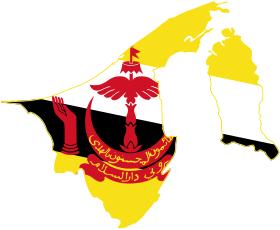
Number of Expats:
50,000-100,000
Expats Job Websites:
Popular Industries for Expats:
Petroleum and Gas Sector, Banking, Hospitality, Construction, Education
Common challenges in securing a Brunei work permit
The Brunei work permit process is essential for hiring foreign talent, but often complex and time-consuming. Employers must manage strict regulations, extensive documentation, and administrative challenges, requiring careful planning, compliance expertise, and significant resources.
Here’s a breakdown of the key challenges businesses encounter during the process:
- Brunei’s immigration rules are regularly updated, making it difficult for companies unfamiliar with local practices to stay compliant.
- Sectors like oil and gas, healthcare, and construction often face hiring challenges due to stringent work permit requirements and a limited pool of local talent.
- Brunei’s specific regulatory expectations can vary, requiring employers to carefully align their hiring strategies with local compliance standards.
- Lengthy processing periods for permits can disrupt recruitment plans, delaying projects and operational goals.
- The financial burden of sponsoring visas, along with compliance expenses, can strain the budgets of small and medium-sized businesses.
- Employers may need to prove that a position cannot be filled by a local candidate, adding additional layers of complexity to the application process.
- Verifying educational credentials and professional expertise for foreign hires can slow down the approval process, particularly for specialized roles.
- Supporting new hires with accommodation, cultural integration, and local registrations can be challenging for employers unfamiliar with the process.
- While Brunei offers targeted visa options for certain professionals, such as in-demand technical roles, navigating these opportunities requires detailed knowledge of their criteria and application procedures.
An Employer of Record (EOR) offers a practical and strategic solution to overcome these hurdles. EOR services simplify the Brunei work permit process by managing compliance, reducing administrative workload, and ensuring adherence to local laws and immigration requirements.
Types of Brunei work permits and visas
Brunei offers multiple work permits and visa options to regulate foreign employment. Each of these is designed for specific roles, durations, and professional requirements.
- Foreign Workers License (LPA): Necessary for all foreign workers in Brunei before they can legally work and is usually issued for the duration of employment, up to one to two years, and is renewable. It serves as the foundation for work and residency compliance and is sponsored by the employer.
- Employment pass: Issued to skilled professionals, managerial staff, and specialists working for registered companies in Brunei. This is often required for expatriates in higher-level positions and is typically valid for one to two years, and can be renewed.
- Green identity card: This allows permanent or long-term residency and work authorization. It is issued to expatriates who have been in Brunei long-term and meet certain eligibility criteria.
- Business Visitor Visa (BVV): This is applicable for foreign nationals visiting Brunei for business meetings, conferences, negotiations, or short-term assignments without formal employment in Brunei. The validity is short-term, generally 14 to 30 days, depending on the applicant’s nationality.
- Professional visit visa: For foreign professionals or experts providing specialized services to Bruneian companies temporarily. This requires a local sponsor or company invitation and is usually valid up to 3 months, but is extendable if necessary.
- Special Authorization Work Pass (SAWP): This is specifically for workers from countries under bilateral agreements with Brunei. Common in sectors like construction, agriculture, and domestic work, and valid depending on the sponsoring employer and work assignment, often renewable.
Sector-specific work permit rules in Brunei
Brunei’s immigration and labor system has different work permit regulations for various industries. Some sectors are subject to stricter requirements due to their economic significance or workforce demands, and employers must be aware of these nuances when applying for permits:
Construction: Typical permit requirements involve LPA along with SAWP for lower-skilled roles. Since the sector relies heavily on foreign labor, especially for large-scale infrastructure projects, employers must comply with labor quotas and provide worker housing and welfare facilities as per labor laws.
Oil and gas industry: Employment pass and professional visit visa for short-term experts are a must. The sector often enforces stricter vetting of foreign workers, requiring employers to prove that no suitably qualified local talent is available before hiring expatriates. In addition, safety training is mandatory, and stringent scrutiny often leads to slower approvals.
Domestic work: In high demand, especially for household staff, domestic helpers are often recruited through SAWP. The rules are stricter in this sector to ensure worker protection. Employers must meet sponsorship obligations, covering accommodation, food, healthcare, and repatriation costs.
Healthcare and education: Foreign professionals in this sector often enjoy streamlined approval due to local skill shortages. However, they must secure recognition of qualifications and licenses from Brunei’s medical or education authorities.
Note: A Green identity card is compulsory for long-term professionals along with an employment pass.
Agriculture and fisheries: Seasonal and lower-skilled workers are often employed under LPA and SAWP, with strict compliance required for labor standards and sponsorship obligations, including proper living arrangements.
In the following section, we’ll explore how an EOR can accelerate your hiring process and enable smooth business expansion in Brunei.
A step-by-step guide to securing work permits in Brunei
Managing Brunei’s work permit and immigration processes can feel overwhelming, with intricate regulations and strict compliance requirements. However, with the right partner — an Employer of Record (EOR) — these complexities can be addressed with ease and efficiency.
Here’s a step-by-step guide to simplify the Brunei work permit process:
Step 1: Partner with an EOR
An EOR serves as your strategic ally, leveraging deep expertise in Brunei’s labor laws, including requirements for industries like oil, gas, and financial services, visa sponsorship criteria, and strict compliance standards. This ensures the work permit application process is both efficient and aligned with Brunei’s regulations.
Step 2: Verify candidate eligibility
The EOR evaluates whether the candidate meets Brunei’s work permit requirements, such as skill level, educational qualifications, and role relevance, ensuring compliance with the country’s focus on hiring foreign talent for specialized or high-demand roles.
Step 3: Handle visa sponsorship
As the legal employer, the EOR manages visa sponsorship, including labor market tests required to demonstrate the unavailability of local talent, and ensures the application adheres to Brunei’s strict immigration policies. This is particularly critical given Brunei’s emphasis on protecting its local workforce.
Step 4: Manage documentation and applications
The EOR prepares and submits all required documents for hiring in Brunei. This includes:
- Employment contracts compliant with local labor laws
- Employer sponsorship forms for foreign hires
- Work permit applications — submitted to the relevant authorities
- Notarized copies of academic/professional certificates — translated into Malay, where applicable.
- Valid passport and identification documents
This ensures full compliance with Brunei’s documentation and translation standards.
Step 5: Monitor compliance
The EOR ensures full adherence to Brunei’s evolving labor and immigration laws, such as maintaining quotas for foreign workers and renewing permits on time, protecting your business from penalties and operational disruptions.
Step 6: Facilitate onboarding
After work permit approval, the EOR oversees key onboarding tasks like payroll setup in compliance with Brunei’s tax regulations, local benefits administration, and even cultural integration support, ensuring employees are ready to contribute immediately.
By partnering with an experienced EOR, businesses can navigate Brunei’s work permit system effectively, focus on hiring top talent, and avoid the administrative and compliance challenges that often accompany global expansion. You can kickstart the visa application process in minutes with an EOR.
In the next section, we’ll explore the top benefits of working with an EOR to manage work permits in Brunei.
Benefits of partnering with a Brunei EOR for work permits and visas
Navigating the Brunei work permit process can be challenging due to its intricate regulations and detailed administrative requirements. Here’s how an EOR streamlines the process and facilitates compliant, efficient hiring:
Expert compliance, zero hassle
An EOR provides specialized knowledge of Brunei’s labor laws, visa policies, payroll systems, and tax regulations. This ensures businesses fulfill all legal requirements while minimizing the risk of penalties, legal disputes, or compliance missteps.
Quick access to Brunei’s talent pool
An EOR manages employment contracts, payroll, and compliance, enabling companies to hire top talent in Brunei without needing to establish a local entity. Employees can be onboarded seamlessly and in full compliance.
Flexible hiring options for dynamic teams
With an EOR, businesses can hire both full-time employees and contractors, offering the flexibility to scale operations or assemble project-specific teams while maintaining compliance and cost-effectiveness.
Smooth onboarding, happy new hires
An EOR ensures smooth onboarding, offering localized benefits packages that enhance employee satisfaction. This boosts engagement, productivity, and retention, fostering a positive work environment.
Cost and time efficiency
By eliminating the need for businesses to set up a local entity, an EOR significantly reduces administrative overhead and associated costs. This allows global hiring to be scalable, affordable, and efficient.
Partnering with an EOR simplifies the Brunei work permit process, allowing businesses to focus on growth while leaving compliance and administrative tasks in expert hands. With EOR support, companies can confidently navigate Brunei’s hiring landscape.
In the next section, we’ll explore how the EOR-assisted approach compares to traditional hiring methods in Brunei and highlight why it’s the preferred choice for global businesses.
Comparing the traditional work visa process to the EOR-assisted approach
Traditional hiring methods in Brunei often demand significant time, effort, and resources to ensure compliance with local regulations. However, partnering with an Employer of Record (EOR) offers a faster, more efficient, and cost-effective alternative.
Here’s how the two approaches compare:
Aspect | Traditional process | EOR-assisted process |
Legal entity setup | Required | Not required |
Time to hire | Typically takes weeks to months due to setup and compliance processes. | A few days to onboard employees, as the EOR handles setup. |
Compliance management | Employers are solely responsible for compliance with local labor laws, taxes, and payroll regulations. | Fully managed by the EOR, ensuring compliance with all legal requirements. |
Administrative burden | High, with multiple processes like documentation, payroll, and tax filings managed internally. | Minimal, as the EOR streamlines all administrative tasks. |
Cost efficiency | Higher costs due to legal entity setup, ongoing administrative expenses, and compliance management. | Lower, with consolidated services and no need for local |
Processing time | Delays are common as entity approval and work permits often extend hiring timelines. | Faster, as EOR already has local presence and processes in place. |
Costs and compliance risks | Upfront incorporation costs, ongoing compliance fees, and a high risk of fines or legal disputes if requirements are not fully met. | Transparent pricing with limited compliance liability, as risk is transferred to the EOR. |
An EOR simplifies the hiring process by managing compliance, handling administrative tasks, and expediting onboarding. Businesses hiring in Brunei can bypass the challenges of traditional methods, focusing instead on building high-performing teams and scaling operations confidently.
In the next section, we’ll explore actionable strategies to leverage EOR solutions to transform the hiring process in Brunei.
Partnering with Multiplier for Brunei work permits
With an Employer of Record (EOR) like Multiplier, navigating Brunei’s regulatory environment becomes a piece of cake. Multiplier manages the operational complexities, allowing you to concentrate on your primary strategic goals, from streamlining work permits to guaranteeing adherence to Brunei’s labor laws.
Multiplier’s end-to-end solutions are customized to meet your unique business hiring requirements, so you can expand your team with confidence and maintain complete compliance.
Book a demo and see how Multiplier can simplify hiring in Brunei with trusted EOR expertise.