A candidate accepts an offer. Six months later, a colleague in the same role asks why their salary is lower. You know the number made sense at the time, but you just can’t explain why… Under new EU legislation, that’s a problem.
Until recently, many companies could get away with basing decisions on what the candidate expected, what the last hire cost, or what felt competitive at the time. That approach has now become a liability, and companies need to adapt fast.
Compensation management is the documented framework behind how pay is set, structured, and justified across your workforce. It covers everything from job levels and salary bands to progression criteria and differences in pay between two people.
This guide covers how to build that framework, and why most companies are less prepared than they think. We spoke to a range of experts to find out everything you need to know, including:
- Amanda Frayne, Chief Legal and Compliance Officer at Multiplier
- Paola Accettola, CEO and Principal Consultant at True North HR Consulting
- Amy Dwyer, Chief Human Resources Officer at Salary.com
- Natalie Lloyd, Global Customer Success Manager at JGA Recruitment Group
Pay transparency is no longer optional
All around the world, the pressure to document and justify pay decisions is steadily building:
- US states including California, New York, and Colorado now require employers to publish salary ranges in job postings
- The UK has required large employers to report gender pay gaps since 2017
- Australia introduced wage secrecy laws in 2022, meaning employers cannot enforce pay secrecy clauses or prevent employees from discussing salaries
And now, the EU Pay Transparency Directive is the most operationally demanding version of this shift yet.
The directive requires companies to prove the logic behind every pay decision and produce that proof on demand. “The historic approach of deciding on a case-by-case basis, depending on the candidate — that stops working,” says Amanda Frayne, Chief Legal and Compliance Officer at Multiplier. “It becomes non-compliant.”
Under Article 7, any worker can request their pay level and the average pay of comparable workers by gender. Employers have two months to respond, and must proactively remind workers of this right every year. If a gender pay gap above 5% exists and the employer can’t objectively justify it, they have to fix it within six months, or employers will need to conduct a joint pay assessment with workers’ representatives.
It’s important to understand that Article 7 applies regardless of company size, from the day a member state transposes the directive.
And that directive sets a baseline, not a ceiling. Member states can go further. Slovakia passed new equal pay legislation in April 2025, becoming one of the first to fully align. Companies operating across multiple EU countries need to track each state’s implementation separately.
Most companies are not prepared for the EU Pay Transparency Directive
Many HR and finance leaders feel uncomfortable with the idea of transparency because their organizations are sitting on years and years of ad hoc pay decisions, with nothing tangible to back them up. “When your pay structure is defensible, transparency is uncomfortable but scalable,” explains Amy Dwyer, Chief Human Resources Officer at Salary.com. “Most structures aren’t defensible because pay equity is genuinely hard to maintain over years of ad hoc decisions.”
This isn’t a niche problem. According to Multiplier’s Global Teams Report 2026, only 8% of companies are fully compliant with international labor laws, leaving 92% exposed to serious risks and penalties.
Generally, companies that are behind on pay transparency aren’t ignoring it. They’ve handed it to legal, or asked HR to prepare a policy document, and assumed that covers it, but it doesn’t.
Companies need watertight documentation to support every hiring and compensation decision. According to Paola Accettola, CEO and Principal Consultant at True North HR Consulting, lack of documentation is the most common issue. “Employers may have legitimate reasons for differences in pay — experience, performance, or specialized skills — but if those reasons were never documented or applied consistently, it becomes difficult to defend them when questioned.”
An effective way to figure out if your company is compliant is a simple “show me” test. If an employee submitted an Article 7 request tomorrow, could you produce a pay comparison, with documented criteria, within two months? For most companies, the honest answer is no.
The root cause of this lack of transparency usually comes down to structural gaps in accountability and infrastructure.
Compensation management is fractured across the business
Oftentimes, no single function owns the full picture, and worse, the data and systems underneath don’t make it possible. HR owns job architecture, finance owns pay decisions and budget, and legal owns compliance.
The problem is that the directive holds the employer entity responsible, not a single department. “The directive doesn’t say it sits with the HR department, or with finance, or with legal,” points out Frayne. “It depends on the company itself. There has to be the organizational structure within the entity in that member state to be able to respond accordingly.”
Unlike a GDPR data subject access request, which asks employers to produce personal data about an individual, an Article 7 request goes to the heart of how the entire organization sets and justifies pay. This is a much broader and more complex obligation that requires a holistic approach and the right systems.
How to create a compensation management strategy that is actually compliant
Building this framework requires doing the foundational work in the right order and making sure the logic behind every pay decision is documented before someone asks for it.
Here’s how to build a compensation management strategy that holds up under EU Pay Transparency.
1. Define a pay philosophy
Before anything else, leadership needs to define how the company positions itself in the talent market. Are you targeting the 50th percentile or the 90th? What role do benefits, equity, and local market conditions play?
This decision shapes everything downstream and needs to be documented, not assumed.
2. Understand local markets
A compensation framework that works in Germany may not hold up in Brazil. What counts as competitive pay, which benefits matter most, and what local law requires all vary significantly by market.
Natalie Lloyd, Global Customer Success Manager at JGA Recruitment Group, recommends “establishing a unified set of compensation principles that apply globally to ensure consistency and fairness across all markets, but tailoring strategies to fit local laws and cultural expectations.”
3. Build job architecture
Job architecture is the underlying structure that defines how roles are organized across your business. It covers job families (groupings of related roles, such as engineering or finance), job levels (the hierarchy within each family, from entry level to senior leadership), and the progression logic that explains how someone moves between them.
This essential foundation forms the basis for everything else. “Job architecture isn’t really a compensation workstream — it’s a workforce philosophy workstream that compensation depends on,” says Dwyer. “You can’t build clean bands until you have clean leveling, and you can’t have clean leveling until you have honest conversations about what jobs are actually worth relative to each other. The retroactive process forces all of that into the open at once.”
Without this structure, salary bands mean nothing. You can’t define comparable work, justify differences in pay, or respond to an Article 7 request if you don’t have a consistent way of classifying roles across your entities.
4. Set salary bands with documented placement criteria
A salary band without documented placement criteria is just a number. Define the logic for where within a band someone sits: relevant experience (not just tenure), performance via a calibrated framework, and geographic differentials tied to a defined policy.
That doesn’t mean that everyone with the same role or band needs to earn exactly the same. “Pay gaps can exist — that’s fine,” clarifies Frayne. “It’s whether you can objectively justify them using gender-neutral criteria, and not just justify them, but evidence that justification.”
A gap is defensible if you defined the criteria before making the pay decision, applied those criteria consistently across comparable roles, and can reproduce that decision with documentation. If any of those conditions fails, the gap is not defensible.
5. Address pay compression
When new hires earn close to or more than experienced employees, the gap becomes both a morale problem and a compliance exposure. Regular band reviews and defined progression criteria help prevent compression from building silently over time.
6. Align payroll data across entities
Without centralized payroll data and consistent reporting across entities, even the best-designed compensation framework falls apart under scrutiny. Clean, consistent data across every jurisdiction you operate in is what makes responding to an Article 7 request actually possible.
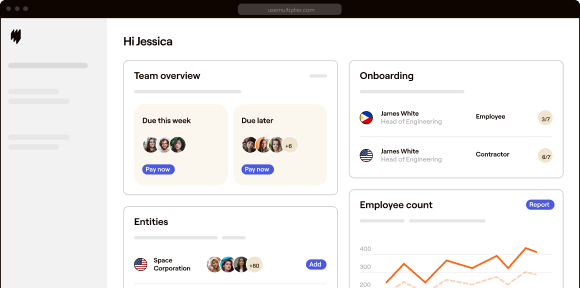
Multiplier’s centralized payroll and reporting across jurisdictions gives finance, HR, and legal a single view of compensation data, providing the business with a solid foundation for any Article 7 response.
7. Build cross-functional ownership
HR, finance, and legal need shared visibility and agreed accountability around compensation management because the directive holds the employer entity responsible.
Traditionally, companies have often made pay decisions in silos, which leads to a lack of transparency. “Many organizations leave compensation largely with managers or finance teams, which can create inconsistencies and make it harder to explain pay decisions later,” warns Accettola.
Going forward, companies need to have a clear policy that compensation management is a shared responsibility between HR, leadership, and finance.
Checklist: is your compensation management defensible?
- Do you have a documented pay philosophy signed off by leadership?
- Do you have consistent job levels and families across all entities?
- Do you have documented pay criteria defined before hiring decisions were made?
- Can you identify all comparable roles consistently across your entities?
- Can you produce a pay comparison for any employee within two months?
- Are your job classifications consistent across every jurisdiction you operate in?
- Can you evidence a pay gap above 5% with objective, gender-neutral criteria?
- Do you have a process for responding to Article 7 requests?
- Do finance, HR, and legal share visibility over compensation decisions?
Build the right foundations for compensation management
The companies that respond well to Article 7 aren’t building something new when a request comes in. They already have consistent, auditable pay data across every entity they operate in. The infrastructure underneath their pay decisions was there before the directive made it necessary.
That’s what Multiplier is built to provide. As the Global Exchange for Work, Multiplier is the infrastructure layer that makes defensible compensation management possible at scale: owned entities across 160+ markets, in-house legal and tax experts available around the clock, continuously updated local compliance frameworks, and centralized payroll and reporting across jurisdictions. Not a tool you add onto an existing setup, but the foundation you build from.
The gap the directive is exposing isn’t a policy gap. It’s an infrastructure gap. If you’re ready to close it, book a demo and talk to one of our experts.
FAQs
What is compensation management for global teams?
Compensation management is the documented framework behind how pay is set, structured, and justified across your workforce. For global teams, that means consistent job architecture, salary bands, and placement criteria that work across every jurisdiction you operate in, not just your primary market.
What does a global compensation management system need to handle?
At a minimum, a global compensation management system needs to support consistent job classification across entities, documented pay criteria that can be applied and evidenced across comparable roles, salary bands that account for local market conditions and geographic differentials, and centralized payroll data that gives finance, HR, and legal shared visibility over compensation decisions.
How does the EU Pay Transparency Directive affect compensation management?
The directive requires employers to justify pay decisions using objective, predefined, gender-neutral criteria — and to produce that justification on demand. Under Article 7, any worker can request their pay level and the average pay of comparable workers by gender. Employers have two months to respond. If a gender pay gap above 5% exists and cannot be objectively justified, employers must fix it, within approximately six months.
What is pay compression and how do you fix it?
Pay compression happens when new hires earn close to or more than experienced employees in the same role. It creates morale problems and, under EU Pay Transparency, a potential compliance exposure. The fix is consistent salary bands with documented progression criteria, reviewed regularly so compression doesn't build silently over time.
How do you manage compensation across multiple countries without setting up legal entities?
An employer of record (EOR) — a third-party organization that employs workers on your behalf in countries where you don't have a local entity — lets you hire compliantly across markets without the cost or complexity of setting up legal entities in each one. The key is choosing an EOR with owned entities and in-house legal expertise across the markets you operate in, rather than one that relies on third-party partners.
What's the difference between compensation management and payroll?
Payroll is the process of paying employees accurately and on time in line with local requirements. Compensation management is the framework that determines what people are paid and why — job architecture, salary bands, placement criteria, and progression logic. The two are connected: your compensation framework is only as defensible as the payroll data that supports it. Fragmented payroll systems make it harder to evidence pay decisions consistently across entities.