Venezuela’s labor force exceeds 11.14 million, and its economic volatility drives increased contractor engagement as companies seek flexible talent solutions. Hyperinflation, currency controls, and strict labor laws make proper classification, tax compliance, and documentation essential.
This guide explains key rules and strategies to manage global contractors while minimizing risk.
What is contractor management in Venezuela?
Contractor management is an end-to-end process that encompasses hiring contractors, onboarding, engaging, paying, and maintaining compliance throughout your relationship with independent service providers.
It includes establishing clear contractual terms, verifying SENIAT registration, managing cross-border payments, handling digital invoicing requirements, and ensuring ongoing adherence to Venezuela’s employment and tax laws. An effective contractor management system protects your business while ensuring contractors receive timely and accurate compensation.
Unlike employees, independent contractors in Venezuela operate under commercial agreements governed by Civil and Commercial Codes rather than the main labor law (LOTTT).
Key compliance requirements for managing contractors in Venezuela
Contractor compliance in Venezuela involves contractual, tax, and regulatory considerations that protect both the contractor and the party engaging them. Below are the core requirements you must address:
Independent contractors vs employees in Venezuela
- Classification is determined by the substance of the relationship, not labels, with courts focusing on control, subordination, and economic dependence
- Venezuela has no single statutory test; classification is assessed case by case based on how, when, and where work is performed
- Employees are subject to employer payroll taxes and mandatory social security contributions; contractors handle their own tax and social obligations
- Employees are entitled to statutory labor benefits; contractors are not entitled to employment protections
- Indicators of contractor status include work autonomy, lack of hierarchical control, financial independence, and use of personal tools and equipment
- Misclassification can lead to fines, back payment of benefits and contributions, and increased legal and compliance risk
Should you hire a contractor or an employee in Venezuela?
This contractors vs employees in Venezuela guide explains legal obligations, costs, benefits, and compliance risks to help you choose the right classification.
Service agreement in Venezuela
- A service agreement establishes clear terms and protects both parties by defining expectations and reducing disputes.
- Key clauses should include project scope with autonomy provisions, payment terms, tax responsibilities, intellectual property ownership, confidentiality requirements, and termination conditions to ensure alignment with Venezuela’s civil law framework.
Scope of work
- Define deliverables, timelines, and performance milestones to avoid ambiguity about what the contractor must accomplish.
- Clearly documenting outcomes rather than hours worked or daily activities reduces misclassification risk and demonstrates that you are engaging a service provider, not an employee.
Essential contract elements
Include clear statements that the contractor is not an employee, is responsible for their own taxes and contributions, and has control over work performance, subject to project deadlines. Emphasize contractor autonomy and include disclaimers that the contractor is not entitled to labor benefits. Use local legal templates that align with Venezuelan civil law.
Contractor invoices in Venezuela
- All independent contractors in Venezuela must register with the national tax authority (SENIAT) and issue valid digital invoices (Factura Digital) for every payment.
- Digital invoicing compliance became mandatory on March 19, 2025. This ruling outlines conditions for issuing invoices and fiscal documents through digital means.
- All taxpayers must use SENIAT-authorized and certified invoicing software that ensures security, integrity, and traceability of fiscal data through automatic transmission, detailed event logging, and real-time audit access.
Tax and finance rules in Venezuela
- Payments to independent contractors in Venezuela are generally made gross, with no employer income tax withholding; contractors must register with SENIAT and are responsible for filing their own income tax returns and paying applicable taxes.
- Depending on the nature of the services, payments may be subject to withholding tax at source, with typical rates of 10% for professional and technical services and 5% for general services and consulting; contractors providing VAT-able services must register for VAT, issue VAT-compliant invoices, and apply the standard VAT rate of 16%.
For global HR managers, the checklist below turns Venezuela’s contractor compliance rules into a practical, documentation-first framework to reduce audit and misclassification risk.
Contractor compliance in Venezuela: HR managers’ checklist
Use this checklist to ensure proper documentation for tax, contractual, and regulatory compliance when working with Venezuela contractors:
☐ SENIAT Registration Certificate
Verify the contractor is registered with SENIAT to reduce legal and reputational risk, especially during tax authority audits.
☐ Venezuelan ID Documentation
Personal details verification as required in mandatory written agreements.
☐ Digital Invoices (Factura Digital)
Collect and store valid digital invoices to demonstrate legal transactions and maintain audit-ready documentation.
☐ Written service agreement/contractor contract
Service agreement outlining the independent nature of engagement with contractor autonomy disclaimers and tax responsibility clauses.
☐ Payment Documentation
Maintain organized records of all contracts, invoices, payment proofs, and related documentation for at least five years.
☐ Bank Account Details
Ensure the payment system can handle agreed-upon currency using formal, traceable methods like bank transfers, Zelle, or PayPal.
Note: You can download this contractor compliance checklist as an Excel sheet to track documentation, assign ownership, and maintain audit-ready records across teams.
Manage global contractors effortlessly
Watch how Multiplier helps you manage global contractors while simplifying compliance, payments, and oversight across countries, including Venezuela, in this short walkthrough.
8 Best practices for contractor management in Venezuela
Providing practical, actionable guidance helps you streamline operations and reduce compliance risk. Here are eight proven strategies:
1. Create systems to simplify contractor operations
Managing tax and labor compliance manually from foreign headquarters can be difficult, risky, and time-consuming in Venezuela’s complex regulatory environment. Centralizing contracts, SENIAT registration details, digital invoices, payment approvals, and compliance documentation in one system helps maintain accurate records, supports proper tax documentation, and ensures you can quickly respond to compliance checks or disputes without manual reconciliation.
2. Standardize workflows to accelerate contractor onboarding
Onboarding after careful assessment of the role’s nature ensures correct classification from the outset, minimizing misclassification penalties and legal disputes. Using consistent workflows for identity verification, service agreements, SENIAT registration checks, and payment setup reduces onboarding time while preventing compliance gaps that could later trigger Ministry of Labor scrutiny.
3. Draft clear service agreements to prevent misclassification risks
Venezuelan courts can reclassify contractors as employees if work implies subordination, even with signed contractor agreements. Service agreements should clearly define project scope, deliverables, timelines, payment milestones, and independence from managerial control. Well-drafted contracts help demonstrate genuine contractor intent and reduce exposure under Venezuelan civil law tests.
4. Pay contractors on time to protect delivery and business continuity
Most contractors prefer USD payments due to hyperinflation. Delayed or inconsistent payments can raise red flags around economic dependency and misclassification under Venezuela’s contract frameworks. Timely payments through traceable channels maintain uninterrupted delivery and reduce legal risk in a challenging economic environment where contractors quickly deprioritize unreliable clients.
5. Maintain clear invoicing to align with SENIAT requirements
SENIAT expects clear, verifiable digital invoicing for contractor payments. Invoices should include contractor details, service descriptions, dates, amounts, and VAT registration numbers if applicable. Proper digital invoicing ensures compliance with SENIAT regulations, supports accurate expense reporting, and reduces audit risk while meeting mandatory requirements.
6. Separate contractor and employee processes to prevent legal risks
Do not assign contractors fixed hours, company email addresses, or include them in daily team management. Applying employee-style controls in Venezuela can weaken contractor classification and increase reclassification risk. Maintaining clearly separate contractor processes reinforces independence and lowers the risk of penalties under employment and tax regulations.
7. Conduct periodic reviews to ensure compliance
Contractor engagements in Venezuela often evolve, which can increase classification or tax risk. Periodic reviews of contracts, payment patterns, scope changes, and working arrangements help identify compliance issues early and allow corrective action before penalties or enforcement actions arise from strict labor and social security law violations.
8. Use unified platforms to improve visibility and reporting
Unified contractor management platforms help Venezuelan businesses track engagement status, payments, documentation, and compliance indicators in real time. Improved visibility supports audit readiness, strengthens internal controls, and enables HR and finance teams to manage contractor engagements at scale with confidence in a complex regulatory environment.
These best practices are easier to implement using a contractor management system. Next, we will explore how to choose the best contractor management system in Venezuela.
How to choose the best contractor management systems in Venezuela
Choosing the best contractor management system in Venezuela requires strong alignment with local tax, documentation, and classification rules.
- Supports SENIAT-compliant invoicing, tax records, and audit-ready documentation
- Enables clear contractor classification through outcome-based contracts and limited controls
- Tracks SENIAT registration status, withholding tax obligations, and VAT applicability accurately
- Securely stores Venezuelan ID details and service agreements
- Handles multi-currency and cross-border payments with detailed approval and reporting trails
“The biggest challenge today is to comply with the local laws and legislative regulations in each country. Within countries, provinces, or states have their own rules, making it even more complex for global employers to stay compliant.” — Menaka Karthikeyarayan, VP Payroll Operations at Multiplier
How Multiplier enables compliant, scalable contractor management in Venezuela
Managing contractors while staying compliant is challenging in Venezuela’s complex regulatory environment, but Multiplier simplifies everything. Here is how Multiplier supports contractor management in Venezuela:
- Hire Venezuela contractors without an entity: Engage contractors through Multiplier without setting up a local company in Venezuela’s challenging business environment.
- Compliant contractor agreements: Use vetted contract agreement templates aligned with Venezuela’s civil law and tax requirements to minimize misclassification risk.
- Centralized payroll and payments: Manage contractor payroll and payments in one dashboard with clear, audit-ready records that meet SENIAT digital invoicing requirements.
- Reduced misclassification risk: Leverage guidance and documentation to avoid classification errors, penalties, and Ministry of Labor enforcement actions.
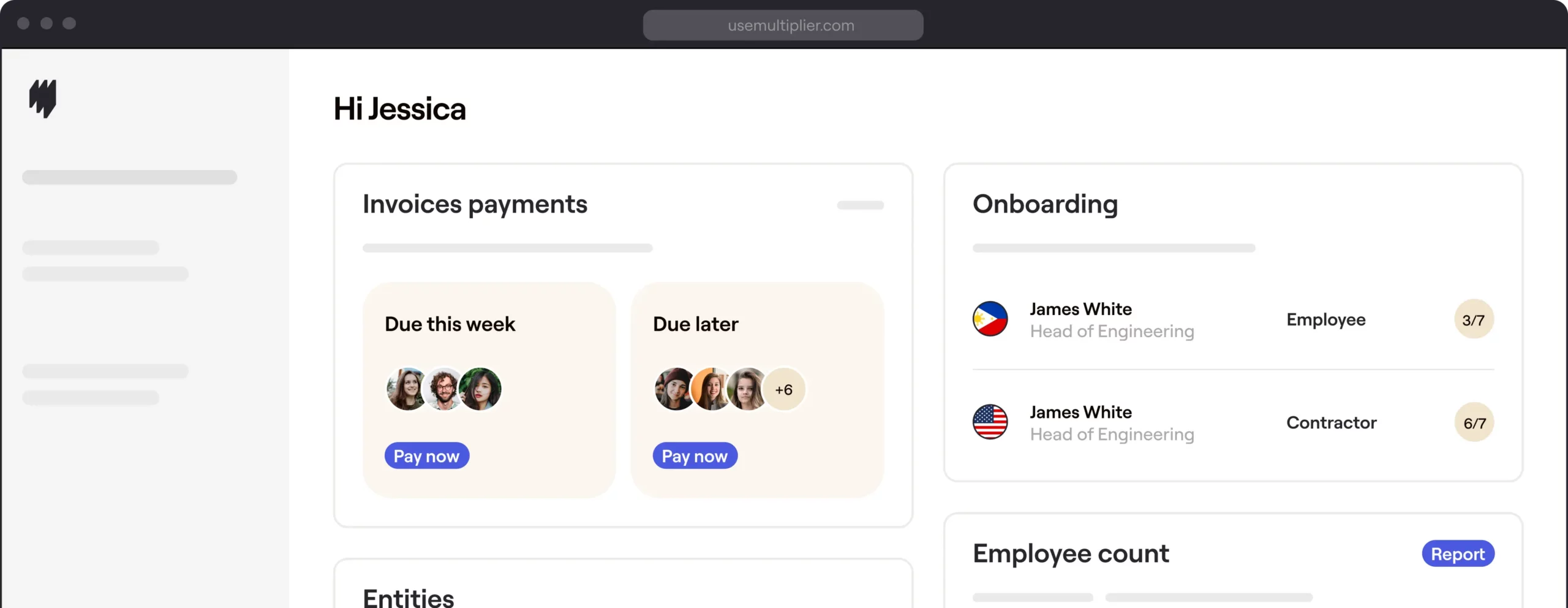
- Unified contractor management: Track contracts, digital invoices, payments, and compliance in one centralized system designed for Venezuela’s regulatory complexity.
What Capterra users say about Multiplier
“We are managing and paying our entire team with Multiplier. We are able to pay multiple teams in their local currency at the right time.” — Saurabh M., General Manager, Computer Software
Book a demo to see how Multiplier simplifies compliant contractor management in Venezuela and helps your team scale confidently.
FAQs
Can I hire a contractor in Venezuela without setting up a legal entity?
Yes. You can engage contractors directly if tax and invoicing rules are met, while platforms simplify compliant hiring without entities.
What is the difference between a contractor and an employee in Venezuela?
Contractors control work methods and manage taxes independently, while employees follow direction, receive statutory benefits, and require social security contributions.
Do I need to withhold tax from contractor payments in Venezuela?
No. Contractors file their own SENIAT taxes, but you must collect digital invoices, verify registration status, and maintain compliant records.
What happens if I misclassify an employee as a contractor in Venezuela?
Misclassification may trigger penalties, social security back payments, benefit liabilities, and investigations by the Ministry of Labor.
Does Multiplier handle contractor payments and compliance in Venezuela?
Yes. Multiplier manages onboarding, compliant contracts, digital invoicing, documentation, and payments through one centralized platform.
What digital invoicing requirements apply to contractors I work with in Venezuela?
All contractors must register with SENIAT and issue digital invoices using authorized software, with mandatory compliance starting March 19, 2025.
How can Multiplier reduce my contractor compliance risk in Venezuela?
Multiplier offers classification guidance, vetted contracts, centralized documentation, and audit-ready records aligned with Venezuelan regulations and SENIAT requirements.