The Bahamas presents compelling opportunities for global hiring. With favorable tax policies, English fluency, and a strategic location, the country continues to attract international employers. However, navigating employment laws, work permit requirements, and compliance obligations requires careful planning.
Hiring trends in Bahamas, 2026
- Unemployment in the Bahamas fell to 9.3% in the second quarter of 2025, the lowest level of the year. The labor force grew to 241,090 people, with 218,620 employed, reflecting an increase of 3,895 jobs compared to the first quarter.
- Construction led job growth with a 17% increase, adding nearly 3,000 workers. Hotels and restaurants saw a 3% rise as tourism remained steady. Elementary occupations grew by 25%, marking the largest increase across job categories.
- Skills gaps persist despite growth. Hundreds of openings listed in the Department of Labor database remain unfilled due to misalignment between available skills and market needs.
- Key employment sectors driving growth include tourism and hospitality (nearly 50% of GDP), financial services, construction and infrastructure, and maritime and port operations.
- Foreign companies increasingly expand into the Bahamas to access specialized skills. The working-age population provides a stable talent pool for international employers.
This guide offers clear, practical insight to help you choose between in-house hiring and partnering with an Employer of Record Service for your Bahamas team.
Why businesses should consider hiring in Bahamas
The Bahamas offers one of the most business-friendly environments in the Caribbean. From Nassau’s financial center to tourism-focused islands, the workforce covers multiple industries and skill sets.
Key advantages include:
- Tax-efficient environment: No income tax, capital gains tax, or estate tax
- Currency stability: Bahamian dollar pegged 1:1 to the US dollar
- Skilled workforce: English fluency and tourism-honed interpersonal skills
- Strategic location: Proximity to North America and Latin America markets
- Foreign ownership freedom: No restrictions on profit repatriation
The advantages are clear, but recruitment and compliance require strong knowledge of local law and regulatory requirements.
Key hiring complexities and costs to consider in Bahamas
Hiring in the Bahamas requires navigating multiple compliance processes, especially around statutory contributions and foreign worker approvals.
Total hiring costs typically reach 1.3-1.5× base salary, including:
- National Insurance Board contributions: 11.3% total (4.65% employee, 6.65% employer) on wages up to $810 per week. Payments are due monthly by the 15th day following the month wages were earned.
- Mandatory benefits: Minimum 14 days annual leave, 7 days sick leave, 12 weeks maternity leave, and 11 paid public holidays. Overtime compensation at 1.5× regular rate for hours beyond 40 per week.
- Administrative costs: Business entity setup ($1,500-$3,000), business license ($100), work permit fees ($100-$500), and ongoing compliance management.
Before beginning recruitment, decide how you’ll manage this complexity: in-house or with an Employer of Record.
What is an EOR, and how does it simplify recruitment in Bahamas
An EOR is a third-party service that becomes the legal employer for your workers. You manage daily work and performance. The EOR handles contracts, payroll, contributions, benefits, and compliance.
- Your company: You select talent and manage daily operations.
- Multiplier (EOR): Manages payroll, contracts, taxes, and compliance.
- Employee: Works for you but is legally employed by Multiplier.
In the Bahamas, where compliance is closely regulated, an EOR simplifies hiring, reduces risk, and ensures compliant onboarding.
Hiring in Bahamas: A strategic playbook
Let’s examine what the hiring process looks like, comparing in-house hiring versus partnering with an EOR.
Step 1: Register your entity and obtain compliance certifications
For in-house hiring, you must register with the Business Licence Division and select your corporate entity type. This takes about one week with a $100 fee. You must register with the National Insurance Board for employee coverage and comply with VAT requirements if taxable supplies exceed $100,000 annually.
Required registrations include the business license, NIB employer registration, and VAT registration, where applicable. Each requires documentation and ongoing compliance.
With an EOR: You skip entity setup, bank account creation, and maintenance filings. You can hire legally without registration, which is ideal for testing new markets.
Step 2: Register for payroll and statutory compliance
Employers must register with NIB by filing Form R.1. Employees must also register for coverage. Employers must establish monthly payroll systems that withhold 4.65% from employee wages and add the 6.65% employer share.
Payroll compliance includes monthly remittances by the 15th of each month and submission of C-10 forms. Employers must keep payroll records for at least seven years.
With an EOR: Payroll registration, calculations, and filings are handled entirely by the EOR. You avoid the administrative burden of tracking contribution deadlines and maintaining detailed employment records.
Step 3: Understand the Bahamas’ employment laws and labor codes
Bahamas employment law is defined by the Employment Act 27 of 2001. Unlike at-will systems, employers must have valid grounds for termination and must provide notice.
Key requirements include:
- Written employment contracts
- Minimum wage compliance at $260 per week
- Preference for Bahamian workers
- Department of Labor approval for hiring foreign nationals
Termination requires:
- Two weeks’ notice for workers with fewer than two years of service
- One month’s notice for longer service
- Severance of one week’s pay per year of service when terminated without cause
With an EOR: The EOR manages legal compliance and ensures contracts and terminations follow statutory rules. You don’t need to track changing employment regulations or manage complex termination procedures.
Step 4: Define roles, source talent, and evaluate candidates
Employers must attempt to hire Bahamian workers before applying for foreign work permits. Work permits require 4 to 6 weeks for processing.
Required documentation includes:
- Employer justification letter
- Employee qualifications
- Health certificate
- Police clearance
- Proof of local job advertising
Work permits range from temporary (90 days) to permanent arrangements. Permit fees range from $100 to $500, depending on job type and employee qualifications.
Candidate verification includes employment history, education checks, and criminal record checks, where allowed.
With an EOR: An EOR reduces your HR team’s administrative burden by handling work permit applications, compliance documentation, and onboarding processes, freeing your team to focus on talent strategy.
Step 5: Draft compliant contracts and employment agreements
Contracts must be written and include salary, working hours, job responsibilities, benefits, and termination procedures. Contracts should address confidentiality, non-compete terms, and dispute resolution.
Essential contract elements include:
- Salary and payment terms (minimum $260 per week)
- Working hours (40 hours per week standard)
- Leave entitlements and public holidays
- Notice periods and termination procedures
- NIB contribution arrangements
Proper employment agreement drafting protects both employer and employee interests while ensuring compliance with local employment standards.
With an EOR: Automated, fully compliant contracts aligned with the Bahamas labor laws are generated for each new hire. This reduces legal risk and ensures every hire meets statutory requirements.
Step 6: Onboard compliantly and set up payroll
Onboarding requires employee documentation, NIB registration, and payroll setup. Employees must obtain their NIB number within 10 days of employment.
Key onboarding steps include:
- Identity verification and authorization checks
- NIB registration and contribution setup
- Payroll account setup
- Enrollment in statutory benefits
- Health and safety training when needed
Proper onboarding ensures productivity, compliance, and positive employee experience from day one.
With an EOR: An EOR streamlines onboarding by automating documentation collection, managing NIB registrations, and establishing compliant payroll systems. Your new hires are ready to contribute immediately while maintaining full compliance.
Getting these steps right supports productivity, ensures data security, and establishes compliant workforce management.
The key considerations checklist for hiring in the Bahamas
☐ Job descriptions aligned with local hiring preference rules
☐ Work permits secured for foreign nationals
☐ NIB registration completed for employer and employees
☐ Written employment contracts with statutory detail
☐ Minimum wage compliance at $260 per week
☐ Overtime compensation structure confirmed
☐ Leave entitlements aligned with the law
☐ Business license and VAT registration when required
Beyond the checklist, compliance continues throughout employment. Monthly NIB contributions and annual reviews require ongoing attention.
Here’s how hiring compares in-house versus with an Employer of Record:
In-house hiring vs. using an Employer of Record (EOR)
Criteria | In-house HR (with entity) | Employer of Record (EOR) |
Registration required | Yes (business license, NIB) | No |
Time to hire | 4-8 weeks | 1-2 days |
Setup costs | $1,500-$3,000 plus ongoing | Zero upfront, pay-as-you-go |
Compliance risk | High | Low (handled by EOR) |
Work permit handling | Manual application process | Automated through EOR |
If you have an established entity and a strong HR team in Bahamas, in-house hiring may work. However, if speed, compliance, and cost-efficiency matter, an EOR like Multiplier offers a practical alternative.
With Multiplier, you get:
- Compliant Bahamas employment contracts
- Automated payroll with accurate NIB contributions
- A unified platform for onboarding and benefits
- Compliance with evolving employment laws
Why HR teams love Multiplier for global hiring in Bahamas
With an EOR in Bahamas, companies gain streamlined hiring and compliance without managing complex local processes.
- Simplified compliance management: Multiplier tracks employment regulations and NIB requirements so you don’t spend time navigating changing local laws and contribution deadlines.
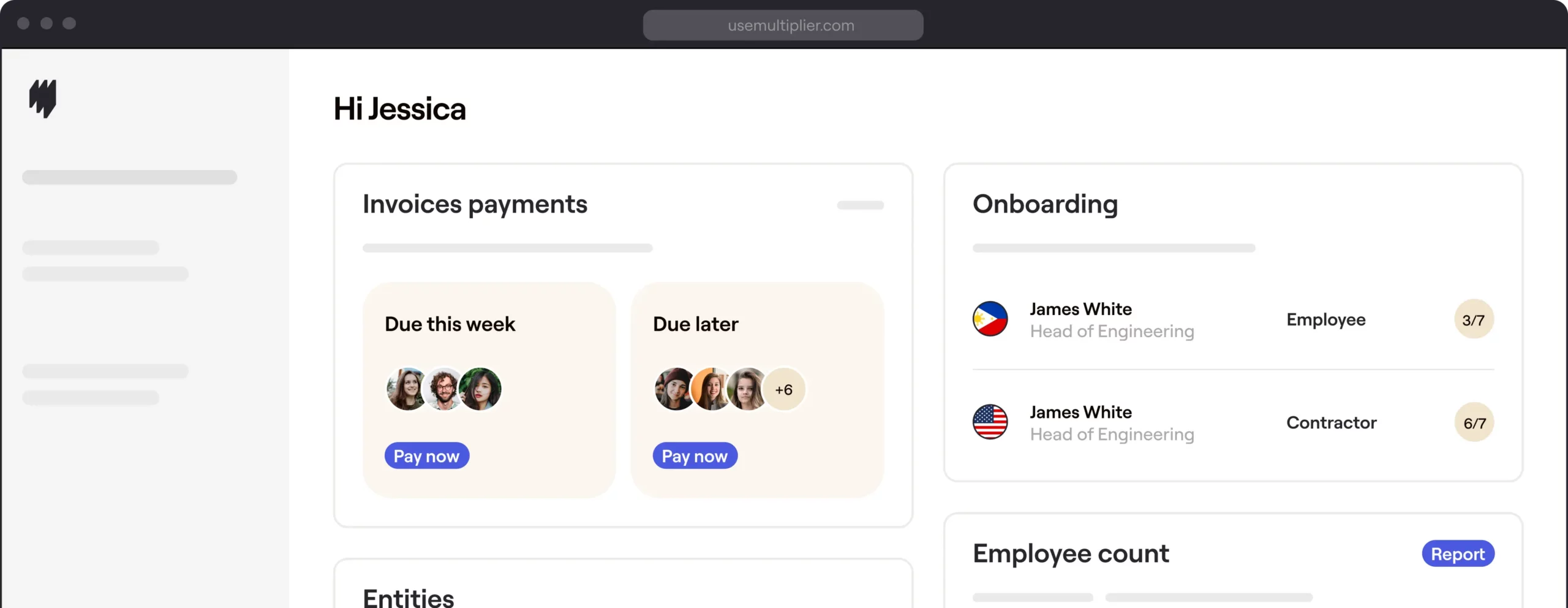
- Seamless onboarding in one platform: HR teams avoid coordinating multiple vendors because everything runs through a unified dashboard for contracts, payroll, and benefits administration.
- Clear pricing with no hidden costs: Transparent pricing helps teams scale confidently, especially when statutory contributions and work permit fees vary by employee type.
- Local expertise without internal legal teams: Dedicated Bahamas employment specialists ensure contracts, documentation, and filings meet requirements correctly the first time.
Reduced administrative burden: Multiplier removes the need for employers to manage NIB filings, work permit applications, or manual compliance tracking, freeing HR teams to focus on talent strategy.
What Reddit users say about Multiplier
“I work in HR and we’ve been using Multiplier for managing remote hires in Brazil and Argentina. It’s been a smooth experience so far. Onboarding is quick, support is responsive, and the platform’s pretty intuitive. Everyone we’ve been in touch with seems well informed about LATAM compliance and payroll. Worth checking them out for sure!” — Bhish0 (r/remotework)
Book a demo today to see how Multiplier can help you expand into the Bahamas with confidence.
FAQs
What visas or work permits do foreign employees need to work in Bahamas?
Foreign workers require an approved work permit from the Department of Labor. Employers must prove no qualified Bahamian is available and submit supporting documents, including job ads, medical certificates, and police records.
How long does it take to hire an employee in Bahamas?
Hiring locally can take four to eight weeks due to registration, job advertising, and work permit processing. Using an Employer of Record reduces timelines to one to two working days.
What is the minimum legally required compensation package for employees in Bahamas?
Employees must receive at least the $260 weekly minimum wage, 14 days paid annual leave, 7 days sick leave, 11 public holidays, and NIB coverage. Maternity leave and overtime pay are also mandatory.
How does Multiplier ensure compliant hiring in Bahamas?
Multiplier manages payroll, contracts, NIB filings, and work permits, ensuring every hire meets Bahamas employment laws. This reduces compliance risk and prevents delays during expansion.
What payroll taxes and employer contributions apply in Bahamas?
Employers must contribute 6.65% to NIB on wages up to $810 per week and remit payments monthly. There are no income taxes, but employers must comply with NIB, licensing, and record-keeping requirements.
Can I hire remote employees in Bahamas without creating a local company?
Yes. With an Employer of Record like Multiplier, you can hire remote workers legally without forming a Bahamian entity. The EOR becomes the legal employer while you direct work.
Why do global teams choose Multiplier for hiring in Bahamas?
Companies choose Multiplier for fast onboarding, clear pricing, and automated compliance. Its platform manages payroll, benefits, and work permits, helping teams scale in the Bahamas without administrative complexity.