Colombia’s economy features a high self-employment rate, making it a strong source of skilled, cost-effective contractors across tech, creative, and professional services. Yet contractor management is tightly regulated.
The Substantive Labor Code and Law 2381 of 2024 classify workers using the legal subordination test, and misclassification can trigger fines, back wages, social security liabilities, and litigation. From July 2025, employers must contribute to contractor social security under certain contracts. DIAN also requires electronic invoicing.
This guide explains classification, RUT registration, e-invoicing, Law 2381 changes, and essential compliance practices.
What is contractor management in Colombia?
Contractor management in Colombia covers hiring, onboarding, paying, and overseeing independent contractors under the Substantive Labor Code, Constitution, and tax rules. Contractors work autonomously on project-based services, while employees work under legal subordination, continuous direction, supervision, and control, and receive statutory benefits.
Courts rely on substance over form, focusing on how work is performed in reality. Law 2381 (July 2025) adds new social security obligations for certain contractor contracts. Effective management requires correct classification, documentation, DIAN e-invoicing compliance, and payment practices that minimize audit and misclassification risk.
Key compliance requirements for managing contractors in Colombia
Contractor compliance in Colombia involves contractual, tax, registration, and regulatory considerations governed by the Substantive Labor Code, Constitution, and DIAN requirements. The following framework turns these requirements into actionable steps:
Independent contractors vs employees in Colombia
Classification hinges on the degree of direction and supervision you exercise; if you control work methods, timing, and performance, the relationship resembles employment. Contractors must retain autonomy, setting schedules, choosing methods, and serving multiple clients, so as to avoid fixed hours, exclusivity, or direct oversight.
Should you hire a contractor or an employee in Colombia?
This contractors vs employees in Colombia guide explains legal obligations, costs, benefits, and compliance risks to help you choose the right classification
Written service agreements
Although not always mandatory, written contracts are essential and often required. They should define scope, deliverables, payments, IP, and clearly state contractor independence. Draft contracts in Spanish, reference the Substantive Labor Code, and avoid language implying hours, supervision, or exclusivity.
RUT registration and tax identification
Contractors must register with DIAN through the RUT before engagement. Always request and store proof of registration, and verify its validity to ensure lawful contractor status and proper tax compliance.
DIAN electronic invoicing compliance
All contractor payments must be supported by DIAN-validated e-invoices; paper invoices no longer qualify. Contractors must issue compliant electronic invoices for every payment, and you should retain validated copies for audits and payment processing.
Income tax and contractor tax obligations
Contractors handle their own income tax filings, and you generally do not withhold their taxes. However, from July 2025, under Law 2381, some service contracts may require employer social security contributions, increasing administrative and cost burdens.
Law 2381 social security contribution requirements
Effective July 2025, Law 2381 introduces phased social security contributions for certain contractor arrangements, depending on income levels and contract type. Begin reviewing contractor relationships now, prepare budgets, and seek local guidance to understand obligations.
VAT and business income registration
High-earning contractors may be subject to Colombia’s 19% VAT, so verify their tax status to ensure proper invoicing and payment planning. Income tax brackets also apply to contractor earnings, which remain their responsibility to manage.
Control and direction avoidance
Avoid continuous supervision, fixed schedules, office requirements, detailed instructions, or imposing company tools, as these suggest employment. Structure engagements around deliverables and allow contractors full control over methods and the freedom to serve multiple clients.
As a global HR manager, the checklist below turns Colombia’s contractor compliance rules into a practical, documentation-first framework to reduce misclassification risk.
Contractor compliance in Colombia: HR manager’s checklist
Use this checklist to ensure proper documentation for tax, contractual, and regulatory compliance when working with Colombian contractors:
RUT (Unique Tax Register) registration proof
Contractor must be registered with DIAN; verify RUT number and maintain proof of registration before engagement and payment processing.
Written service agreement (Contrato de Prestación de Servicios)
Outcome-based agreement in Spanish defining scope, deliverables, payment terms, intellectual property ownership, and confirming no legal subordination or employee relationship exists.
Bank account details for Colombian peso payment
Contractor’s Colombian bank account or international payment details; confirm account is in contractor’s professional or business name for DIAN compliance.
DIAN-approved electronic invoices for all payments
Mandatory valid e-invoices for every payment with DIAN validation; maintain electronic copies and validation receipts for audit readiness and payment documentation.
Control avoidance documentation
Evidence that you do not exercise continuous direction or supervision; documentation showing the contractor maintains work autonomy, flexible scheduling, and multiple client relationships.
Law 2381 impact assessment
Document whether your contractor relationship triggers new social security contribution requirements under Law 2381 (effective July 2025); assess income levels and contract type.
Professional licenses or certifications (if applicable)
For regulated professions, proof of required licenses, certifications, and professional standing with relevant Colombian regulatory bodies.
Note: You can download this contractor compliance checklist as an Excel sheet to track documentation, assign ownership, and maintain audit-ready records across teams.
Manage global contractors effortlessly
Watch how Multiplier simplifies contractor compliance, payments, and oversight across countries, including Colombia, in this short walkthrough.
8 Best practices for contractor management in Colombia
Managing Colombian contractors compliantly requires intentional practices that reduce misclassification risk and ensure legal subordination compliance. Here are eight best practices you can implement immediately:
1. Create systems to simplify contractor operations
Centralizing contracts, documentation, RUT records, and DIAN e-invoices reduces administrative errors and strengthens compliance. A contractor management system prevents lost paperwork, missed validations, and rejected invoices, ensuring every engagement meets Colombian requirements and lowering the risk of tax or labor authority scrutiny.
2. Standardize workflows to accelerate contractor onboarding
Standardized onboarding checklists ensure consistent documentation, proper RUT verification, and early assessment of legal subordination risks. This creates a uniform, compliant onboarding experience, reduces delays, and establishes contractor independence from the outset, helping your team maintain reliable, repeatable processes aligned with Colombian labor standards.
3. Draft clear service agreements to prevent misclassification risks
Clear, well-structured service agreements focus on deliverables rather than control, reinforcing contractor independence and reducing misclassification exposure. Explicit clauses denying subordination, defining scope, and outlining payment terms demonstrate good-faith compliance with Colombian law and protect your company during audits or labor disputes.
4. Pay contractors on time to protect delivery and business continuity
Timely payments build trust, reduce disputes, and support long-term contractor relationships. Reliable payment practices encourage consistent performance and reinforce a commercial, non-employment relationship, helping demonstrate independence in case of audits or challenges to contractor classification.
5. Maintain clear invoicing to align with DIAN and Law 2381 requirements
Accurate, organized DIAN-validated e-invoices support transparency, simplify reconciliations, and reduce audit exposure. Proper invoice storage ensures compliance with tax rules and upcoming Law 2381 obligations, making it easier to respond to DIAN inquiries and maintain clean financial records across all contractor engagements.
6. Separate contractor and employee processes to prevent legal risks
Distinct workflows help avoid accidentally extending employee-only benefits or controls to contractors. Maintaining separate systems for onboarding, payments, and documentation reinforces true independence, reduces misclassification exposure, and protects your organization if Colombian labor authorities review your practices.
7. Conduct periodic reviews to ensure compliance
Regular compliance reviews identify classification risks, tax obligations, documentation gaps, and upcoming Law 2381 requirements before they escalate into legal issues. Consistent audits keep your contractor program aligned with Colombian law and minimize exposure to Ministry of Labor investigations.
8. Use unified platforms to improve visibility and reporting
A unified contractor management platform enhances visibility across payments, compliance, and documentation. Centralized reporting simplifies audits, ensures consistent application of policies, and scales with your operations, supporting better oversight and smoother interactions with Colombian regulators.
All of the above best practices can be effectively implemented and sustained using a contractor management system, enabling compliant, scalable, and audit-ready contractor operations in Colombia.
How to choose the right contractor management system for Colombia
Selecting a contractor management system is a compliance-first decision, not just a payment tool. Use the following guidance to evaluate systems based on your needs:
- Frame contractor management as compliance-first: Prioritize alignment with the Substantive Labor Code, legal subordination rules, Law 2381 (July 2025), and DIAN e-invoicing mandates to ensure regulator-ready contractor operations.
- Emphasize legal subordination and control assessment: Use platforms that assess subordination, document independence, track control-avoidance practices, and store real-world performance evidence to reduce manual work and legal exposure.
- Highlight RUT verification and DIAN e-invoicing automation: Choose tools that verify RUT with DIAN, generate and validate e-invoices automatically, track invoice deadlines, and maintain compliant documentation to minimize errors and ensure DIAN compliance.
- Stress secure documentation and audit readiness: Centralize contracts, e-invoices, RUT checks, subordination analyses, and compliance evidence; maintain five-year records and generate audit-ready reports for DIAN or the Ministry of Labor.
- Cover COP and USD payments with Law 2381 automation: Ensure your system supports COP/USD payments, automates Law 2381 social security contributions, and produces clear records demonstrating subordination avoidance and full tax compliance.
“Every country — and even each province or state within it — has its own laws and regulations. Unless there’s a specialized team constantly monitoring and implementing these updates, it’s going to be very difficult to run accurate and compliant global payroll.” — Menaka Karthikeyarayan, VP Payroll Operations at Multiplier
How Multiplier enables compliant, scalable contractor management in Colombia
Multiplier simplifies how you hire, manage, and pay contractors in Colombia while ensuring full compliance with the legal subordination test, DIAN requirements, and Law 2381 obligations. Here’s how:
Hire Colombian contractors without setting up a local entity
You can engage Colombian talent and contractors without establishing a company in Colombia. Multiplier handles contractor agreements, RUT verification, legal subordination assessment, DIAN e-invoicing, Law 2381 compliance, and documentation so you focus on finding and managing the right people for your projects.
Use contractor agreements aligned with Colombian law
Multiplier provides contractor agreement templates specifically tailored to the Substantive Labor Code, legal subordination principles, Law 2381, misclassification prevention, and tax requirements. Templates are pre-reviewed in Spanish and English to ensure compliance and reduce legal risk.
Access centralized payroll and payment visibility
Manage contractors and employees in one system. Multiplier’s centralized payroll platform gives you real-time visibility into all payments, RUT status, DIAN e-invoicing compliance, Law 2381 social security obligations, and documentation—whether you’re paying one contractor or scaling across teams.
Reduce misclassification and legal subordination risk
Multiplier’s contractor management system guides you through legal subordination assessment, documents contractor independence, tracks control avoidance practices, and automates Law 2381 compliance starting July 2025. Built-in safeguards help you avoid costly misclassification penalties and regulatory investigations.
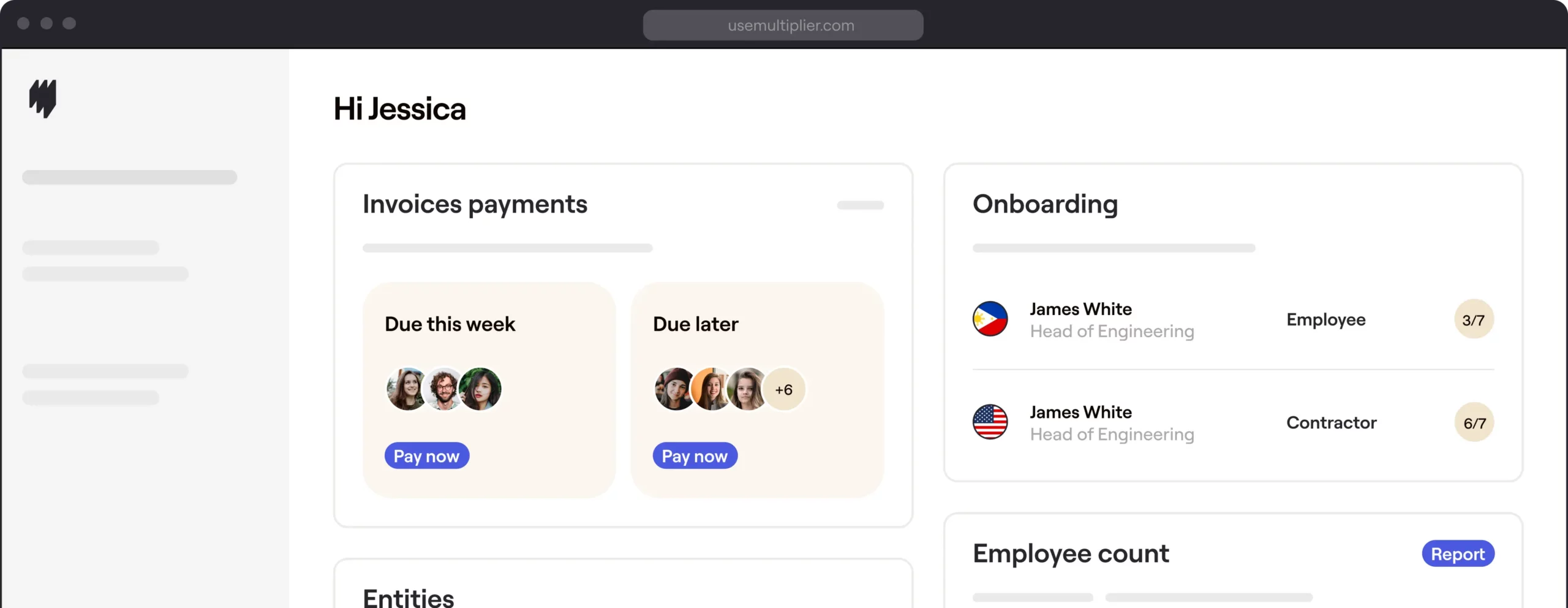
Access a unified dashboard for all contractor activity
Track all contractor engagements, contracts, payments, DIAN e-invoice status, legal subordination compliance, and documentation from one dashboard. Centralized oversight ensures consistency and compliance as you scale your Colombian contractor workforce.
What Capterra users say about Multiplier
“Partnering with Multiplier has helped in employing smart talent beyond the U.S. We had a goal which we were able to achieve quickly, without having to spend lots of money on setting up local entities.”
Book a demo to see how Multiplier simplifies compliant contractor management in Colombia and helps your team scale across borders with confidence.
FAQs
What is legal subordination, and how do Colombian courts determine contractor versus employee status?
Legal subordination involves continuous employer control. Courts assess whether you direct work, supervise performance, and control methods or timing. Substance-over-form analysis determines true status, overriding contract labels.
What is Law 2381, and how does it affect contractor social security contributions starting July 2025?
Law 2381 introduces phased contractor social security contributions beginning July 2025. Employer obligations vary by income level and contract type, significantly affecting contractor costs.
What happens if you misclassify an employee as a contractor in Colombia?
Misclassification leads to five years of back wages, benefit arrears, social security penalties, fines up to roughly $3.5 million COP, and potential lawsuits. Employees may claim damages and attorney fees.
How does Multiplier ensure DIAN e-invoicing compliance and prevent invoice submission errors?
Multiplier automates DIAN e-invoice creation, validates each invoice, tracks submission deadlines, and stores audit-ready records. The platform prevents non-compliant or invalid invoices automatically.
Are written contractor agreements legally required in Colombia?
Not always mandatory, but strongly recommended and required in some regions. Spanish agreements defining scope, deliverables, payments, and independence, and referencing the Substantive Labor Code, provide stronger protection for both parties.
Can you provide Colombian contractors with company tools or equipment?
Providing tools may indicate employment if paired with control, but limited-use equipment or reimbursed expenses are acceptable when contracts preserve independence and avoid other subordination factors.
What DIAN and Ministry of Labor documentation does Multiplier maintain for government investigations?
Multiplier stores contracts, DIAN-validated e-invoices, RUT checks, payments, subordination assessments, control-avoidance evidence, and Law 2381 records, generating audit-ready reports and retaining all documentation for five years.