Hong Kong’s competitive business environment encourages global hiring. To regulate this, the country monitors the visa ecosystem with stringent requirements. To build a remote team or pursue professional opportunities, you need to understand the various work visa categories in Hong Kong.
While some types provide easy access to exceptional workers, you still need to prove a genuine need for foreign talent and demonstrate that local professionals cannot fill the vacancy.
Use this guide to understand work visa sponsorship in Hong Kong, ensuring regulatory compliance, minimizing legal risks, and supporting the expansion of compliant global teams in Asia’s leading financial center.
Types of work visas in Hong Kong
Hong Kong offers several employment visa categories designed to attract skilled professionals while protecting local employment opportunities. Each work visa type serves a specific purpose and comes with distinct requirements for the sponsorship process.
Employment-based work visas
- General Employment Policy (GEP) visa: Most common work visa for professionals who possess special skills, knowledge, or experience of value that is not readily available in Hong Kong. This visa is quota-free and non-sector specific, making it the primary pathway for foreign talent across industries.
- Admission Scheme for Mainland Talents and Professionals (ASMTP): Employment visa for residents from the Chinese Mainland who have special skills, knowledge, or experience valuable to Hong Kong. It is quota-free, industry-neutral, and issues an entry permit upon successful application, mirroring GEP’s requirements.
- Immigration Arrangements for Non-local Graduates (IANG): Employment visa for non-local students who have graduated from a full-time, locally-accredited program in Hong Kong to stay and work in Hong Kong for 12 months without needing a job offer. Standard work visa requirements apply after employment.
- Technology Talent Admission Scheme (TechTAS): This work visa is for professionals who specialize in specific technology sectors, including artificial intelligence and financial technologies. Eligible companies must first apply for a quota before sponsoring individual candidates.
- Other categories: Working Holiday Scheme for young adults aged 18-30 from eligible countries, training visa for short-term skills development, and investment visas for entrepreneurs establishing businesses in Hong Kong.
Talent admission schemes (Permanent pathways)
- Quality Migrant Admission Scheme (QMAS): Allows highly skilled or talented individuals to settle in Hong Kong without a job offer. Must meet basic requirements and are assessed under either the General Points Test or the Achievement-Based Points Test, with successful candidates receiving an initial three-year stay.
- Top Talent Pass Scheme (TTPS): Allows high-caliber professionals and graduates from top universities to obtain a work permit without a job offer. Unlike QMAS, which is points-based, TTPS is a criteria-based scheme with clear income and education thresholds.
- Capital Investment Entrant Scheme (CIES): Employment visa for individuals who invest at least HKD 30 million in permissible investment assets in Hong Kong. This scheme targets individuals seeking residency through significant capital investment.
Quick comparison of top immigrant and non-immigrant Hong Kong work visas
| Visa type | Best for | Validity | Sponsorship required | Key limitation |
|---|---|---|---|---|
| GEP | Foreign professionals with special skills | 3-3-2 year extension pattern | Yes | Must prove skills not available locally |
| ASMTP | Mainland Chinese professionals | 3-3-2 year extension pattern | Yes | Limited to Mainland Chinese residents |
| IANG | Non-local Hong Kong graduates | 24 months without job offer | Initially no | Must have Hong Kong degree |
| TechTAS | Technology professionals | Full-time employment in R&D sectors | Yes, with a quota application | Company must first obtain a quota |
| QMAS | Highly skilled individuals | 3-3-2 (General Points Test entry); up to eight years (Achievement-based Points Test) | No job offer required | Points-based assessment |
Hong Kong work visa sponsorship process for employers
Successfully obtaining a Hong Kong work visa requires careful preparation, comprehensive documentation, and adherence to the Immigration Department’s strict requirements. The process typically takes four weeks, but can extend if information is not sufficiently furnished.
Phase 1: Eligibility and planning
To apply for an employment visa, applicants must possess:
- Skills, knowledge, or experience not readily available in Hong Kong
- Relevant academic or professional qualifications,
- Confirmed job offer
- Compensation that matches market standards.
You must prove that you have made efforts to recruit from the local market, providing an advertisement of the job vacancy, the number of candidates, and an explanation of why other candidates were unsuccessful. This documentation forms a critical part of the application and requires careful recording of all recruitment activities.
Phase 2: Documentation and certification
These are the types of documents you and the sponsored worker would require for a work visa application in Hong Kong.
For the employer:
- Employer application form, i.e., ID 990B
- Employment contract containing information about the post, salary, other fringe benefits, and employment periods
- Business Registration Certificate and proof of financial standing
- Documents with details of business activities
- Evidence of recruitment efforts
For the employee:
- Completed Application for Entry for Employment as Professionals in Hong Kong, i.e., ID 990A
- Copies of the applicant’s passport and proof of qualifications
All documentation needs to be in Chinese or English, or translated into Chinese or English by a certified translation body.
Phase 3: Petition filing and processing
- Applications can be submitted online with all supporting documents and relevant application fees through the Immigration Department’s electronic system.
- To verify the authenticity of information, field visits may be conducted by officials. You should ensure all submitted information is accurate and verifiable.
- If successful, the Immigration Department issues a visa entry permit label. The visa holder must present the entry permit to immigration officers upon arrival to activate their work authorization.
Phase 4: Extension and compliance setup
- Employment visa holders may apply for an extension within 4 weeks before their limit of stay expires. Extensions typically follow a 3-3-2 year pattern based on continued employment and company compliance.
- If approved, an extension follows typically the duration of the employment contract or standard extension periods, whichever is shorter. The employment visa is tied to a specific employer and is not transferable without proper authorization.
- Companies should establish systematic tracking of visa expiry dates, extension deadlines, and renewal requirements to maintain continuous compliance.
An Employer of Record, like Multiplier, uses automated employee-tracking and payroll systems to ensure compliance with relevant authorities for each employee. Learn more about Hong Kong Employer of Record services for worry-free global hiring.
Cost breakdown for employers applying for Hong Kong work visas
To better understand and fit the work visa requirements in your business plans, let us take a look at the various costs involved in this process.
| Cost component | Approximate amount | Who pays | Notes |
|---|---|---|---|
| Immigration Department fees | $242 for stays over 180 days; $155 for stays 180 days or less | Employer | Applies to all categories of work visas |
| Legal fees | $1,285 for main applicant; additional $580 for each dependent visa | Employer | For preparation, documentation, and filings |
| Company registration (if needed) | Variable | Employer | To hire or relocate employees legally, you need your own local entity |
| Employee relocation and benefits | Variable | Employer | Depends on the package structure |
Note: Actual costs vary depending on the visa category and whether processed internally or externally through an Employer of Record.
7 Challenges global employers face with Hong Kong work visas
Hong Kong applies strict law enforcement, making global hiring more complex. Here are some of the most common obstacles you can face in your work visa application process:
1. Proving local unavailability and recruitment efforts
Companies must demonstrate genuine attempts to fill positions locally before seeking foreign talent. Collecting and organizing this evidence can be time-consuming, but it is essential for a successful application.
2. Complex documentation and compliance requirements
Employment agreements must be clear and comply with Hong Kong labor laws and the Immigration Department’s expectations for successful applications. Careful contract review is essential to avoid or navigate compliance issues accurately.
3. Financial stability demonstration
The Immigration Department reviews both the applicant’s and the sponsor’s finances. Even if the applicant meets GEP criteria, the application may still be declined if the sponsor has been established for less than 2 years or has had low turnover for more than 2 years.
4. Employee-specific visa limitations
The issued employment visa is tied to a specific employer and is not transferable. For any change in employment, the visa holder must obtain approval from the Director of Immigration by applying. This restriction limits employee mobility and requires additional administrative processes for job changes.
5. Strict processing timelines and renewal requirements
Companies must plan renewal processes well in advance to avoid work authorization gaps. Since delays are entirely possible, especially with incomplete information or documents, processing deadlines are easy to miss unless thoroughly prepared for.
6. Background verification and character assessment
Hong Kong’s immigration department conducts thorough background checks. Any past legal issues can cause complications or denial. This is relevant since character assessment extends to both applicants and sponsoring companies, requiring clean legal records for successful applications.
7. Local entity and sponsorship requirements
All employment visa applications must be sponsored by a local sponsor company that is registered in Hong Kong as a legal entity. This requirement creates barriers for companies without established operations in Hong Kong.
“It’s often easier to be non-compliant, and that’s why it’s so important to have the right partnerships — consultants, accountants, whoever — to give you that expertise.”
The complexity of Hong Kong’s visa system requires careful planning and expert guidance to avoid costly mistakes and delays. Before sponsoring, employers should evaluate their structural readiness and compliance capabilities. The checklist below is a great starting point for that.
Employer readiness checklist for sponsoring Hong Kong work visas
Use this quick checklist to evaluate if your organization is ready to sponsor and manage Hong Kong work visas compliantly.
| Readiness Item | Key Questions for HR Teams | Status (Yes/No) |
|---|---|---|
| Local entity structure | Do we have a Hong Kong legal entity or EOR partner authorized to hire? | |
| Role justification | Can we prove the position requires skills not readily available locally? | |
| Compensation alignment | Are salary and benefits aligned with Hong Kong’s prevailing market standards? | |
| Recruitment documentation | Do we maintain records of local recruitment efforts and reasons for selection? | |
| Financial documentation | Do we have audited financial reports and business registration certificates? | |
| Compliance ownership | Have we assigned responsibility for filings and renewals (HR/legal)? | |
| Documentation readiness | Are all contracts, job descriptions, and supporting documents compliant? | |
| Renewal planning | Do we have visibility into visa expiry and renewal timelines? |
Note:
- If most answers are “Yes“, your organization is structurally ready to sponsor Hong Kong work visas. You can move confidently into the petition and onboarding phase while maintaining compliance oversight.
- If several answers are “No“, it’s a signal to pause and address key gaps, for instance, partnering with an EOR service can immediately help you meet compliance, payroll, and entity-readiness requirements without setting up a local branch.
- Revisit this checklist periodically, especially when hiring across multiple visa types or expanding into new markets. Regulatory requirements evolve, and ongoing compliance monitoring prevents costly errors or delays.
While problems like authority delays or changes in local policies are beyond your control, others can be addressed with planning and expert support. The next section outlines some strategic approaches to work visa management and renewal processes.
Visa extension and renewal strategy
Effective visa management requires proactive planning and systematic employee tracking to ensure continuous work authorization for foreign employees. Here’s what you can do:
- Support transitions between visa categories: Helping employees move from standard employment visas to long-term schemes reduces uncertainty and reinforces employee commitment.
- Cover extension-related fees and legal support: By covering administrative fees and optional legal assistance, employers remove financial and procedural stress, ensuring smooth renewals.
- Align renewal timelines with talent reviews: Synchronizing visa renewals with performance or promotion cycles gives employees clarity on their status and sets regular markers for legal work.
- Maintain records of work authorization audits: Keeping accurate, audit-ready documentation of visas, hiring process, and payroll safeguards smooth renewals.
- Partner with an external service: Working with global HRs or EOR service providers helps you navigate extension, role changes, and dependent cases with precision, reducing processing risks.
EOR support: Use Multiplier’s Employer of Record service to seamlessly manage visa renewals, transfers, and status tracking across more than 150 countries.
Hiring in Hong Kong without a local entity
To hire or relocate employees to Hong Kong legally, you need to set up your own local entity in Hong Kong. It entails registering with the Companies Registry, opening a local bank account, and adhering to local tax and employment regulations. It requires substantial investment and ongoing compliance management.
Another approach is to partner with an Employer of Record service that acts as the official employer of your staff as a locally registered entity. It navigates immigration laws and regulations while onboarding on your behalf, as well as handling payroll, benefits, and other HR requirements.
With an EOR like Multiplier, you can quickly and easily hire employees in Hong Kong without registering a company, reducing time-to-market and administrative burden significantly.
How Multiplier helps you simplify Hong Kong work visa management
Multiplier handles the entire work visa management process for you, ensuring your talent can integrate into your workflow as quickly as possible. It minimizes compliance risk with local legal and HR experts who monitor your sponsorship duties, renewal timelines, dependent applications, and hiring documentation to safely align with Hong Kong’s employment regulations.
Multiplier helps you:
- Employ and pay talent compliantly in Hong Kong without setting up a subsidiary.
- Manage the complete visa application process from documentation preparation to Immigration Department liaison
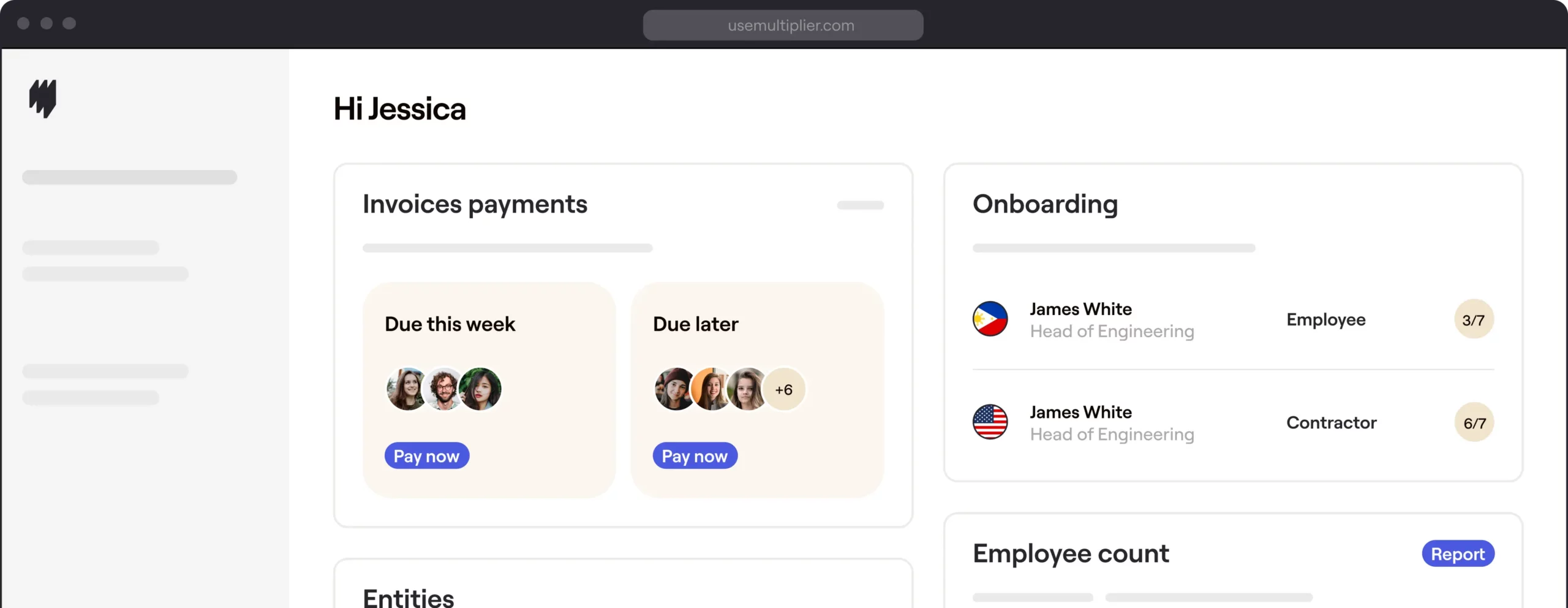
- Automate Hong Kong payroll, employee tracking, and legal filings from one dashboard.
- Access legal partners for visa petitions, extensions, and sponsorship requirements.
- Centralize payments for both contractors and full-time employees globally while ensuring local compliance with Hong Kong’s tax and employment regulations.
What Capterra user say about Multiplier
“We were trying to get a few expats in Thailand and Multiplier helped us hire them quickly without delay by assisting us with visa solutions. Dependable crew and great support especially if you want to expand and employ in different markets.” — Andrew D., CEO
Accelerate your hiring in Hong Kong with Multiplier’s EOR services. Let us handle your work visa application to ensure compliance, shorten delays, and cut down unnecessary expenses. Book a demo to experience the best global hiring systems!
FAQs
Do foreign nationals need a work visa to work in Hong Kong?
Yes, foreign nationals need a work visa issued by the Hong Kong Immigration Department to work in the country.
What is the most common work visa for foreign professionals?
General Employment Policy (GEP) is the most common work visa for foreign professionals in Hong Kong.
How long does it take to process a Hong Kong work visa?
It takes four weeks or more to process a Hong Kong work visa, with possible delays. EOR services like Multiplier can shorten this timeline by handling compliance with the authorities.
Can I change employers while on a Hong Kong work visa?
Employment visas are specific to the sponsoring employer, requiring a change of visa by the new employer. If they use EORs like Multiplier, the process can take less time than your notice period.
Can I bring my family to Hong Kong on a work visa?
Work visa holders in Hong Kong may be eligible to sponsor their spouse and children for dependent visas, allowing them to reside in Hong Kong.
Do I need a job offer to apply for a Hong Kong work visa?
For most visa categories, you need a confirmed job offer, while some schemes like QMAS and TTPS are exceptions to this rule. You can use Multiplier's Hong Kong country guides to verify your eligibility for the different visa types.
What happens if my Hong Kong work visa expires?
Working with an expired visa is illegal and can result in fines, deportation, and future visa restrictions. Apply for renewal at least 4 weeks before expiry to avoid gaps.