Understanding Dutch work visa categories is essential for employers entering European markets and for professionals pursuing opportunities in the Netherlands’ innovation-driven economy. The country offers strong infrastructure, multilingual talent, and a business-friendly environment, but immigration rules can be complex. Proper sponsorship and documentation speed hiring, minimize legal risks, and ensure compliance.
This guide equips employers with a clear roadmap to Dutch work authorization, covering permit types, costs, and compliance strategies.
Types of work visas in the Netherlands
The Dutch immigration system offers several work visa categories designed for different employment scenarios. Understanding which visa aligns with your hiring needs is essential for efficient sponsorship and compliance.
Work Permit (TWV)
- For employment under 90 days without a residence permit.
- Employer applies through the UWV for short-term or seasonal work.
- Valid up to one year, depending on assignment needs.
Combined Residence and Work Permit (GVVA)
- Single permit for employment exceeding 90 days in the Netherlands.
- Issued by IND when roles don’t qualify for HSM or Blue Card.
- Requires a labor-market test demonstrating no suitable local candidates.
Highly skilled migrant visa
- Fast processing for recognized sponsors hiring international professionals.
- Salary thresholds: $6,100 (30+) and $4,470 (<30) per month.
- Allows family work rights and leads to permanent residency eligibility.
EU blue card
- For highly qualified workers with advanced degrees and strong experience.
- Requires $6,290 monthly salary and a minimum 12-month contract.
- Provides EU mobility and counts toward EU-wide permanent residency.
Intra-Company Transfer (ICT) permit
- For specialists or managers transferred from non-EU company branches.
- Valid up to three years with mobility across EU ICT programs.
- Supports long-term assignments within multinational corporate structures.
Other categories
- Includes orientation year permits for recent graduates seeking jobs.
- Startup visas support entrepreneurs launching innovative Dutch ventures.
- Seasonal permits cover short-term roles in agriculture or hospitality.
Quick comparison of the top immigrant and non-immigrant Netherlands work visas
| Permit type | Best for | Validity | Sponsorship required | Key limitation |
|---|---|---|---|---|
| TWV | Short-term assignments under 90 days | 1 year | Yes | Limited duration |
| GVVA | Standard employment over 90 days | 1-5 years | Yes | Labor market test required |
| Highly skilled migrant | Specialized professionals | Up to 5 years | Yes (recognized sponsor only) | Salary thresholds |
| EU Blue Card | Advanced degree holders | Indefinite (renewable) | Yes | Higher salary requirement |
| ICT permit | Intra-company transfers | Up to 3 years | Yes | Must be with the same employer group |
This comparison enables you to quickly identify the most appropriate permit pathway based on role requirements, duration, and your organization’s sponsorship status.
Netherlands work visa sponsorship process for employers
Successfully sponsoring international talent requires following a structured process with precise documentation and timeline management. Here’s your step-by-step roadmap.
Eligibility and planning
Confirm the role qualifies for the appropriate IND permit. Check if it meets the highly skilled migrant salary thresholds or requires a GVVA labor-market test. Determine whether you need recognized sponsor status, which is mandatory for highly skilled migrants. Align the job description, skills, and salary with Dutch prevailing-wage rules. For GVVA applications, document EU/EEA recruitment efforts for the required period.
Documentation and certification
Prepare a compliant employment contract, detailed job description, proof of qualifications, and salary evidence. For GVVA, secure UWV labor certification. Maintain organized records, including offer letters, recruitment evidence, and compliance logs, especially if you’re a recognized sponsor, as poor recordkeeping can jeopardize your status.
Petition filing and processing
Apply through the IND business portal (for recognized sponsors) or by paper if required. Processing is about two weeks for highly skilled migrants and up to 90 days for GVVA. Non-recognized employers must complete sponsor registration first, adding roughly 12 weeks. Pay IND fees of $430–$550, track the application, respond quickly to requests, and guide employees through consular or in-country procedures.
Onboarding and compliance setup
After approval, employees must register with the municipality within 5 days to obtain a BSN for payroll purposes. Configure payroll for Dutch wage tax, social-security contributions, and mandatory health insurance. Maintain ongoing compliance, track address or role changes, and begin renewal planning at least six months before the permit expires.
An EOR in the Netherlands can manage these registrations, payroll configurations, and compliance tasks on your behalf, reducing administrative effort.
Cost breakdown for employers applying for Dutch work visas
Transparency around total sponsorship costs enables accurate budgeting and prevents financial surprises during the hiring process.
| Cost component | Approximate amount | Who pays | Notes |
|---|---|---|---|
| IND filing fees | $430-$550 depending on permit type | Employer | Mandatory for all permit applications. GVVA costs $550 for adults, $330 for spouses/partners, $110 for children under 18 |
| MVV (entry visa) fees | $95-$235 | Employee/Employer | Required if applying from abroad |
| Recognized sponsor registration | $3,080-$6,160 | Employer | One-time fee: $6,160 for large companies, $3,080 for small businesses. Valid for indefinite period if compliance maintained |
| Attorney/Legal fees | $1,050-$5,250 | Employer/shared | For preparation, documentation, labor market test evidence, and application filing |
| Labor market test costs | Varies | Employer | Includes job advertising across EU platforms for 5+ weeks, recruitment agency fees if applicable |
| Employee relocation and benefits | Variable | Employer | Depends on the package, including temporary housing, insurance, and integration support |
Note: Actual costs depend on permit category, whether you’re a recognized sponsor, and the complexity of the role. Working with an EOR can provide cost predictability and eliminate hidden fees associated with entity setup and ongoing compliance.
7 challenges global employers face with Dutch work visas
Even with clear processes, employers encounter operational, regulatory, and compliance hurdles that can delay hiring or disrupt workforce planning. Anticipating these challenges helps you develop mitigation strategies.
1. Recognized sponsor requirements
Only IND-recognized sponsors can hire highly skilled migrants. Recognition takes up to 90 days and requires strong compliance systems; without it, employers face slower, more limited permit options.
2. Salary threshold complexity
Highly skilled migrant and EU Blue Card routes require minimum annual salaries: $6,100 (30+), $4,470 (<30), and $3,200. Falling below these levels can trigger permit revocation.
3. Labor market testing requirements
GVVA applicants must prove that no suitable EU/EEA candidates are available by advertising roles for at least five weeks and maintaining full recruitment evidence, adding time and administrative burden.
4. Multi-agency coordination
Dutch work authorization involves the IND, UWV, municipalities, and tax authorities. Misaligned documentation across these bodies can create processing delays.
5. Changing regulations and processing times
Salary thresholds, IND policies, and processing times shift frequently. Employers must stay up to date and build buffer time into hiring plans to avoid disruptions.
“If changes to legislation aren’t implemented within the defined timeframes, it could result in huge penalties. This makes timely statutory updates critical for any global employer.” — Menaka Karthikeyarayan, VP Payroll Operations at Multiplier
6. Renewal and retention management
Permits renew every 1–5 years. Missing deadlines or failing to maintain job and salary conditions risks employment gaps and compliance violations.
7. State-level payroll and tax compliance
Employers must meet Dutch payroll withholding, social security contributions, pension requirements (~15%), and mandatory health insurance requirements. Errors can lead to penalties and costly back payments.
Before sponsoring any Dutch work permit, evaluate whether your organization is structurally and operationally ready for these responsibilities. The checklist below helps teams assess their preparedness and identify gaps requiring attention.
Employer readiness checklist for sponsoring Dutch work visas
Use this evaluation to determine if your organization is ready to sponsor and manage Dutch work permits compliantly.
| Readiness item | Key questions for HR teams | Status (Yes/No) |
|---|---|---|
| Entity or EOR structure | Do we have a Dutch legal entity or an EOR partner authorized to hire? | |
| Recognized sponsor status | Are we registered as an IND-recognized sponsor for highly skilled migrants? | |
| Role classification | Does the position meet salary thresholds for highly skilled migrants or labor market test exemptions? | |
| Compensation alignment | Is salary aligned with Dutch minimum wage standards and permit-specific thresholds? | |
| Internal documentation | Do we maintain offer letters, recruitment records, and compliance logs for audits? | |
| Compliance ownership | Have we assigned responsibility for permit applications, renewals, and IND notifications? | |
| Payroll and tax readiness | Are payroll, wage tax withholding, and social security systems configured for Dutch jurisdiction? | |
| Renewal planning | Do we have visibility into permit expiry dates and 6-month renewal initiation timelines? |
Note:
- If most answers are “Yes,” you’re ready to sponsor Dutch work permits and can move into application and onboarding with confidence.
- If several answers are “No,” address the gaps first. An EOR service like Multiplier can help you meet compliance, payroll, and entity requirements without creating a local entity.
- Revisit this checklist regularly. Evolving regulations make ongoing compliance reviews essential to avoid delays and costly errors.
Certain challenges, like IND processing times, are unavoidable, but many can be mitigated through effective planning. Next, we outline strategies to improve workforce continuity through permit conversions and renewals.
Visa conversion and renewal strategy
Managing renewals and transitions proactively reduces attrition risk and maintains employment continuity for valued team members.
- Temporary to permanent pathways: Support employees on highly skilled migrant or GVVA permits in applying for permanent residency after five years, ensuring language requirements and continuous compliant employment are met.
- Extension timelines: Begin renewals at least six months before expiry to prevent work gaps. Early filing creates buffer time for IND delays or document requests.
- Change of employer: New employers must file notifications or new applications. Employees can maintain status for up to three months if both roles qualify and filings are timely.
- Compliance recordkeeping: Keep complete visa histories, salary records, and audit logs. Strong documentation ensures smoother renewals and permanent residency applications.
EOR support: Use Multiplier’s Employer of Record service to seamlessly manage permit renewals, employer transfers, and status tracking across countries, ensuring no employee experiences authorization gaps.
Hiring in the Netherlands without a local entity
Setting up a Dutch entity requires Chamber of Commerce registration, obtaining KVK/RSIN/BTW/LEI numbers, configuring payroll for Dutch tax and social-security rules, and handling ongoing administrative upkeep. This process can cost $5,250+ and take several weeks to months.
Even without an entity, employers must verify work authorization, comply with payroll taxes, follow wage laws, and meet mandatory insurance obligations, non-compliance leads to penalties and hiring restrictions.
An Employer of Record like Multiplier lets you hire Dutch talent, run compliant euro payroll, provide statutory benefits, and manage work authorization without forming a subsidiary, speeding market entry and removing entity-maintenance burdens.
How Multiplier simplifies Dutch work visa management
Multiplier provides comprehensive solutions for employers seeking efficient, compliant access to the talent markets of Netherlands.
- Entity-free hiring: Hire and pay talent in the Netherlands without setting up a subsidiary. Multiplier acts as your employer of record and manages all local registration and compliance.
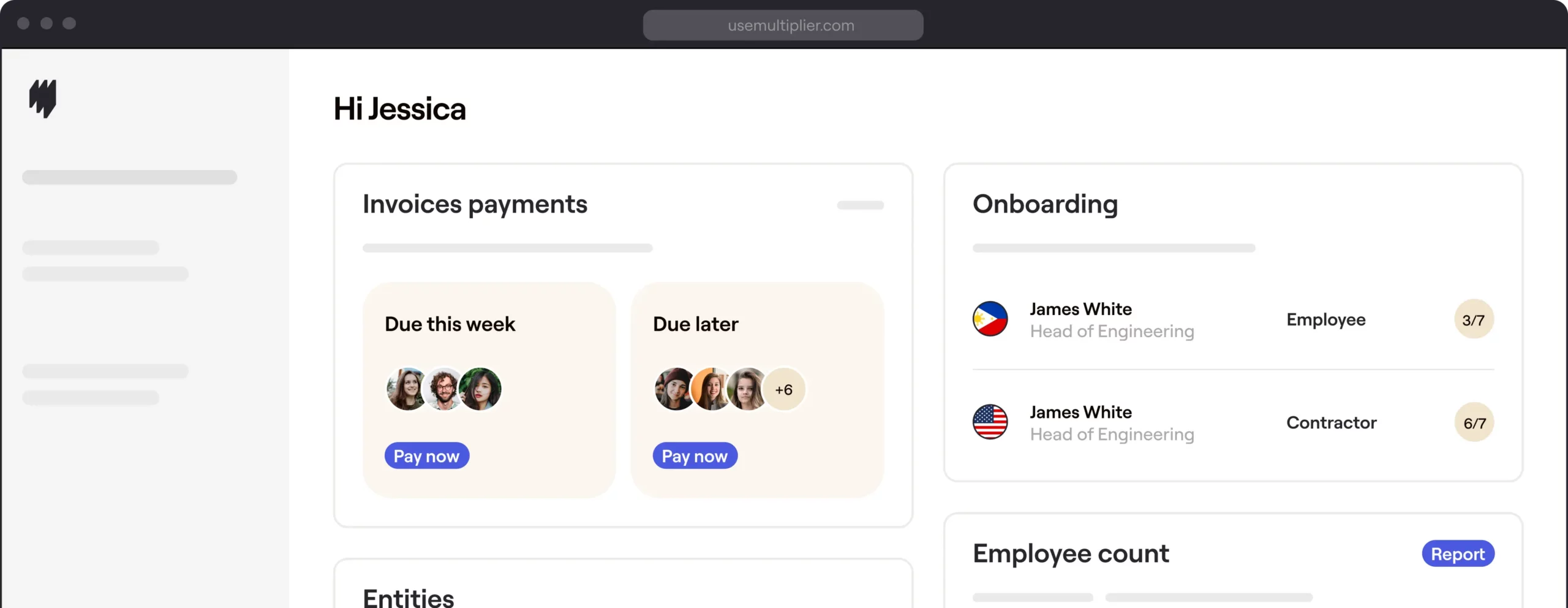
- Automated compliance: Track work authorization, wage tax, social-security contributions, and employment lawobligations from one dashboard, with automated alerts for renewals and regulatory changes.
- Expert support: Access Dutch immigration specialists for permit strategy, application preparation, recognized-sponsor guidance, and renewal management. Our team handles communication with the IND throughout the process.
- Unified payroll: Run compliant payroll for contractors and employees globally. Dutch tax withholding, pension contributions, and holiday allowances are calculated automatically under current rules
- Onboarding: Simple and quick with 24-48 hour setup for most positions.
What Capterra users say about Multiplier
“Onboarding happens in just minutes. We enjoy how quickly we can employ someone in less than a day. This is a big plus for Multiplier.”
Book a demo today to explore how Multiplier can accelerate your Netherlands expansion.
FAQs
How can employers sponsor foreign workers for Dutch permits?
Employers must be registered with the IND as recognized sponsors (for highly skilled migrants) or pass labor market tests (for GVVA), then file applications with required documentation and fees.
Which Dutch work permit processes fastest?
The highly skilled migrant visa processes in approximately 2 weeks for recognized sponsors, making it the fastest pathway for qualified professionals meeting salary thresholds.
How long does Dutch work permit approval take?
Processing ranges from 2 weeks (highly skilled migrant for recognized sponsors) to 90 days (GVVA), with an additional 12 weeks if becoming a recognized sponsor first.
Can employees transfer employers on Dutch work permits?
Yes, employees can transfer if the new employer meets permit requirements and files proper notifications within 4 weeks. Highly skilled migrants can maintain status for up to 3 months between qualifying employers.
How does Multiplier help with Dutch work authorization?
Multiplier acts as employer of record, handling all permit sponsorship, IND applications, payroll compliance, and renewal management so you can hire without establishing a local entity.
What happens if a Dutch work permit expires?
Employees must stop working immediately upon expiration. Employers should initiate renewals 6+ months early. Multiplier's automated tracking prevents authorization gaps through proactive renewal management.