Understanding US work visa categories is essential for employers looking to hire foreign talent legally and efficiently. The right visa sponsorship strategy safeguards your organization’s compliance, accelerates hiring timelines, and helps you scale global teams confidently.
With proper planning and knowledge of visa types, documentation requirements, and sponsorship obligations, you can navigate the complex US immigration landscape successfully.
Types of work visas in the US
The US has two major categories of work visas. The right option depends on whether the job is temporary or a path to permanent residency.
Non-immigrant work visas (Temporary work in the US)
These visas allow individuals to work in the US for a limited period without granting permanent residency.
H-1B: Specialty occupations
- For roles requiring a bachelor’s degree or higher (STEM, IT, finance, engineering).
- Employers must file a petition with USCIS; most applicants go through a lottery.
- Annual cap: 65,000 + 20,000 for US master’s degree holders.
- Valid for up to 3 years, extendable to 6 years.
L-1: Intra-company transfers
- For employees moving from a foreign entity to its US branch.
- L-1A: Managers/executives, valid up to 7 years.
- L-1B: Specialized knowledge staff, valid up to 5 years.
- Employee must have worked for the foreign affiliate for 1 year in the past 3 years.
O-1: Extraordinary ability
- For individuals with proven exceptional achievements in science, education, business, arts, or athletics.
- Requires substantial documentary evidence (awards, publications, press, etc.).
- Valid for up to 3 years, renewable in 1-year increments.
H-2B: Temporary non-agricultural work
- For seasonal or peak-load roles in sectors like hospitality, landscaping, tourism, and construction.
- Employer must prove a temporary need.
- Subject to annual caps.
Other common categories
- TN: Canadian/Mexican professionals under USMCA.
- E-2: Investors from treaty countries.
- J-1: Interns, trainees, researchers, and exchange visitors.
Immigrant work visas (Employment-based green cards)
These lead to permanent residency (green card status).
EB-1: Priority workers
- For executives/managers, outstanding researchers, or individuals with extraordinary ability.
- Typically, the fastest processing route.
EB-2: Advanced degree or exceptional ability
- For professionals with a master’s degree or higher, or exceptional ability in their field.
- Usually requires the PERM labor certification (unless applying under a National Interest Waiver).
EB-3: Skilled, professional, and other workers
- For skilled workers (2+ years experience) and bachelor’s professionals.
- PERM labor certification required.
Quick comparison of the top immigrant and non-immigrant US work visas
Visa type | Best for | Validity | Sponsorship required | Key limitation |
H-1B | Specialty occupations (IT, engineering, finance) | 3 years + extensions | Yes | Annual lottery cap; new petitions filed after September 21, 2025 require a $100,000 fee |
L-1 | Intra-company transfers | Up to 7 years | Yes | Must be with same employer group |
O-1 | Extraordinary ability professionals | 3 years + extensions | Yes | Requires proof of achievements |
H-2B | Temporary non-agricultural work | 1 year | Yes | Seasonal and quota-based |
EB-2 / EB-3 | Permanent skilled employment | Indefinite (Green Card) | Yes | PERM Labor Certification needed |
This comparison enables you to quickly evaluate visa pathways based on your organization’s specific hiring needs and timeline constraints.
US work visa sponsorship process for employers
Successfully sponsoring foreign workers requires a systematic approach across four key phases. Here’s your step-by-step roadmap for managing visa sponsorship compliantly.
Eligibility and planning
Confirm the role meets USCIS criteria, check caps such as the H-1B quota, determine whether a PERM is needed, and ensure job details and salary meet DOL prevailing-wage standards.
Documentation and certification
Prepare job descriptions, salary data, and eligibility evidence. Obtain a Labor Condition Application (LCA) for H-1B and PERM for EB-2/EB-3. Keep offer letters, postings, and compliance logs audit-ready.
Petition filing and processing
File Form I-129 or I-140, pay fees, and use premium processing if needed. Track status, respond quickly to RFEs, and guide employees through consular or change-of-status steps.
Onboarding and compliance setup
Align payroll, taxes, and benefits with federal and state rules, maintain sponsorship records, and begin onboarding once authorization is approved.
As ongoing payroll, tax, and employment compliance becomes operationally heavy, an Employer of Record (EOR) can manage these obligations on your behalf and ensure compliant employment in the US.
Learn more about US Employer of Record services to simplify this process.
Cost breakdown for employers applying for US work visas
Understanding the total cost of sponsorship is essential for accurate budgeting and planning. Here’s a transparent breakdown of expenses you can expect.
Cost component | Approximate amount | Who pays | Notes |
USCIS filing fees | $460 – $2,500 depending on visa type | Employer | Mandatory for all visa petitions |
New H-1B petition fee (from Sept 21, 2025) | $100,000 | Employer | Only for new H-1B petitions filed after September 21, 2025; does not apply to renewals or existing visa holders |
Attorney/legal fees | $1,000 – $5,000 | Employer / shared | For preparation, documentation, and filings |
Premium processing (optional) | $2,805 | Employer | Guarantees 15-day processing for most visas |
Compliance/audit costs | Varies | Employer | Includes LCA preparation, record-keeping, HR systems |
Employee relocation and benefits | Variable | Employer | Depends on package (onboarding, insurance, benefits) |
Note: Actual costs depend on the visa category, legal counsel rates, and whether filings are processed internally or through a global EOR.
With these cost considerations in mind, you can now anticipate the operational challenges that often accompany the visa sponsorship process.
7 Challenges global employers face with US work visas
Even with clear processes, employers encounter several hurdles that can delay hiring or disrupt workforce planning. Being prepared for these challenges helps you mitigate risks.
1. Visa quota limits and timing
Employers must plan hiring around strict annual visa caps that limit the number of workers they can sponsor each year. Once the quota is filled, companies must wait for the next cycle, which slows hiring and disrupts planning. This creates uncertainty when trying to fill critical roles quickly.
2. Strict eligibility and documentation
US visa categories require strong evidence that the job and the candidate meet specific legal criteria. If documents are incomplete or unclear, USCIS may issue Requests for Evidence, which can delay the process. Employers must prepare detailed job descriptions, qualifications, and proof to keep petitions moving smoothly.
3. Wage, labor, and LCA compliance
Companies must comply with prevailing wage rules, employment laws, and complete LCA submissions accurately. They also need to post required notices and maintain records to prove compliance with labor standards. Any mistakes can result in audits, penalties, or petition denials, affecting hiring plans.
4. Multi-agency complexity
The visa process involves several agencies, including the Department of Labor, USCIS, and US consulates. Each step has different requirements, forms, and waiting times that increase administrative workload. Coordinating these stages correctly is essential to avoid errors and costly delays.
5. Policy and adjudication changes
US immigration rules and processing standards change often, sometimes with very limited warning. Employers must track updates to avoid filing petitions that no longer meet revised rules or criteria. Sudden changes can slow hiring, increase scrutiny, or lead to unexpected denials.
💡 Do you know? Nov 2025 US immigration updates could benefit Indian professionals
The US recently introduced policies that ease work permits, mobility, and residency for Indian STEM professionals, with faster processing and greater flexibility for H-1B families.
You can read a quick breakdown of these policy updates here: USA immigration policy shifts for Indian professionals.
6. Renewal and retention challenges
Many visas are issued for short periods, so companies face frequent deadlines for extensions and renewals. This includes tracking the ongoing validity of work permits or visas to ensure uninterrupted employment authorization. If renewals are delayed or denied, it disrupts continuity and increases turnover risk.
7. Payroll and tax readiness
Hiring foreign workers requires aligning payroll, benefits, and tax withholding with complex US laws. Employers must ensure proper classification, setup with state agencies, and accurate deductions from day one. Any errors in payroll or taxation can lead to compliance violations and financial penalties.
“Compliance matters are probably the biggest hurdle any of the HR or Finance people run into. The visa issues, payroll matters, deductions, taxation, immigration, benefits, insurance — all of that becomes such a humongous problem that not many people have the bandwidth or inclination to even start solving those problems.”
Before sponsoring any US work visa, you should first evaluate whether your organization is structurally and operationally ready to take on these responsibilities.
Employer readiness checklist for sponsoring US work visas
Use this checklist to evaluate if your organization is ready to sponsor and manage US work visas compliantly.
Readiness item | Key questions for HR teams | Status (Yes/No) |
Entity or EOR structure | Do we have a US entity or EOR authorized to hire? | |
Role classification | Is the role eligible under USCIS specialty-occupation or intra-company rules? | |
Compensation alignment | Are salary and benefits aligned with DOL prevailing-wage requirements? | |
Internal documentation | Do we maintain offer letters, LCAs, and sponsorship records for audits? | |
Compliance ownership | Have we assigned HR/legal ownership for filings and renewals? | |
Compliance with state tax rules | Are we registered for state payroll tax and unemployment insurance? | |
Payroll and tax readiness | Are payroll, tax, and insurance systems configured for US compliance? | |
Renewal planning | Do we track visa expiry and renewal timelines effectively? |
Note:
- If most answers are “Yes,” you’re ready to sponsor US visas and proceed with petitioning and onboarding while maintaining compliance.
- If several answers are “No,” pause and address gaps; an EOR service like Multiplier can manage compliance, payroll, and entity readiness without a local branch.
- Revisit this checklist regularly, especially when hiring across visa types or expanding states; evolving regulations make ongoing monitoring essential.
While federal caps and shifting USCIS policies are uncontrollable, strong planning can address other challenges. The next section explains how structured visa conversion and renewal strategies strengthen workforce continuity.
Visa conversion and renewal strategy
Strategic visa renewal and conversion planning reduces attrition risk and protects continuity.
- Non-immigrant to immigrant: Move long-term H-1B employees toward EB-2/EB-3; PERM now takes ~472 days, so start early.
- Extensions: Begin renewals at least six months before expiry to prevent work gaps.
- Change of employer: File a new Form I-129 before an employee joins another US entity.
- Recordkeeping: Maintain full visa histories and audit logs to streamline extensions and green card steps.
Use Multiplier’s Employer of Record service to seamlessly manage visa renewals, transfers, and status tracking across countries.
Hiring in the US without a local entity
Setting up a US entity requires state registrations, an EIN, payroll systems, and ongoing compliance, with high costs and timelines of weeks to months. Even without an entity, you may still face payroll tax, wage, and E-Verify obligations.
Using an EOR like Multiplier lets you legally hire US talent, run USD payroll, offer benefits, and stay compliant, without forming a subsidiary, enabling fast, efficient market entry.
How Multiplier helps you simplify US work visa management
Multiplier provides comprehensive solutions that address the full spectrum of US employment challenges:
- Entity-free hiring: Employ and pay talent compliantly in the US without setting up a subsidiary.
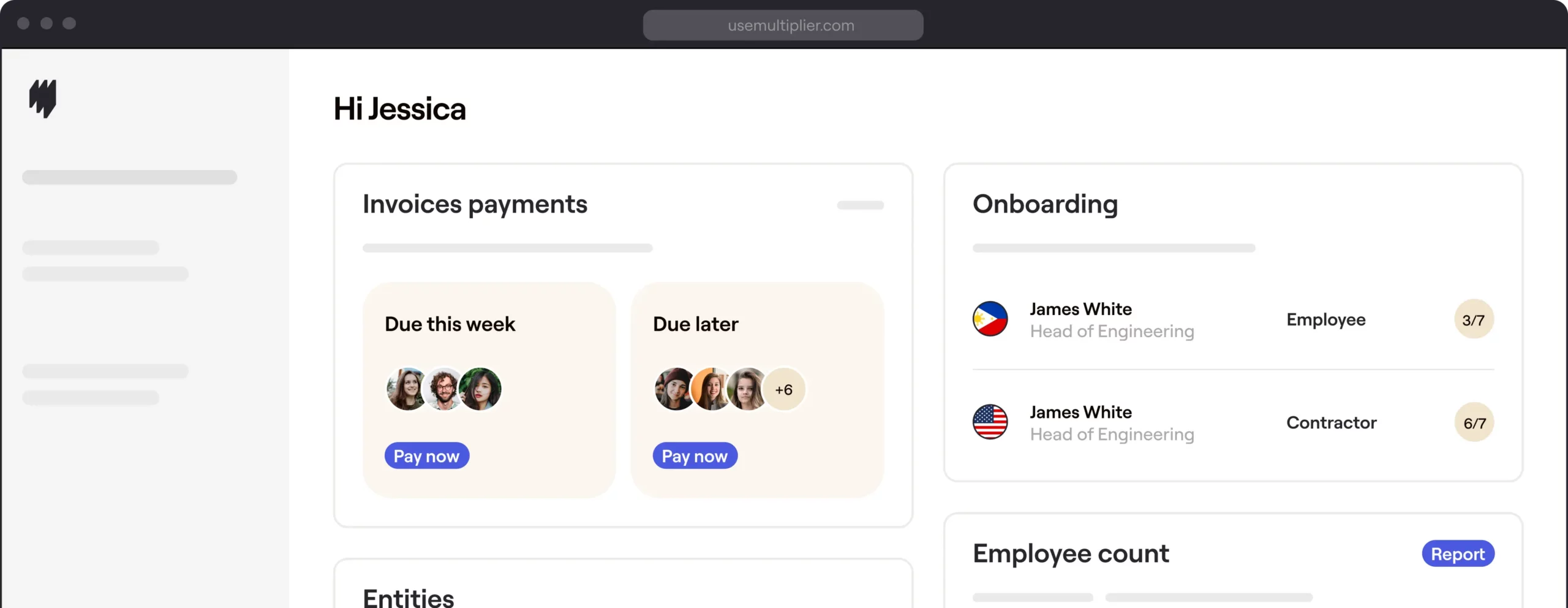
- Automated compliance: Manage work authorization, taxes, and employment law filings from one centralized dashboard.
- Expert support: Access legal partners for visa petitions, extensions, and sponsorship guidance throughout the process.
- Unified payroll: Centralize payments for both contractors and full-time employees globally, simplifying your financial operations.
Onboarding is simple and quick, typically completed within 24-48 hours.
Book a demo today to see how Multiplier can transform your US hiring strategy.
FAQs
What are the main types of US work visas?
US work visas include non-immigrant options such as H-1B for specialty occupations and L-1 for intra-company transfers, as well as immigrant visas such as EB-2 and EB-3 for permanent residency.
How can employers sponsor foreign workers for a US visa?
Employers must file Form I-129 or I-140 with USCIS, obtain the necessary labor certifications, pay the filing fees, and demonstrate that the role meets specific eligibility criteria.
Which US work visa is the fastest to get?
O-1 visas and L-1 visas typically process faster than H-1B visas, especially when premium processing is used, though timelines vary by case complexity.
How long does PERM labor certification take?
PERM labor certification currently averages 472 days (approximately 16 months) for processing, with additional time required if audited.
Can I transfer my US work visa to a new employer?
Yes, but your new employer must file a new Form I-129 petition before you begin work, and you should maintain a valid status throughout the transfer.
How does Multiplier simplify US visa management?
Multiplier manages work authorization, compliance, payroll, and benefits through one platform, eliminating the need for a local entity while ensuring full legal compliance.
Can Multiplier help if my company doesn't have a US entity?
Yes, Multiplier serves as your Employer of Record, enabling you to legally hire and pay US employees without establishing a subsidiary or local presence.