As organizations accelerate global expansion, Chief Financial Officers (CFOs) face complex decisions balancing growth ambitions with financial discipline. Almost 60% of CEOs expect global growth to increase over the next 12 months, while just 5% of mid-market CFOs believe their firms are fully prepared for future regulatory changes.
International hiring introduces challenges like entity setup costs, tax compliance, currency risks, and regulatory penalties. Employer of Record (EOR) services offer a strategic solution, transforming the financial dynamics of global growth.
This guide equips CFOs with insights into EOR’s cost efficiencies, compliance benefits, and financial control mechanisms.
Why should CFOs consider EOR services?
EOR services are a strategic financial tool, not just an HR solution, addressing cost predictability, risk mitigation, and operational control.
Predictable cost structures for better forecasting
Traditional expansion involves variable costs — legal fees, compliance updates, and market-driven expenses — that complicate forecasting. EORs streamline these into predictable per-employee costs — typically $300 to $500 per month — which cover payroll, compliance, and benefits. For example, a CFO expanding into Japan can budget confidently, avoiding surprises from regulatory changes.
Comprehensive risk transfer and penalty protection
Non-compliance penalties can vary widely — for example, wrongful termination claims can cost $40,000–$60,000, while discrimination claims can reach $100,000–$200,000 or more per case. EORs, as the legal employer, absorb liabilities for employment law, payroll taxes, and benefits, shielding CFOs from financial risks. For example, a CFO expanding into Brazil can avoid unexpected severance costs by relying on the EOR’s compliance expertise and legal coverage.
Enhanced financial control through technology
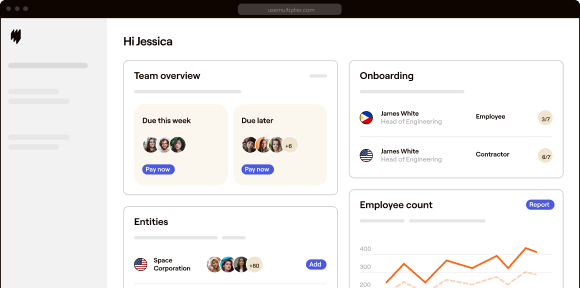
EOR platforms provide unified oversight via real-time dashboards, variance alerts, and audit trails. For instance, a CFO managing teams in Germany and Singapore can monitor costs and compliance centrally, reducing oversight complexity.
EORs empower CFOs to drive growth while maintaining financial discipline.
Key decision criteria for CFOs
CFOs need clear frameworks to evaluate EOR vendors. Below are critical criteria:
✅ Financial impact: EORs cut first two-year costs by avoiding entity setup fees, compliance overhead, and local HR hires, making market entry faster and cheaper.
✅ Risk management: Comprehensive liability transfer and insurance protect against penalties.
✅ Operational efficiency: Streamlined processes reduce administrative costs by up to 30%.
✅ Strategic flexibility: Scalable cost structures support dynamic expansion plans.
Choosing an EOR partner aligns financial strategy with growth objectives.
The evolving role of CFOs in global expansion
CFOs are now strategic architects, not just financial gatekeepers, shaping global growth through mergers and acquisitions, regulatory alignment, and financial integration.
Mergers and acquisitions
With 78% of dealmakers planning at least one transaction in 2025, CFOs lead due diligence, financial structuring, and synergy capture — helping avoid post-deal cost overruns that can exceed 10–15% of deal value if integration is delayed.
Greenfield projects
CFOs evaluate market-entry ROI and utilize EORs to bypass incorporation fees (often $20,000–$50,000 per country) and months of setup, enabling revenue generation three to six months faster than traditional entity formation.
Regulatory alignment
They navigate employment laws, tax treaties, and data privacy rules like GDPR — critical when non-compliance penalties can reach $24m or 4% of global turnover under GDPR.
Value protection
CFOs hedge currency exposure, design tax-efficient structures, and avoid compliance fines, such as wrongful termination claims, which can cost $50,000–$ 200,000 per case.
Financial integration
They ensure smooth payroll, tax, and benefits integration across jurisdictions; EORs consolidate these processes into a single platform, cutting admin time by 30–40% and improving forecast accuracy.
EORs enhance CFOs’ ability to execute such complex global strategies.
Why cross-border payroll and compliance are CFO priorities
Cross-border operations introduce significant financial risks that EORs mitigate.
Labor law complexity and misclassification risks
Misclassifying contractors can trigger retroactive social security contributions, penalties, and legal liabilities. EORs ensure accurate worker classification, reducing compliance exposure.
Payroll tax compliance and penalty exposure
Tax errors can incur penalties of 20% of unpaid amounts plus interest, per OECD guidelines. EORs handle local tax obligations, minimizing errors.
Foreign exchange risk and budget volatility
Even small currency swings can raise payroll costs by several percentage points, complicating forecasts. EORs mitigate this risk with multi-currency billing and local payment options, helping businesses stabilize budgets.
Benefits compliance and administration
Non-compliance with mandatory benefits, such as UK workplace pension auto-enrollment, can trigger fines ranging from $500 (£400) fixed penalties to $60–$12,500 (£50–£10,000) per day, depending on employer size. EORs manage enrollment and reporting, helping businesses stay compliant.
Multiplier’s EOR simplifies payroll and compliance across borders, enhancing CFO visibility.
Are EORs cost-efficient?
Comparing EORs to traditional entity setups reveals significant savings, speed, and flexibility.
Feature | Entity setup | EOR | Key advantage |
Initial costs | $150K–$250K for five markets (incorporation, legal, licenses, office setup at ~$30K–$50K per country) | $0 setup; $300–$500 per employee/month (~$75K/month for 50 employees) | EOR avoids a large upfront investment, preserving cash flow |
Ongoing costs (2 years) | ~$600K–$800K for payroll, HR/admin, accounting, audits, benefits | ~$1.8M–$3M total ($300–$500 × 50 employees × 12 months × 2 years) | Predictable per-employee costs make budgeting easier |
Compliance and legal liability | Employer bears risk for misclassification, back taxes, and fines | EOR assumes responsibility for employment law, payroll, and benefits | Reduces CFO risk exposure and surprises |
Time-to-market | 2–4 months to incorporate, set up payroll, and hire staff | 1–2 weeks to onboard employees | Faster entry into new markets enables quicker revenue |
Administrative burden | High: HR, payroll, benefits, reporting, audits | Low: handled by EOR | CFOs can focus on strategic priorities, not back-office tasks |
Flexibility for scaling | Scaling requires more entity resources and admin | Add/remove employees easily via per-employee fee | Scales directly with headcount without extra entity costs |
This means:
- EOR: Suitable for rapid expansion, smaller teams, or trial markets; predictable costs and faster onboarding.
- Entity setup: Best for long-term, high-volume operations with lower per-employee cost over time.
Compliance risk management with EORs
Non-compliance poses significant financial risks, which EORs mitigate through comprehensive coverage.
Key risk categories
- Wrongful termination: $50,000-$200,000 per claim, plus $100,000-$300,000 in legal fees.
- GDPR violations: Up to 4% of global revenue or $22 million, whichever is higher.
- Tax penalties: 20% of unpaid amounts plus interest, often $10,000-$100,000 per incident.
EOR protections
- Liability insurance: Covers employment and tax disputes.
- Tax compliance guarantees: Ensure accurate filings, with EORs absorbing penalties.
- Legal defense coverage: Provides local expertise for disputes or audits.
EORs transfer risks, protecting CFOs from financial exposure.
Financial control and budget management with EOR platforms
EOR platforms enhance control, contrary to myths of reduced oversight.
Control feature | Traditional setup | EOR platform |
Real-time cost tracking | Monthly/quarterly reports | Live dashboards |
Approval workflows | Manual, paper-based | Automated digital workflows |
Multi-currency management | Requires treasury expertise | Built-in hedging and conversion |
Cost allocation | Manual journal entries | Automated departmental charging |
Budget vs. actual | Quarterly variance analysis | Real-time variance alerts |
EORs provide CFOs with real-time insights and automated controls, surpassing traditional setups.
Strategic advantages of EORs for CFOs
EORs align with CFO goals of growth, cost optimization, and value creation.
- Faster market entry: Hire in 1-2 weeks vs. 6-12 months for entities.
- Predictable costs: Per-employee fees eliminate hidden legal expenses.
- Streamlined payroll: Centralized platforms manage multi-country payroll.
- M&A talent retention: Localized benefits ensure employee continuity.
- Scalability: Expand without infrastructure or headcount investment.
EORs enable CFOs to prioritize strategy over administrative burdens.
How Multiplier’s EOR delivers CFO-level financial excellence
Multiplier’s EOR combines transparency, control, and integration for CFOs.
Financial management platform
- Real-time visibility: Track headcount, payroll costs, compliance status, and expenses across your entire global team from a single, powerful dashboard.
- Advanced reporting: Compliance and benchmark analysis across jurisdictions.
Comprehensive risk management
- Financial protection: Protects independent contractors from business-related losses.
- Compliance excellence: Simplify tax calculations, compliance, and reporting across multiple countries while enhancing accuracy and operational efficiency.
CFO-specific service excellence
- Dedicated support: Provides support for budget planning and escalation paths.
- Transparent pricing: Offers flat and transparent pricing with no hidden fees.
Multiplier empowers CFOs to achieve profitable global growth with full control. Ready to optimize your global expansion?
Book a demo with Multiplier to explore cost scenarios.
FAQs
What financial risks does an EOR mitigate?
EORs cover employment law, tax penalties, GDPR fines, and termination claims.
How can CFOs maintain budget control with EORs?
Real-time dashboards, variance alerts, and automated workflows ensure financial oversight.
What are the tax implications of using an EOR?
EOR fees are operating expenses that improve financial ratios and provide budgeting flexibility.
Can EOR services integrate with our existing financial systems?
Leading EORs offer API integration with ERP systems for seamless data flow.
What happens to financial liability with an EOR?
EORs assume primary liability for employment and compliance issues.
How do currency fluctuations affect EOR costs?
Multi-currency billing and hedging stabilize costs despite fluctuations.